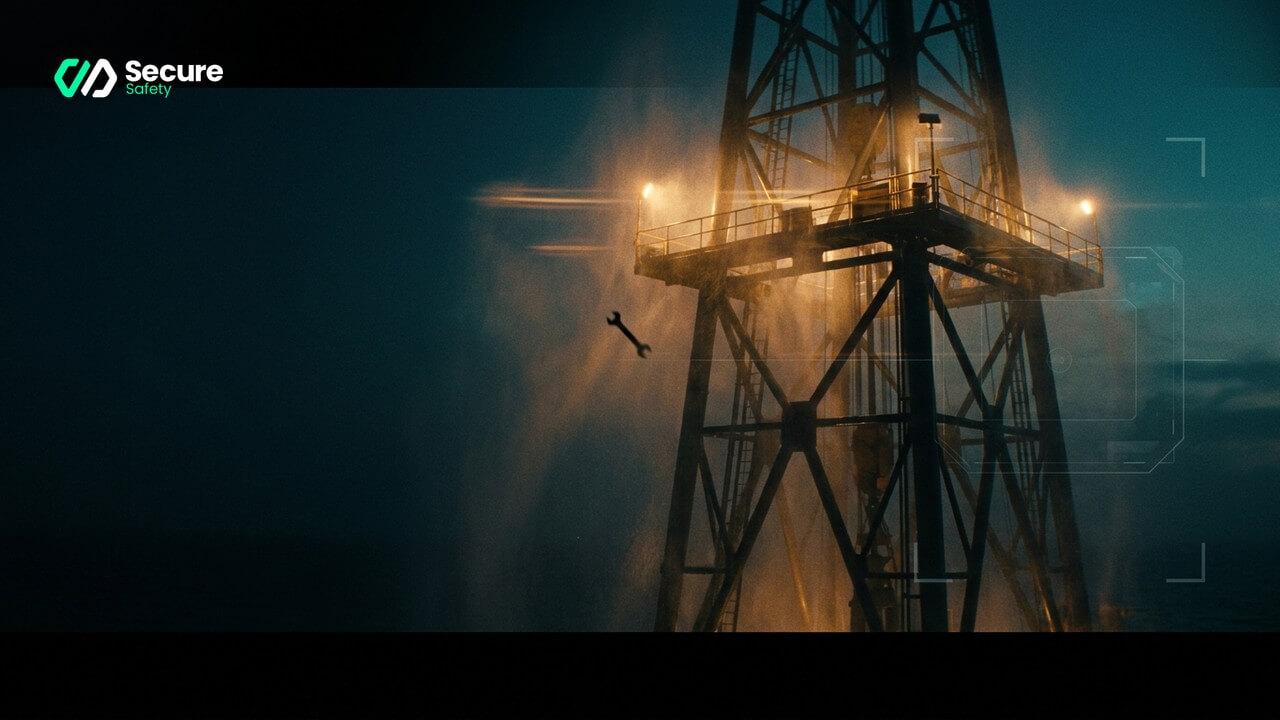
Every rigger knows the sound. A spanner slips from a gloved hand forty metres up the derrick, clips a beam once, and by the time it reaches the drill floor it is travelling fast enough to split a hard hat. There is no siren before it happens. No warning light. Just a small object, gravity, and whoever happened to be standing in the wrong place.
Dropped objects are the hazard that safety leaders lose sleep over precisely because they are so ordinary. A shackle pin. A length of pipe left on a grating. A torch clipped carelessly to a belt. None of it looks dangerous sitting still. All of it becomes lethal the moment it falls into the space below — the space the industry calls the line of fire.
Why dropped objects stay invisible until it is too late
The uncomfortable truth about DROPS incidents is that most of the risk is dormant, not dynamic. The dangerous object is rarely the one someone fumbles in front of you. It is the tool that was set down on a monkey board a week ago, the corroded light fitting nobody logged, the bolt that worked loose over forty tidal cycles. Static dropped objects — things at height that could fall — outnumber dynamic ones many times over, and they are almost impossible to police by eye.
Traditional controls do genuine good. Tethered tools, tool pouches, barricaded exclusion zones, DROPS surveys and toolbox talks have all pushed the numbers down over decades. But every one of them depends on human attention that never lapses, and human attention always lapses. A survey is a snapshot. A barricade is only as good as the discipline that keeps people behind it. And none of these controls can tell you, at two in the morning on a night shift, that a worker has just walked beneath a suspended load.
That is the gap. Not a shortage of rules — a shortage of eyes.
What "seeing" a dropped object actually means
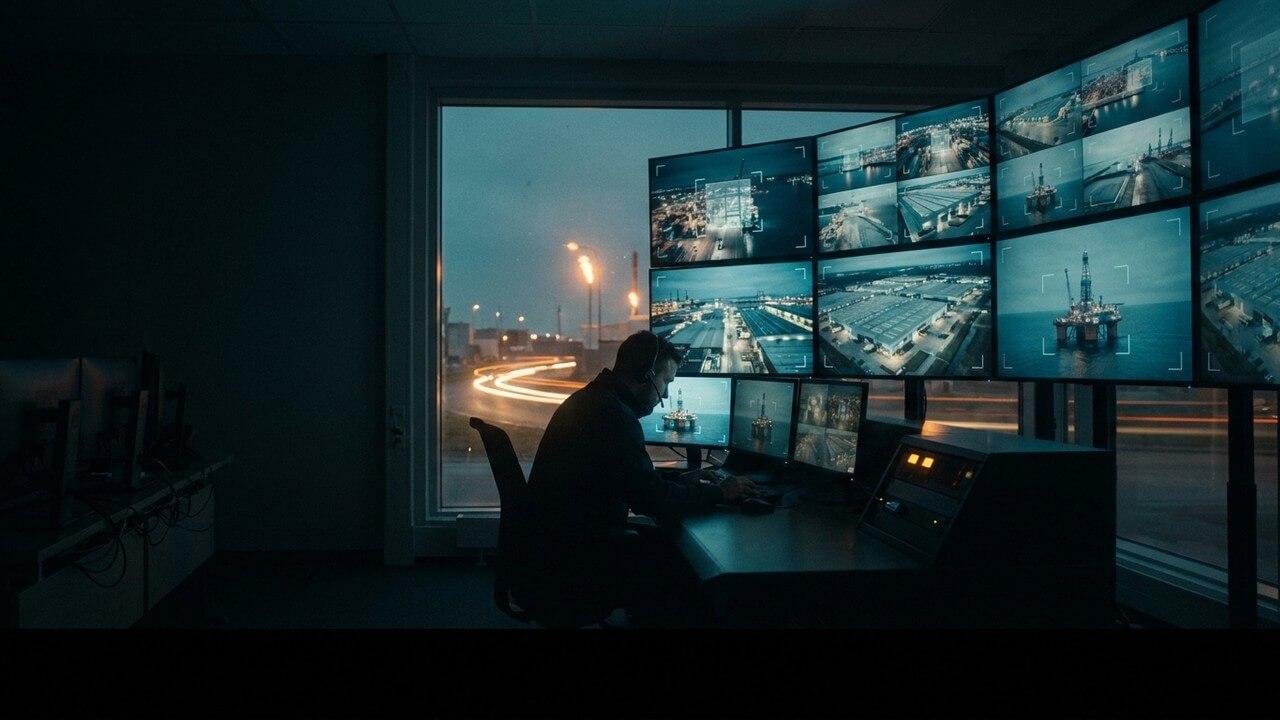
Here is where computer vision changes the arithmetic. Your site already has cameras. On a drill floor, on a gantry, over a laydown area, they are watching continuously and remembering nothing. An AI safety layer gives that footage the one thing it has always lacked: comprehension.
Instead of recording pixels, the system understands the scene. It recognises the geometry of the line of fire and flags the two conditions that precede almost every dropped-object injury.
It watches the space above people, not just the people
The system continuously maps where personnel are standing and cross-references it against the zones overhead — suspended loads, elevated work, open gratings. When a worker steps into an exclusion zone beneath a live lifting operation, the alert fires in the moment it matters, not in the incident report afterwards. Line of fire safety stops being a poster on the wall and becomes a live measurement.
It sees the fall itself
Falling object prevention AI can detect the sudden, downward, anomalous motion of an object breaking free at height — the shackle that slips, the panel that gives way — and raise an immediate alarm to the control room. Even where a fall cannot be prevented, seconds of warning change everything: a floor cleared, a load halted, a near miss logged with video instead of a fatality investigated with none.
From lagging paperwork to leading data
There is a quieter benefit that operations directors tend to seize on faster than anyone. Most DROPS programmes are starved of data. You know about the incidents that hurt someone and almost nothing about the hundreds of near misses that did not — the objects that fell into an empty zone, the moments a person lingered under a load and got lucky.
An AI layer captures all of it automatically, with timestamped video. Over a quarter, patterns surface that no clipboard survey would ever reveal: the shift when exclusion-zone discipline slips, the crane operation that repeatedly puts people in harm's way, the walkway everyone cuts through to save ninety seconds. Dropped object detection becomes a leading indicator, and leading indicators are what let you fix a problem before it writes itself into the accident book.
Forged where the margin for error is zero
This capability was not born in a laboratory. It was built and hardened on offshore drill floors — heavy moving equipment, suspended loads, zero tolerance for error, lives quite literally overhead. That environment is unforgiving of false alarms and even less forgiving of missed ones. Proven in national oil-major operations, a major international port and an international airport, the detection now runs at a sub-0.05% error rate and has been measured cutting unsafe behaviour by around 90% on live sites. What survives a drill floor tends to work rather well in a warehouse.
What it looks like on your site
The practical picture is deliberately undramatic, which is rather the point.
- No new hardware. The AI layer works with the CCTV you already have. No gantry-mounted sensors, no tethered gadgets to maintain.
- On-premise. Footage of your people and your operations never leaves your site. The analysis happens locally, which matters as much to your workforce as it does to your data officer.
- Real time. Alerts reach the control room or a supervisor's screen in the moment, not in a Monday-morning review.
- Always watching. Night shift, back-shift, the quiet hours when the DROPS coordinator has gone home. The camera does not get tired or complacent.
None of this replaces tethered tools or a good exclusion-zone regime. It sits behind them as the backstop that never blinks — the layer that catches what discipline, on its worst day, lets through.
The object you never saw coming
The hardest thing about dropped objects has always been that you cannot manage what you cannot see. A survey ends. A barricade is trusted. A tired eye slides past the loose fitting for the fiftieth time. For as long as safety has depended entirely on human vigilance, the silent killer has kept its advantage.
Giving your existing cameras the ability to understand the line of fire does not remove gravity from the equation. But it removes the blindness — and blindness, not gravity, is what turns a slipped spanner into a statistic.
Where dropped object detection delivers the most value
Offshore and height-intensive operations
The offshore environment has the highest dropped-object fatality rate of any industrial sector because the combination of work at height, heavy steel components, and crew working below the drop path creates conditions where a single dropped object can be fatal from relatively modest heights. Camera-based drop-zone enforcement on offshore rigs — monitoring the area beneath tubular handling, crane operations and maintenance activities at height — was one of the first operational capabilities SecureSafety developed, precisely because the risk-to-consequence ratio is highest in that environment.
Construction sites
On construction sites, dropped objects from scaffolding, crane operations and leading-edge work represent a consistent source of serious injury and near-miss events. The challenge on a large construction site is the dynamic nature of the hazard: the drop zone beneath a specific lift is not a fixed area, and the height from which objects can fall changes as the structure rises. Camera-based zone monitoring that activates around lift operations and enforces an exclusion beneath the load path addresses the dynamic nature of the hazard in a way that a static physical barrier cannot.
Maintenance at height in manufacturing and utilities
Maintenance activities at height — on mezzanines, on plant roofs, on elevated service walkways — routinely create drop-object hazards in areas where normal production activity is happening below. The combination of permit-to-work controls for the maintenance activity with camera-based zone monitoring beneath the work area creates a two-layer control that is more reliable than either approach alone.
Implementation checklist for dropped object detection
- Drop-zone mapping: for every area where regular height work occurs, define the potential drop zone beneath it based on the height, the type of work and the likely movement of dropped items
- Camera coverage of drop zones: confirm that the area beneath each identified drop zone has camera coverage — this is often an area not covered by existing cameras because it is ground-level operational space rather than an access control or traffic monitoring point
- Zone activation triggers: for planned height work, define the trigger for zone activation — this may be a work permit issue, a scheduled time window, or a manual control room activation at the start of the task
- Personnel exclusion protocol: define who is authorised to be in the drop zone during height work and under what conditions — the camera zone should enforce this exclusion rather than relying on verbal instruction from the height worker
See what your cameras have been missing — book a demo.