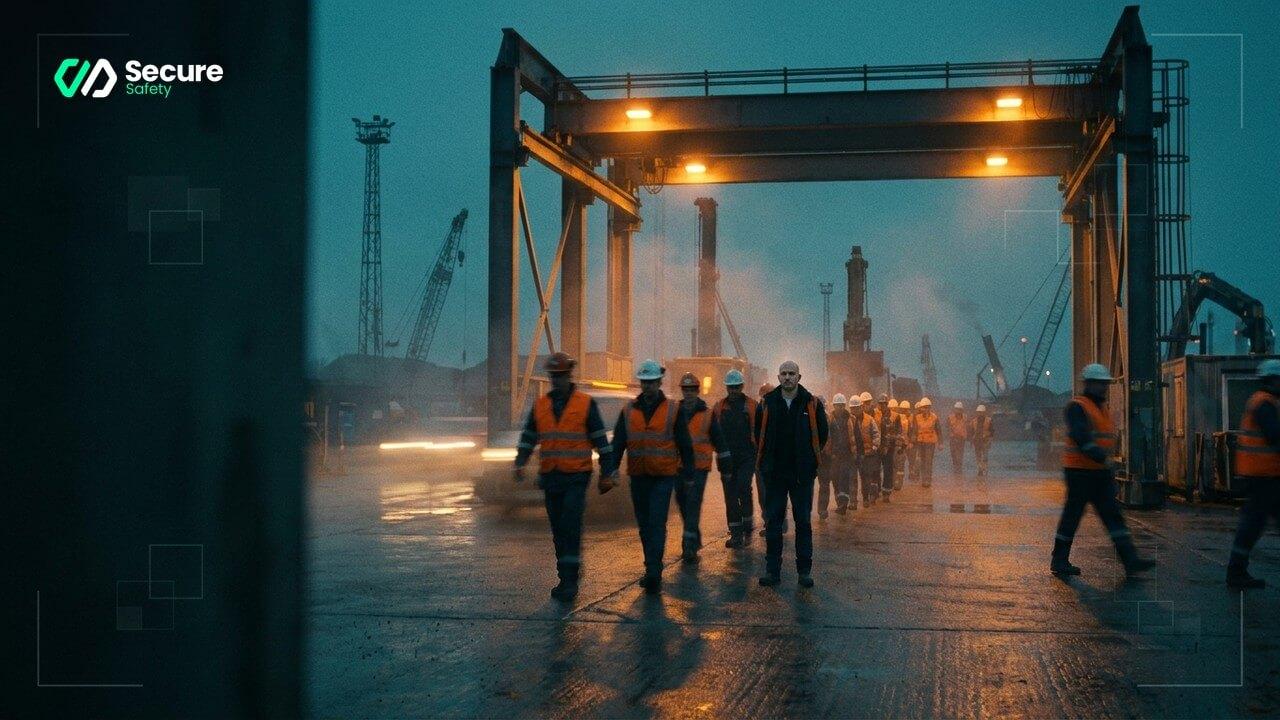
PPE compliance. Checked on every worker, every shift, automatically.
Stop relying on spot checks. The AI verifies the right protective equipment is worn the moment someone enters a zone that requires it, and flags the gap in real time. It checks by item and by colour, so contractor and crew rules are enforced consistently.
The hazard
Personal protective equipment is the last engineered barrier between a worker and the hazard. When it is missing, that barrier is gone. Yet in most industrial environments PPE compliance is checked by a supervisor walking a route, a site manager doing a morning briefing, or not checked at all. A shift of two hundred workers can pass through a gate without a single item-level verification.
The cost of non-compliance is direct and measurable. HSE prosecutions routinely find that at the moment of a serious injury, the injured worker was not wearing equipment they were required to wear, and that the employer could not demonstrate any systematic check was in place. A PPE enforcement system that runs on existing cameras closes this gap without adding any headcount or changing any process.
SecureSafety verifies compliance by item, by zone and by colour. Where hard hat colours indicate contractor tier or task type — a common scheme in offshore and heavy industry — the platform enforces those rules consistently, shift after shift, across every camera on site. Every non-compliant event is logged with a timestamp and camera reference, giving the evidence trail that manual checks cannot produce.
From camera to alert in under a second.
Zone entry triggers verification
Each camera zone is configured with the PPE requirements for that area: hard hat, hi-vis, gloves, glasses, harness or any combination. The moment a person enters the frame, the platform checks every required item against the configured rule for that zone before they reach the hazard.
Items are checked by type and colour
Detection models identify each item individually — hard hat colour, vest type, glove fit, glasses presence — so the enforcement matches the specific site rule, not a generic "wearing PPE" binary. Contractor colour codes and task-specific requirements are supported within the same zone configuration.
Non-compliance is flagged and logged instantly
A gap fires an alert to the control room within one second. The event is stored with camera reference, timestamp and item detail, giving supervisors the evidence they need to act and the audit trail compliance requires. Repeat non-compliance by location surfaces in the platform dashboard for targeted intervention.
PPE compliance was one of the first detection layers proven on offshore oil & gas rigs since 2018, where hard hat colour-coding and item-by-item verification are mandated procedures. The same models run at scale in port and airport environments, adapting to each site's colour and item requirements without platform changes.
What people ask about this detector.
Which PPE items can the platform detect?
The platform covers hard hats (including colour), hi-vis vests, gloves, safety glasses, ear defenders, harnesses and safety boots. Detection sets are combined per zone to match the specific requirements of each area on your site.
Can it enforce different PPE rules in different zones?
Yes. Each camera zone carries its own PPE rule. An area requiring full PPE including harness is configured separately from a visitor route requiring only a hard hat and hi-vis, and the platform enforces each rule independently.
How does the system handle the volume of workers on a large site?
The platform processes all configured cameras in parallel, so a site with hundreds of workers passing through multiple zones generates real-time detections across every gate simultaneously. Alert volume is proportional to actual non-compliance, not camera count.
Will it work on our current camera resolution?
The models are engineered to operate on standard IP camera feeds as already deployed on most industrial sites. A technical assessment during the Discovery phase will confirm coverage and flag any cameras where distance or angle limits detection accuracy.
Can the system detect harnesses and other full-body PPE, not just head and torso items?
Yes. The detection library includes harnesses, belts, glove classes, ear defenders, safety boots and respiratory protective equipment in addition to hard hats and hi-vis vests. The specific items verified per zone are configured to match your site rules during the Discovery phase.
How does the system handle workers who are legitimately exempt from a PPE requirement for a specific task?
Exemption zones can be configured to reflect legitimate operational exceptions — for example, an office area within a generally PPE-required site. For task-specific exemptions, the zone rule can be adjusted temporarily by the control room. All zone changes are logged with a timestamp and operator reference for audit purposes.
What is the detection accuracy for PPE items at a typical camera distance?
Hard hat and hi-vis detection is highly reliable at the distances typical of gate entries, aisle ends and zone boundaries, which are the primary deployment points for PPE verification. At greater distances, detection confidence decreases. The Discovery phase establishes the camera positions and lens specifications that provide reliable detection for your specific site geometry.
How does the platform handle the PPE compliance reporting that auditors and insurers require?
The platform generates a continuous compliance log: every person, every zone entry, every item verified, every non-compliance event. This data is exportable in formats compatible with most EHS management systems and can be presented directly to an HSE inspector or insurance assessor as evidence of systematic compliance monitoring. The audit trail is timestamped and camera-referenced, providing the level of specificity that verbal evidence and sample checks cannot.
Can we use this to enforce contractor PPE as well as employee PPE?
Yes. The platform monitors every person in frame regardless of their employment status. Contractor non-compliance is detected and logged identically to employee non-compliance. For sites with contractor-specific PPE rules or colour codes, those rules are configured per zone during Discovery and enforced automatically on every contractor entry.
Does the system work in dusty, steamy or outdoor environments where camera clarity is compromised?
The models were trained and validated in offshore and industrial environments with challenging imaging conditions — sea spray, steam, dust and variable lighting. Performance in specific environments is confirmed during the Discovery phase camera survey, which identifies any locations where lens placement, cleaning interval or specification upgrade is needed to maintain detection accuracy.
What happens when a worker is detected as non-compliant but they have a medical exemption from a PPE requirement?
Medical exemptions from PPE requirements are handled through zone configuration. A worker with a documented exemption from, for example, ear defenders due to a hearing impairment can have their access to the relevant zone noted in the site's management system. If the exemption is site-wide, the detection rule for that item can be adjusted. If it is worker-specific, the alert response protocol defines how the control room should handle the alert — typically acknowledging it against the exemption record rather than dispatching a supervisor. The Discovery phase includes a review of any existing PPE exemptions that need to be reflected in the configuration.

Tell us the hazard. We'll detect it.
Book a demo and we'll show the detectors running live, on-premise, and scope the ones that fit your site.