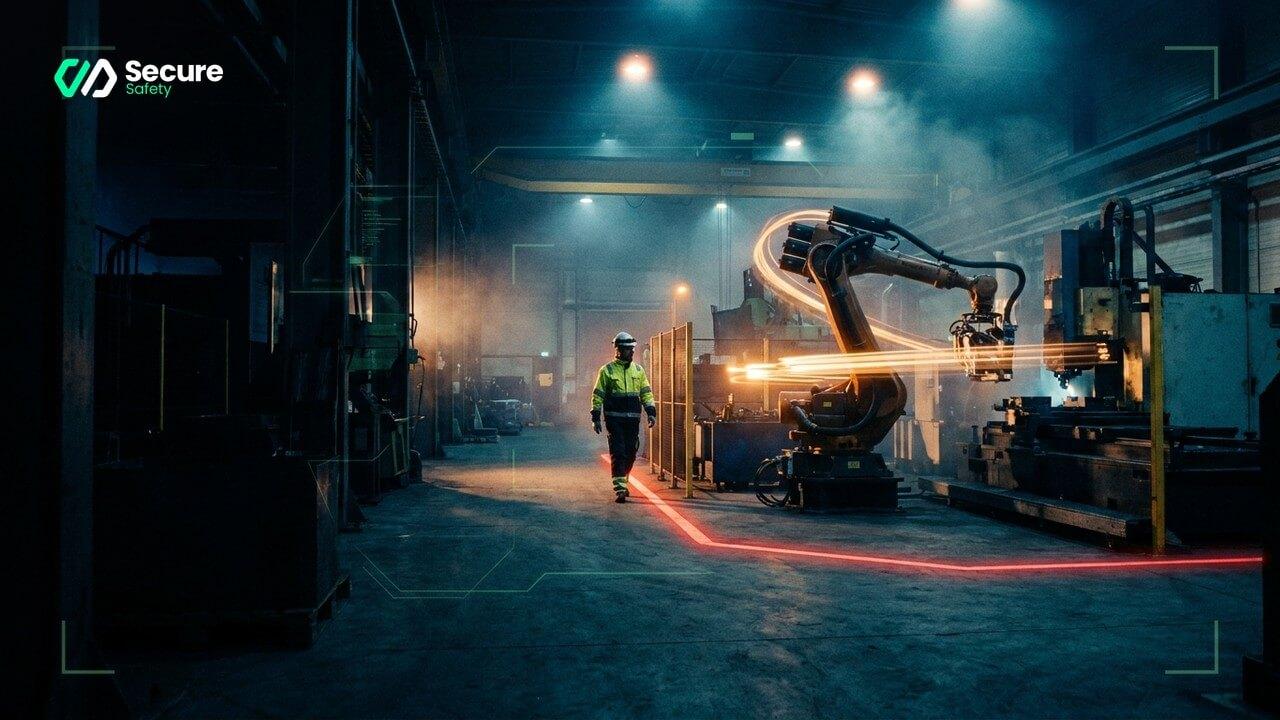
Restricted zones & access. Red zones that enforce themselves.
Draw an exclusion area once and the platform holds it, flagging anyone who enters a live line-of-fire, an energised machine zone or a restricted area without the right PPE or authorisation, day and night.
The hazard
Line-of-fire incidents — workers entering the path of a moving load, an operating machine, or a pressurised system — account for a disproportionate share of serious workplace injuries. These are not accidents of inattention alone; they are failures of the control system that was supposed to keep people out of dangerous areas. Physical barriers and signage work when people respect them. Under shift fatigue, deadline pressure, or simple familiarity, they are routinely ignored.
Red zones are the most tractable safety problem that technology can solve: the geography is fixed, the rule is simple, and a camera can monitor the boundary continuously without fatigue. The challenge has always been that enforcement required a supervisor to be watching. AI changes this by making the camera itself the enforcement layer, active every second of every shift.
The value of continuous zone enforcement goes beyond preventing individual entries. It generates a heat map of where zone violations concentrate — the gate that workers cut through because the authorised route is longer, the machine guard that is propped open during maintenance. These patterns, visible in the platform data, are the engineering interventions that prevent the next generation of incidents.
From camera to alert in under a second.
Zones are configured once, then held permanently
Exclusion areas, line-of-fire boundaries, edge proximity zones and machine guard areas are drawn on the camera feed during setup. Each zone carries its rule: hard exclusion, PPE-conditional entry, or occupancy limit. Once configured, the platform enforces each zone on every camera frame, with no ongoing supervision required.
Unauthorised entry fires an instant alert
The moment a person or vehicle crosses a zone boundary without meeting the configured condition — not wearing the required PPE, or entering a hard exclusion during a live operation — the control room receives an alert with camera, timestamp and clip. Site PA speakers can announce the breach automatically for immediate audible warning.
Zone activity is logged for audit and improvement
Every entry event, authorised or otherwise, is stored. The resulting data shows which zones are most frequently breached, at what times and by whom, enabling the safety team to target their improvement effort at the highest-frequency failure points rather than responding to incidents after they occur.
Red-zone enforcement was central to the offshore deployment that has run since 2018 — specifically the moonpool and drill-floor exclusion zones where a person in the wrong place during operations can be struck or swept over the side. The platform has managed live exclusion zones across some of the world's most dangerous workplaces and is proven at the error rate that operational credibility demands.
What people ask about this detector.
How long does it take to configure a new zone on site?
Zones are drawn on the camera feed through the platform's configuration interface. A straightforward exclusion zone for a single camera can be active within minutes. Complex multi-camera zones, PPE-conditional access rules and occupancy limits are scoped during the Discovery phase and configured before go-live.
Can the platform enforce PPE-conditional zone access — that is, entry permitted only when a worker is wearing full PPE?
Yes. A zone can be configured with a combined rule: the person must be wearing a defined set of PPE items to enter without triggering an alert. This is used for high-risk areas such as chemical handling zones, confined space entries and energised electrical areas.
Does the zone monitoring work at night and in poor weather?
The platform operates on infrared and low-light camera feeds, and the zone enforcement logic is not dependent on natural lighting. Specific camera performance in outdoor environments is verified during the Discovery phase to ensure consistent detection across all shifts.
Can zones be activated and deactivated based on the operating schedule?
Yes. Zones can be placed on a time schedule — for example, a machine guard zone that is only enforced when the machine is running — or activated manually by the control room when a specific operation begins. This prevents alarm fatigue during maintenance periods when normal access rules do not apply.
How does the system handle a zone that has different access rules for different categories of worker?
Each zone can carry multiple access rules based on PPE items, hat colour codes or other visual identifiers. A zone with different requirements for contractors versus employees is configured with the contractor rule applied to the camera zones covering the contractor access route, and the employee rule applied to the employee access route. Role-differentiated access based on visual signals is a core feature of the zone configuration system.
What happens if the control room does not acknowledge a zone-breach alert immediately?
Unacknowledged alerts escalate through the configured chain. After a configurable period, the alert is forwarded to a secondary contact — a site supervisor or safety manager — and the PA can automatically announce the breach if configured. The escalation chain and timeouts are defined during the Discovery phase to match your operational response protocols.
Can the system distinguish between a person who has accidentally entered a zone and one who has done so deliberately?
The system detects zone entry regardless of intent — which is the correct approach, since the hazard is the same whether the entry is accidental or deliberate. The clip and location data in the alert give the control room operator the context to determine whether the situation is an emergency, a near-miss requiring intervention, or a minor procedural deviation. Tracking of repeat offenders by location and time is available through the compliance reporting dashboard.
Is there a way to issue a visible or audible warning to the person entering the zone before escalating to a control room alert?
Yes. The alert sequence can be configured to activate a visual warning device — a flashing beacon at the zone boundary, for example — or a PA announcement specific to that zone, before the control room alert fires. This gives the entering person an opportunity to reverse out of the zone immediately, reducing the number of alerts that require active control room intervention while still creating a logged event.
How does the system handle zones that are adjacent to authorised working areas, where the boundary is not physically marked?
Zone boundaries are configured on the camera feed as a drawn line or polygon, independent of any physical marking. A boundary drawn at the edge of a machine guard area enforces the exclusion even if the only physical indicator is painted floor markings. For zones where the boundary is genuinely ambiguous or unclear to workers, the platform alert data will show a concentration of near-boundary entries that indicates a physical demarcation improvement is warranted.
Can zone violations be automatically linked to a permit-to-work system?
Yes. Via the REST API, zone breach alerts can be forwarded to permit-to-work platforms with the camera reference, timestamp and location. For environments where a permit-to-work is the authorisation mechanism for zone access, integration with the PTW system allows the AI to verify whether an active permit exists for the zone at the time of entry, and escalate alerts accordingly.
Can the system enforce pedestrian speed limits as well as zone exclusions?
Yes. Running detection in pedestrian areas is a specific event that can be monitored and alerted on separately from zone exclusion. In environments where running near machinery or in congested areas creates a risk — a food processing line, a narrow production corridor, or an elevated walkway — the platform can detect the running behaviour and generate an alert. This is distinct from vehicle speed monitoring: it uses the same spatial tracking infrastructure but applies to pedestrian movement patterns rather than vehicle velocity.

Tell us the hazard. We'll detect it.
Book a demo and we'll show the detectors running live, on-premise, and scope the ones that fit your site.