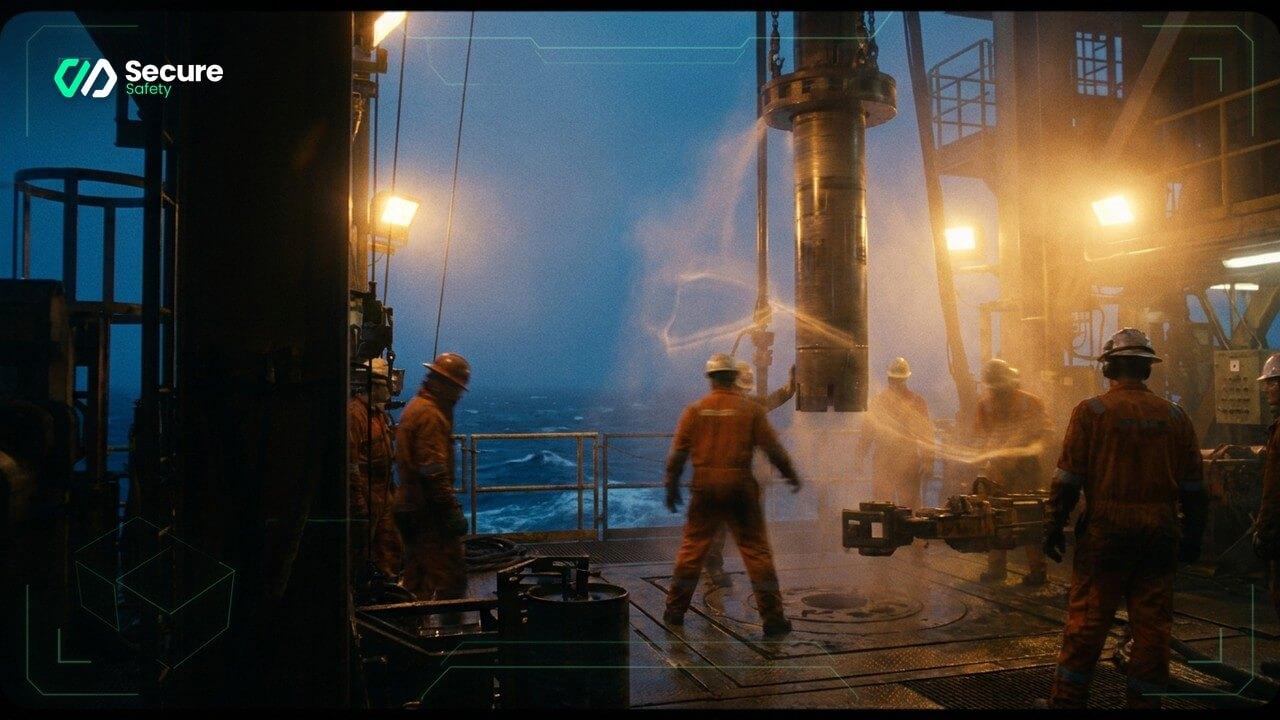
Offshore-specific. Detectors forged on the drill floor.
A library of detectors built for the world’s hardest workplace and proven there since 2018. That is the depth no land-first competitor can match, and the reason our platform arrives already hardened.
The hazard
The offshore drilling rig is the most safety-critical industrial environment on earth. A drill floor in operation combines rotating heavy steel, suspended tubulars, pressurised systems and personnel working in close proximity to all of them, on a surface that moves, in weather conditions that never let up. The margin for error is measured in centimetres and milliseconds. Manual supervision, even at the most experienced level, cannot maintain continuous awareness of every hazard simultaneously.
SecureSafety was built offshore — not adapted for offshore after building something else. Development began on operational drillships and FPSOs in 2018, creating a library of detectors tuned to the specific hazards of the offshore environment: moonpool activation zones, man-rider operations, drill-floor shelter positions, master bushing hazards and the 3D reconstructed awareness of a rig deck that no flat camera grid can provide.
The operational track record is unique in the industry. Running across approximately half of a national drilling fleet at a sub-0.05% error rate, through thousands of well operations and across every watch rotation, the platform has accumulated a body of operational experience that land-first competitors cannot match. That experience is what makes the technology reliable enough to trust in an environment where an alert that cries wolf gets switched off, and an alert that is ignored gets people hurt.
From camera to alert in under a second.
Drill-floor operations are monitored continuously
Multiple cameras cover the drill floor from optimised angles, monitoring personnel position relative to active pipe handling, rotating equipment, and the rotary table. The platform tracks every person on the floor simultaneously and fires an alert when someone enters a defined exclusion around active machinery or approaches the drill floor from the wrong access point during a critical operation.
Moonpool zones activate in real time
Moonpool and over-water operations carry the highest risk of swept-overboard events. The platform activates a hard exclusion zone around the moonpool edge the moment an operation begins, and maintains it for the duration. Anyone who approaches the boundary receives an immediate warning; a breach fires an alert to the control room and nearby PA.
Man-rider and height operations are tracked from lift to completion
Man-rider basket operations create a zone of risk above and below the lift path. The platform detects the operation, activates the associated exclusions, and tracks the basket position throughout the lift. Anyone who enters the lift path on the deck or at height triggers an instant alert.
Running on offshore oil & gas rigs since 2018, across ~half of a national drilling fleet, at a sub-0.05% error rate across 18,000 events per day. No other AI safety platform has this operational depth on the drill floor. When it runs in a port, a warehouse or a construction site, it brings every lesson from the world's most demanding environment with it.
What people ask about this detector.
What makes the offshore-specific detectors different from the standard platform?
The drill-floor detector library was built from zero using footage from operational rigs, not adapted from land-based models. Moonpool zone logic, man-rider tracking, master bushing exclusions and drill-floor shelter position monitoring are purpose-built for offshore operations.
How does the platform handle the 3D complexity of a rig deck?
Standard cameras produce a 2D image of a 3D environment. The platform uses overlapping camera views and spatial modelling to reconstruct the 3D position of workers and equipment on deck, making zone enforcement accurate even when a person is standing on a different level than the zone boundary appears to occupy in a flat camera view.
Can the system be deployed on drillships as well as fixed platforms?
Yes. The platform is designed for deployment on drillships, semi-submersibles, FPSOs and support vessels. The on-premise edge device is compact and does not require the fixed network infrastructure of a platform installation.
Does the system require continuous satellite uptime to function?
No. The platform processes all video and generates all alerts on the on-site edge device, with no dependency on uplink connectivity for real-time operation. Alerts fire and are logged locally even during connectivity outages.
What specific rig types and configurations has SecureSafety been deployed on?
The platform has been deployed on drillships, semi-submersibles, FPSOs (floating production storage and offloading vessels), jack-up rigs and drill support vessels. Each vessel type has different deck geometry and operational hazard profiles; the platform configuration is adapted to each during the Discovery phase.
How does the moonpool zone activation system know when an operation is live?
Zone activation can be triggered by the control room operator manually at the start of an operation, scheduled based on the drilling programme, or integrated with the rig's drilling control system via API. For operations with a predictable schedule, automated scheduling reduces the dependency on manual activation and prevents zones being forgotten open or closed.
Can the platform monitor a drill floor that has both fixed cameras and PTZ cameras?
Yes. Fixed cameras provide continuous zone coverage; PTZ cameras are integrated as supplementary feeds that can be directed to specific areas as needed. Fixed camera coverage is the primary detection layer for zone enforcement and continuous monitoring; PTZ feeds supplement coverage of areas that benefit from operator-directed investigation.
How does the system handle the noise and spray conditions on an offshore rig that affect camera image quality?
The detection models were trained on real offshore footage captured under operational conditions, including the camera quality degradation from spray, vibration and partial lens contamination. Camera maintenance schedules and lens protection specifications are defined during the Discovery phase to maintain adequate image quality. The platform flags camera feeds that fall below detection-quality thresholds so lens cleaning or replacement can be triggered before a gap in coverage occurs.
What HSE regulations and offshore safety standards does deployment against?
UK offshore deployment operates against the Offshore Installations (Safety Case) Regulations 2015, the Offshore Installations (Prevention of Fire and Explosion, and Emergency Response) Regulations 1995 (PFEER), and the Offshore Installations and Pipeline Works (Management and Administration) Regulations 1995 (MAR). The platform generates the evidence trail and compliance log that support Major Accident Hazard (MAH) management and safety case documentation.
How is the offshore platform managed by an onshore fleet safety team?
Each rig runs an autonomous on-premise instance. A central fleet dashboard consolidates alert data, compliance metrics and system health from all rigs, accessible from the onshore operations centre via secure connection. The fleet safety team can view live alerts from any rig, access compliance reports across the fleet, and manage zone configurations remotely. Each rig team sees only their own rig's data unless fleet-level access is granted.
How does the platform handle the 12-hour watch rotation typical of offshore operations without configuration changes between watches?
The platform operates continuously regardless of watch rotation. Zone configurations, PPE rules and detection parameters are set once and enforced on every watch without modification. The compliance data is timestamped and can be disaggregated by watch to allow the fleet safety team to compare compliance performance across watches and identify whether any watch consistently shows higher non-compliance rates. The system does not need to know who is on watch: it monitors behaviour rather than identity, applying the same rules to every person in the monitored area regardless of their role or watch assignment.
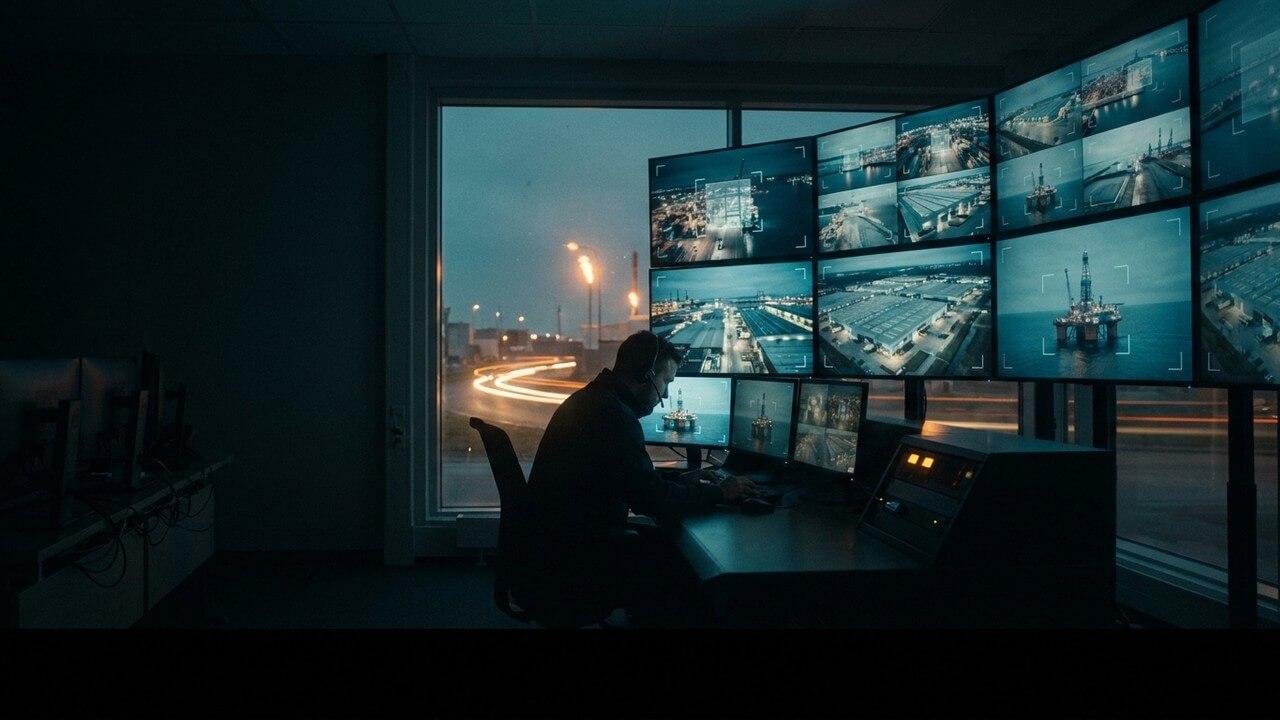
Tell us the hazard. We'll detect it.
Book a demo and we'll show the detectors running live, on-premise, and scope the ones that fit your site.