Ports & Logistics.
A real, large-scale ports reference, directly relevant to UK and EU port and terminal operators.
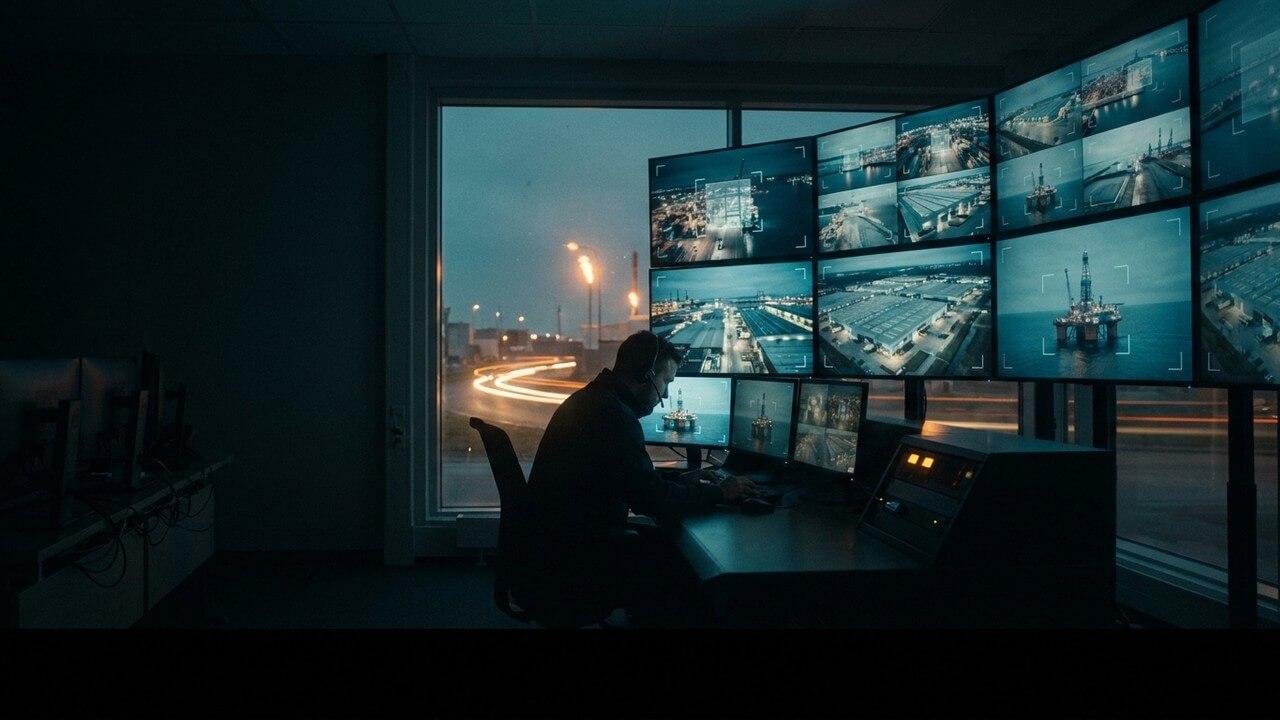
Yards and quays are dense with moving vehicles and people on foot, the classic struck-by hazard. SecureSafety runs on a major port's existing cameras across a million-square-metre estate, watching every crossing in real time.
Why this sector is demanding.
Ports and logistics facilities are among the most vehicle-intensive workplaces in any sector. HGVs, reach stackers, terminal tractors and forklifts move continuously across the same ground as stevedores, surveyors and contractors on foot. At shift changeover and during peak throughput, the density of vehicles and people on the quayside creates a struck-by risk that most port operators manage through signage, painted walkways and supervisor presence — controls that are inconsistently followed and never continuous.
The scale of a modern port terminal makes comprehensive manual supervision impossible. A million-square-metre estate with dozens of active vehicle movements at any one time cannot be adequately monitored by any number of people walking routes. The CCTV infrastructure that already covers most terminals exists primarily for security, not safety — but it is the same camera network that SecureSafety adds an AI layer to, turning passive footage into real-time hazard monitoring.
Cargo-handling operations introduce additional hazards: lifting operations above shared working areas, quayside edges, and the dynamic exclusion zones around cranes and spreaders that change as lifts progress. These are not hazards that can be managed with a static barrier. They require continuous, operation-aware monitoring of the kind that only camera-based AI can provide at port scale.
The problems AI solves here.
Vehicle-pedestrian conflict at crossings and aisle ends
The highest-risk locations on any port estate are the points where vehicle routes and pedestrian routes intersect — gate entries, warehouse aisle ends, and quayside crossings. SecureSafety monitors every crossing simultaneously, alerting the control room when a vehicle and a pedestrian are on a collision course before contact is possible.
Speed enforcement across the estate
Vehicle speed limits on port estates are routinely exceeded, particularly by HGVs under time pressure. The platform tracks vehicle speed on all monitored routes and flags breaches in real time, while accumulating data that identifies the specific vehicles, drivers and locations where violations concentrate for targeted management action.
Cargo-handling and crane exclusion zones
Lift operations on a busy quayside create dynamic drop zones that share space with working personnel. The platform monitors the area beneath and around each active lift, activating exclusions for the duration of the operation and alerting immediately when the zone is entered. This turns the camera coverage already covering the quay into an active lift-safety layer.
SecureSafety monitors vehicle-pedestrian conflict, cargo-handling safety and restricted working space at a major port, across a million-square-metre estate on existing cameras. This is a live, large-scale reference, not a pilot.
Questions from ports & logistics.
Can the platform handle the camera estate of a large terminal — hundreds of cameras?
Yes. The platform is architected to scale horizontally. Larger estates run multiple edge devices with a unified management layer. Camera count is addressed during the Discovery phase, which scopes the hardware and network requirements for your specific estate.
Does the system work for HGVs as well as forklifts and smaller vehicles?
Yes. Detection models cover the full range of port vehicles: HGVs, reach stackers, terminal tractors, forklifts, mafi trailers and port service vehicles. Speed tracking operates on all vehicle classes.
How are exclusion zones managed for lifts that move as the operation progresses?
Crane and spreader operations generate a moving drop zone. The platform supports dynamic zone logic that follows the load position as the lift progresses, maintaining the exclusion for the full duration of the operation without manual zone adjustment.
What happens to the data — can it be used for insurance and compliance reporting?
Every detection is logged with timestamp, camera reference and clip. The resulting data supports RIDDOR reporting, HSE audit, insurance claim substantiation and internal safety performance review. The platform includes a reporting dashboard for safety managers and a data export for integration with EHS management systems.
How does the system handle the camera estate of a large terminal — potentially hundreds of cameras?
The platform is architected for horizontal scaling. Larger estates use multiple edge nodes with a unified management layer. The Discovery phase determines the number of nodes, their placement and the prioritisation of camera coverage across the estate. Not every camera needs to be connected from day one — typical deployments begin with the highest-risk areas (gate crossings, quayside approaches, crane lanes) and expand as operational confidence builds.
Can the system operate in the outdoor environment of a port — rain, direct sunlight, fog?
Yes. The detection models were developed in offshore and outdoor port environments with the full range of UK weather conditions. Camera selection for outdoor deployment is reviewed during the Discovery phase, with housing and weatherproofing specifications recommended where needed. In conditions of very heavy fog or rain that reduces visibility to near zero, the system flags the reduced detection confidence rather than continuing to generate alerts that may not be reliable.
How does the platform handle the complex shift patterns and contractor workforce typical of a port?
The platform monitors behaviour and PPE rather than identity, so shift changes and contractor rotations do not affect detection. The compliance data can be disaggregated by time window to identify shift-specific patterns. For ports with high contractor volumes, the system's ability to enforce PPE and zone rules without pre-registering individuals is a practical advantage over access-control-based monitoring approaches.
What does integration with the terminal operating system (TOS) look like?
Integration with the TOS is typically limited to scheduling data: crane lift schedules, vessel arrival times and shift patterns can be used to schedule zone activations and set alert thresholds appropriate to the operational state of the terminal. Full TOS integration is optional and is scoped during the Discovery phase based on the specific TOS platform in use.
Tell us the hazard. We'll detect it.
Book a demo and we'll show SecureSafety running in a ports & logistics environment. Then scope your site with a fully-costed Discovery phase.