Offshore Oil & Gas.
Proven at fleet scale, at a sub-0.05% error rate. Technology that arrives already hardened for anywhere else.
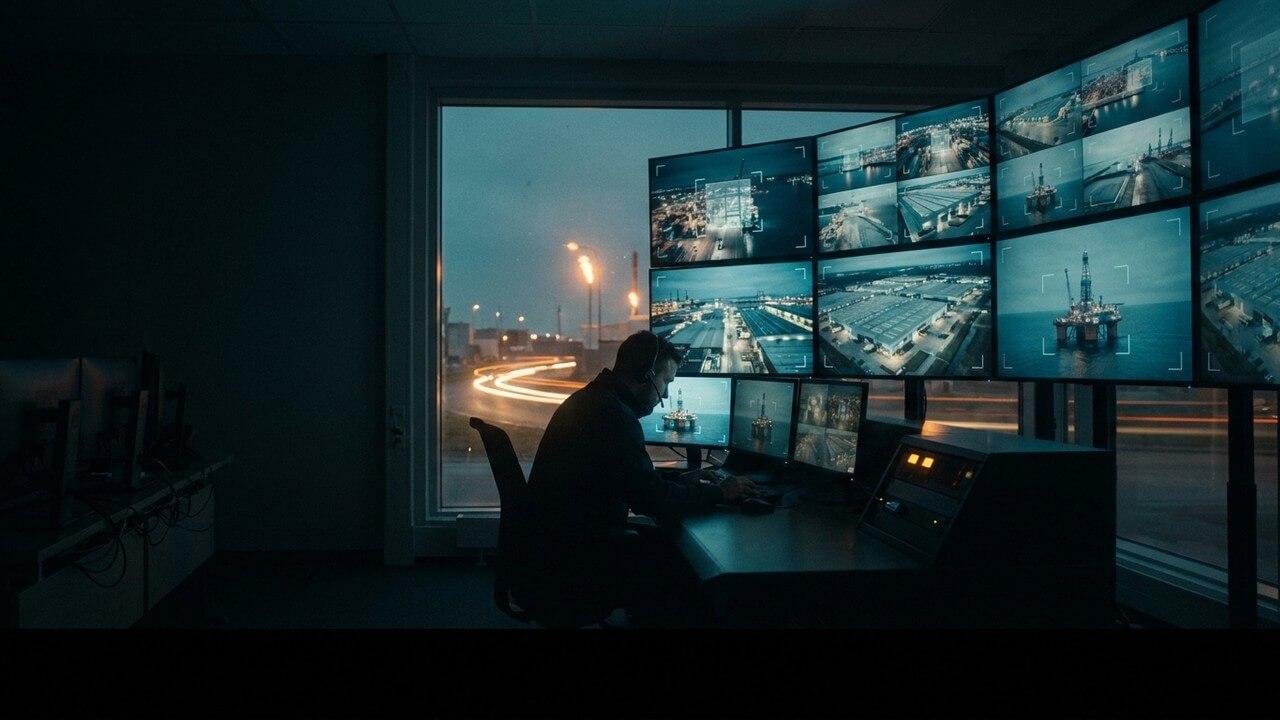
The drilling rig is the hardest safety environment on earth: heavy moving steel, suspended loads and crews working inches from danger, around the clock. SecureSafety has run there since 2018 and today monitors ~half of a national drilling fleet.
Why this sector is demanding.
Offshore oil and gas operations combine the full spectrum of industrial hazards — heavy rotating machinery, suspended loads, high-pressure systems, confined spaces and over-water working — in an environment with no room for evacuation delay and no nearby emergency services. Every watch rotation runs with a crew that cannot be replaced at short notice, operating equipment that cannot be shut down without significant consequence.
Manual supervision at this scale is fundamentally insufficient. A single drillship generates over 430 hours of video feed every day. Even the most experienced toolpusher cannot monitor every camera, every access point and every lift simultaneously. The result is that near-misses go unreported, zone breaches go unwitnessed, and PPE compliance is checked by exception rather than by rule.
The offshore environment is also where the consequences of a failure are most severe. A struck-by on the drill floor, a swept-overboard at the moonpool, or a dropped object during a tubular run cannot be treated as a near-miss and learned from. The technology required to prevent these events must be proven to operate reliably in that environment before being trusted with it — which is exactly the standard SecureSafety has met since 2018.
The problems AI solves here.
Drill-floor and moonpool exclusions
The drill floor and moonpool area are where the highest-energy operations occur and where a person in the wrong position faces the greatest risk. SecureSafety monitors both continuously, activating hard exclusion zones the moment an operation begins and alerting the control room within one second of any breach — without requiring the toolpusher to watch every camera.
Man-rider and suspended load monitoring
Man-rider basket operations and tubular handling create dynamic drop zones that change as the lift progresses. The platform tracks each operation in real time, maintaining the exclusion zone for the full duration of the lift and raising an alert the moment anyone enters the area beneath or beside the load path.
PPE and watch-floor compliance at scale
Hard hat colour-coding, body harness requirements and area-specific PPE rules on a rig are complex and shift-dependent. The platform verifies compliance by item and by colour zone, providing automatic enforcement across all watch rotations without relying on supervisors to walk every area at the right moment.
Live on offshore oil & gas rigs since 2018, across ~half of a national drilling fleet including drillships, FPSOs and support vessels, at a sub-0.05% error rate across 18,000 events per day. No other AI safety platform has this operational pedigree on the drill floor.
Questions from offshore oil & gas.
Does the platform work in the environmental conditions of an offshore rig — vibration, spray, poor lighting?
Yes. The models were trained and validated on operational rig footage, including the camera quality, lighting variation and physical conditions typical of offshore environments. Specific camera performance is confirmed during the Discovery phase.
What is the connectivity assumption — does the system need satellite uptime to function?
All processing and alerting is on-premise on the edge device. The system operates fully without uplink connectivity. The satellite connection is used for management, reporting and remote support only.
How does the system handle the rotation of contractors and crew who are not regular workers?
The platform monitors behaviour and PPE rather than identity. A new contractor entering a zone is subject to the same detection rules as a regular crew member, without requiring any pre-registration.
Can the system support multiple rigs from a single onshore operations centre?
Yes. Each rig runs an on-premise instance. The platform supports a multi-site management view that consolidates alerts and compliance data from all rigs into a single onshore dashboard for the fleet safety team.
How does the platform support the safety case requirement to demonstrate ALARP compliance?
The platform generates a continuous, timestamped record of every detection, alert and response across all monitored hazard categories. This record is the evidence that a safety case auditor or HSE inspector requires to demonstrate that monitoring controls are operational, that alerts are acknowledged and responded to, and that the incident frequency has been measured and is being managed. The compliance dashboard provides the trend data that demonstrates the safety programme is delivering measurable improvement.
Can the platform be installed on a rig that is currently on a campaign, or does it require a rig move for installation?
Installation is designed to be achievable during a rig campaign without halting drilling operations. The edge hardware is compact and is typically installed in the control room or an electrical cabinet adjacent to the existing CCTV system. Camera connections are made to the existing network. Installation is scoped during the Discovery phase to confirm the specific approach for each rig configuration, but campaign installation is the standard approach.
How does the system handle the watch rotation system on an offshore rig?
The platform monitors behaviour and PPE rather than individual identity, so watch rotation does not affect detection. Zone enforcement, PPE checking and occupancy monitoring apply equally to every watch regardless of who is on the floor. The compliance data is aggregated by watch to allow the safety team to identify whether any watch consistently shows higher near-miss or non-compliance rates, enabling targeted briefings without the system needing to know who each worker is.
What is the data retention approach for a rig with limited storage capacity?
The system retains alert clips and compliance logs with configurable retention periods. Continuous footage is not retained indefinitely — only the clips associated with detection events are kept, plus a rolling buffer of recent footage for operator investigation. The storage requirement is a fraction of what a conventional continuous-recording DVR requires. Storage sizing is confirmed during the Discovery phase based on the number of cameras and the expected detection frequency.
Tell us the hazard. We'll detect it.
Book a demo and we'll show SecureSafety running in a offshore oil & gas environment. Then scope your site with a fully-costed Discovery phase.