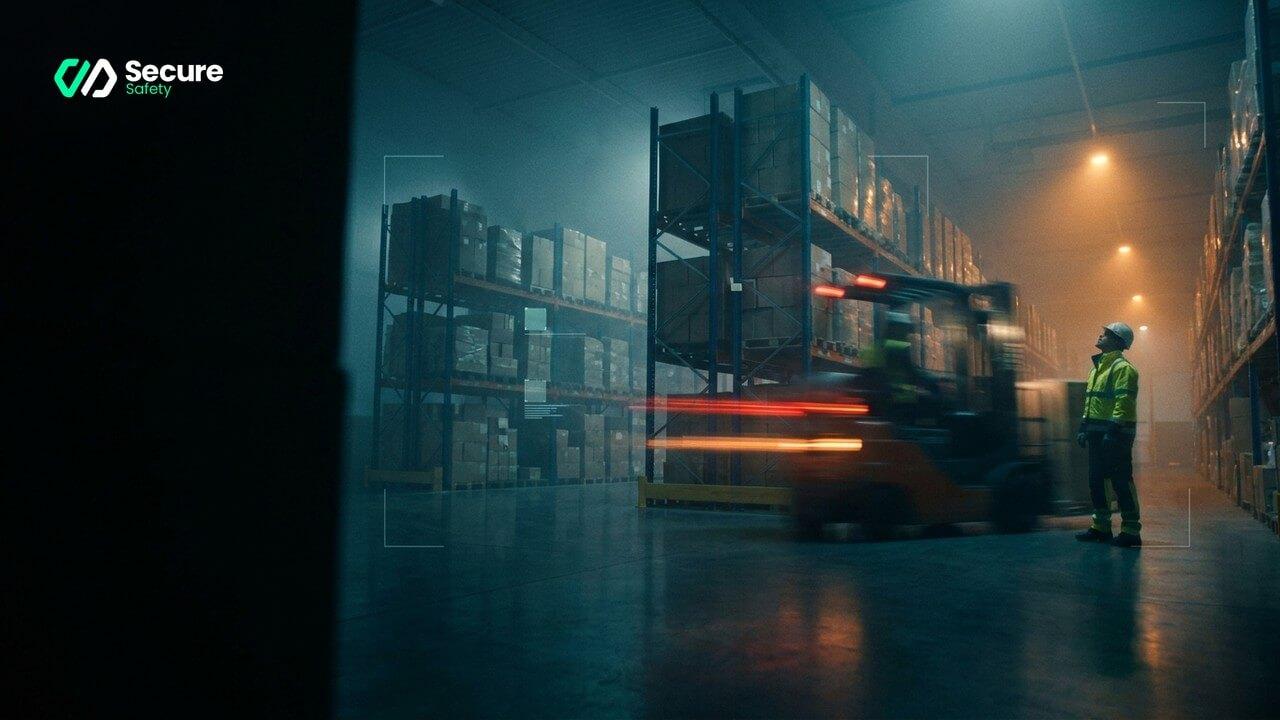
Vehicle & pedestrian safety. The #1 cause of UK workplace fatalities, and where we lead.
Forklifts, HGVs and plant moving metres from people is the hazard that kills most often and costs most in prosecution. We watch every crossing, warn before contact, and hold vehicles to the site speed limit. This turns your cameras from evidence into prevention.
The hazard
Vehicle-pedestrian conflict is the leading cause of workplace fatality in the UK. Every year, workers are struck by forklifts, HGVs and plant in yards, warehouses and ports they know well — often on routes they have walked hundreds of times before. The hazard is structural: vehicles and people share the same ground-level space, and moments of conflict happen faster than a supervisor can react.
The financial and legal consequence is severe. HSE prosecutions following a struck-by fatality routinely result in fines exceeding £1 million, alongside a human cost that cannot be measured in money. Most prosecutions reveal a common thread: the organisation knew the hazard existed, had incomplete controls, and waited for an incident to force action.
SecureSafety addresses this by making every crossing and conflict visible in real time. Cameras already on-site become active prevention tools: the AI watches every aisle end and gate simultaneously, raises an alert the moment a vehicle enters a pedestrian zone, and holds trucks to the site speed limit without adding any hardware beyond an edge device.
From camera to alert in under a second.
Every vehicle and person is tracked
The platform runs detection models on all connected cameras in parallel, identifying vehicles and pedestrians simultaneously and building a persistent spatial map of where each is moving. Context from adjacent cameras is fused to cover blind spots at aisle ends, gates and loading bays.
Proximity and speed breaches trigger an instant alert
When a vehicle enters a defined pedestrian zone, closes within a configured distance, or exceeds the site speed limit, an alert fires in under one second — to the control room, to site PA speakers and to any worker wearables in the area.
Every event is logged for investigation and compliance
Every detection is time-stamped, camera-referenced and stored. Near-miss data builds a heat map of where conflicts concentrate, enabling engineering controls to be targeted at the locations that actually matter.
SecureSafety runs at a major port monitoring vehicle-pedestrian conflict across a million-square-metre estate, and at a major international airport managing airside ground-crew safety. The same platform was forged on offshore drilling rigs — environments far more demanding than any yard or warehouse — before it reached the land.
What people ask about this detector.
Does this work on older IP cameras, or do we need new hardware?
The platform ingests streams from standard IP cameras, DVRs and NVRs already on your network. No new camera hardware is required to get started. Where camera coverage has gaps, wearable proximity tags can extend detection to areas cameras cannot reach.
How do you prevent false alerts at permitted vehicle-pedestrian crossings?
Zones are configured for your site layout — you define where vehicles and pedestrians are permitted to coexist and where they are not. Combined with the platform's sub-0.05% error rate, the result is an alert load that crews treat seriously rather than mute.
Can you detect vehicle speed as well as proximity?
Yes. The platform tracks vehicle speed relative to the site speed limit you configure. Breaches are flagged immediately, and cumulative speed data surfaces repeat offenders for targeted intervention.
What does integration with our existing VMS or control room look like?
The platform connects over your local network and streams detections to your control room dashboard. It also integrates with PA speakers and worker wearables. A full integration scope is costed during the Discovery phase.
How does the system distinguish between an authorised crossing and a conflict situation?
Zone configuration defines where vehicles and pedestrians are permitted to share space and the conditions under which an alert should fire. A marked pedestrian crossing where vehicle speed is capped does not generate alerts if the vehicle is within the speed limit and the pedestrian is in the designated crossing space. An alert fires when a vehicle enters a pedestrian zone at speed, or when a pedestrian enters a vehicle route outside the designated crossing. The site-specific zone configuration is part of the Discovery phase scope.
Can the system track individual vehicles across multiple camera feeds?
Yes. The platform uses a handoff model that maintains vehicle and pedestrian identity across adjacent camera zones, so a vehicle that enters one camera frame and exits into the next is tracked as the same object throughout its route. This enables persistent speed tracking over longer distances and near-miss correlation across the full site rather than per-camera.
What happens when a vehicle is partially occluded — behind a column, for example?
Partial occlusion is handled by trajectory modelling: when a vehicle disappears behind a column, the platform uses its last known position, velocity and direction to project its continued trajectory. If the projected trajectory intersects with a pedestrian position, an alert fires even before the vehicle re-emerges. Edge-case performance in heavy-occlusion environments is reviewed during the Discovery phase.
How does the alert reach the vehicle operator, not just the control room?
Alerts can be routed to PA speakers in the affected zone, to driver-mounted wearables, or to an in-cabin device if vehicles are equipped. The routing configuration depends on your site infrastructure and is scoped during the Discovery phase. For sites with no existing speaker infrastructure, wearable proximity alerts are the standard fallback.
What is the typical reduction in near-miss events after deployment?
The most directly relevant data point from a controlled SecureSafety deployment is an approximately 80% reduction in total tracked unsafe events over a trial period, with human-machine segregation breaches eliminated entirely. Vehicle-pedestrian near-miss reduction in port and manufacturing environments consistently falls in the 60-80% range after a 90-day bedding-in period during which the deterrence effect builds.
Is the system able to enforce pedestrian-free zones during specific operations rather than all the time?
Yes. Zones can be time-scheduled or manually activated by the control room. A dock approach that is a hard exclusion during vessel berthing but a shared-access area at other times is handled by a scheduled zone that activates at the start of the berthing window and deactivates when the operation is complete. This prevents alarm fatigue during normal operations while maintaining strict enforcement when risk is highest.
How does the system handle forklifts that have visibility aids like mirrors — does it still alert for conflicts those aids are designed to prevent?
Visibility aids such as convex mirrors at aisle ends are effective controls in their own right, but they require the forklift driver to be actively using them at the critical moment, and they provide no warning to the pedestrian. AI detection operates independently of whether the driver uses the mirror — it monitors the trajectories and generates the alert regardless of what the driver can see. The two controls are complementary: the mirror assists the driver; the AI monitoring detects conflicts when the driver has not used the mirror, or when the mirror's coverage does not extend to the full approach geometry.

Tell us the hazard. We'll detect it.
Book a demo and we'll show the detectors running live, on-premise, and scope the ones that fit your site.