Critical Infrastructure.
Multi-site visibility and on-premise processing, proven at fleet scale offshore.
Utilities, data centres, transport hubs and large campuses run complex, spread-out operations with big camera estates. SecureSafety gives one live safety picture across every site.
Why this sector is demanding.
Critical infrastructure operators — utilities, transport hubs, data centres, water treatment facilities and large campuses — share a common safety challenge: spread-out, complex operations across large physical estates, often combining manned and unmanned facilities, with a camera network that covers the estate for security but has never been connected to a safety management layer. The result is that safety monitoring is concentrated in staffed areas during working hours and absent everywhere else.
Restricted zone integrity is a particular concern in critical infrastructure. Substations, transformer compounds, control rooms, server halls and water treatment areas are restricted for both safety and security reasons, and unauthorised access carries the potential for both personal injury and operational disruption. Camera-based access monitoring provides a continuous enforcement layer that does not depend on a guard being present at every boundary.
Lone-worker risk in critical infrastructure arises from the combination of remote locations, unmanned facilities and work that requires individual engineers to operate in high-voltage, confined or hazardous areas without colleagues nearby. The gap between the last confirmed check and a potential incapacitation event is longer in critical infrastructure than in most other sectors, making automated monitoring and alerting essential.
The problems AI solves here.
Perimeter and restricted-zone access control
Substations, control rooms and compound areas require continuous monitoring that a guard on a scheduled patrol cannot provide. SecureSafety monitors every boundary in real time, alerting on unauthorised access and providing the time-stamped evidence record required for both safety and security incident reporting.
Lone-worker safety across unmanned sites
Engineers working at remote substations or unmanned treatment facilities often operate without colleagues on site. The platform combines camera monitoring with wearable check-in and man-down detection, maintaining a continuous thread on every lone worker regardless of whether they are within camera coverage.
Multi-site management from a single control centre
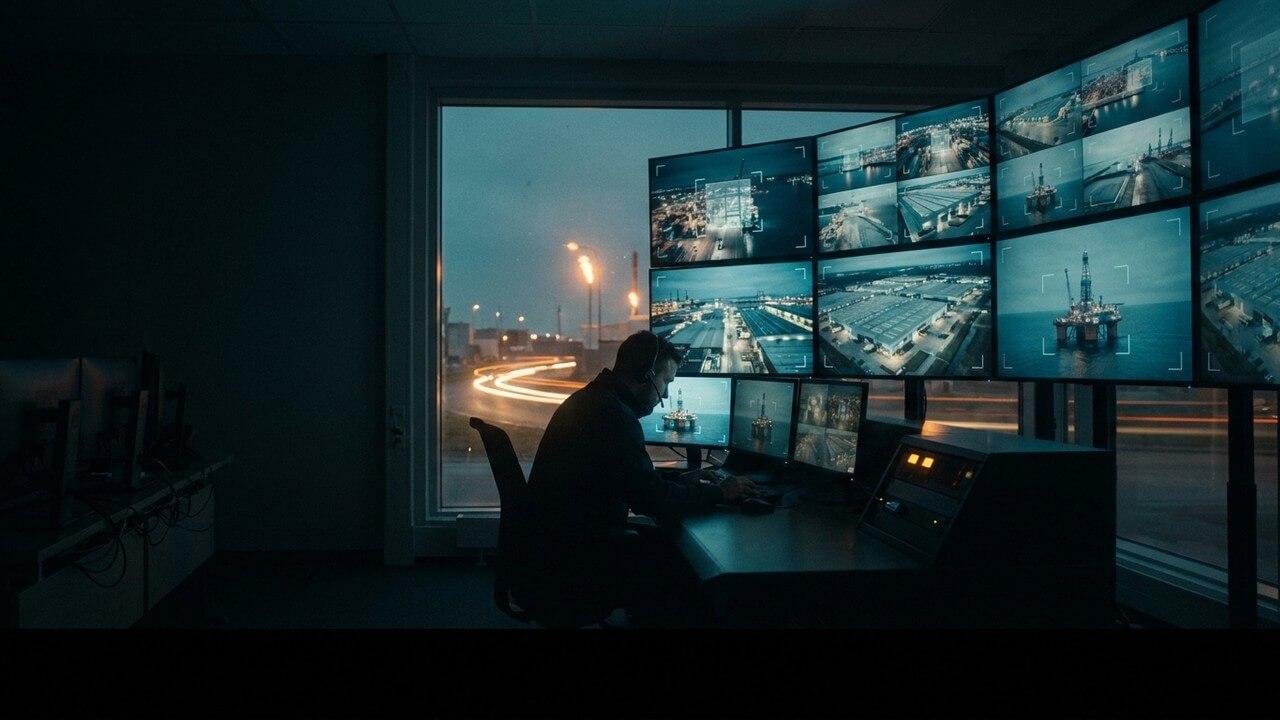
Critical infrastructure operators typically manage dozens of sites from a central operations function. SecureSafety provides a multi-site management view that consolidates alerts, compliance data and incident records from all sites into a single dashboard, enabling the central team to maintain oversight without physically visiting every location.
SecureSafety has managed the safety monitoring of a fleet of sites from a central operational view since the offshore deployment — where multiple rigs are managed from a shore-based operations centre. The same multi-site architecture, on-premise processing and sub-0.05% error rate carries directly into critical infrastructure operations.
Questions from critical infrastructure.
Can the system operate at unmanned sites where there is no on-site IT infrastructure?
Yes. The edge device is compact and self-contained, operating on a local network connection with no on-site IT team required. Remote management, configuration changes and support are delivered over the existing site uplink. Alert routing is configured to reach the central operations team or on-call engineer rather than a local control room.
How does the system handle sites with high-voltage restricted areas?
High-voltage exclusion zones are configured as hard perimeters with no conditional entry. The platform monitors the boundary continuously, alerting the central operations team immediately on any approach or crossing. Camera positioning outside the restricted area ensures no personnel or camera equipment enters the hazardous zone.
Does the system support security integration — for example, triggering CCTV review or access control systems on an alert?
Yes. Alert outputs integrate with access control systems, security management platforms and CCTV review interfaces. The platform distinguishes safety alerts from security events in the routing configuration, so the right teams receive the right notification for each event type.
Can the platform scale from a small number of sites to an estate of hundreds of locations?
Yes. Each site runs an on-premise instance, and the multi-site management layer is architected to consolidate any number of sites. Implementation is phased, with each site connected and verified before the next. The Discovery phase scopes the initial deployment and defines the rollout plan for the full estate.
How does the system support lone-worker safety for engineers working alone at remote infrastructure sites?
Remote site deployments combine camera coverage of the main working areas with wearable man-down, no-motion and check-in monitoring for engineers who may be working outside camera coverage. The control room or emergency coordinator sees the status of every lone worker across all sites on a single platform, with each worker's check-in status, location (where beacons are installed) and alert state visible in real time. Automatic escalation to the emergency coordinator fires when a check-in is missed or a man-down signal triggers.
Can the system be deployed at a site that has strict security requirements and no cloud connectivity?
Yes. The platform is specifically architected for sites with no cloud connectivity requirement. All processing and alerting is on-premise; the management connection to SecureSafety support uses an encrypted management tunnel that carries only system health and management data, not video. Sites with strict connectivity restrictions can operate the platform in a fully air-gapped mode with local management and periodic offline reporting.
Does the system support the access logging requirements of CNI (critical national infrastructure) sites?
Yes. The platform logs all access events, PPE compliance checks and zone monitoring events with timestamps and camera references. This log is exportable for integration with the site's access control and security management systems. For sites with regulatory requirements for access audit trails (NIS Regulations, security-designated sites under the Critical National Infrastructure protection regime), the log format and retention policy are configured during Discovery to meet the specific requirement.
Tell us the hazard. We'll detect it.
Book a demo and we'll show SecureSafety running in a critical infrastructure environment. Then scope your site with a fully-costed Discovery phase.