Industrial Manufacturing.
Behavioural and vehicle detectors proven in far harsher conditions than a factory floor.
Machine zones, forklifts and production lines put people and equipment in constant close contact. SecureSafety enforces segregation and PPE rules across the floor without adding cameras.
Why this sector is demanding.
Industrial manufacturing environments combine the two hazard categories most likely to produce serious injuries: moving vehicles and energised machinery. Forklifts and counterbalance trucks operating in the same space as production workers create struck-by risk at every aisle end and loading area. Machine guarding zones around presses, grinders, conveyors and robotic cells create line-of-fire risk whenever a worker enters to clear a jam or check a product without following the lockout procedure.
Production pressure is one of the most consistent factors in manufacturing incidents. Under output targets, workers cut corners on segregation rules, enter machine zones without completing the isolation procedure, and work faster than safe movement speeds allow. Manual supervision is insufficient because supervisors are also under production pressure and cannot simultaneously watch every line, every aisle and every machine zone across a large floor.
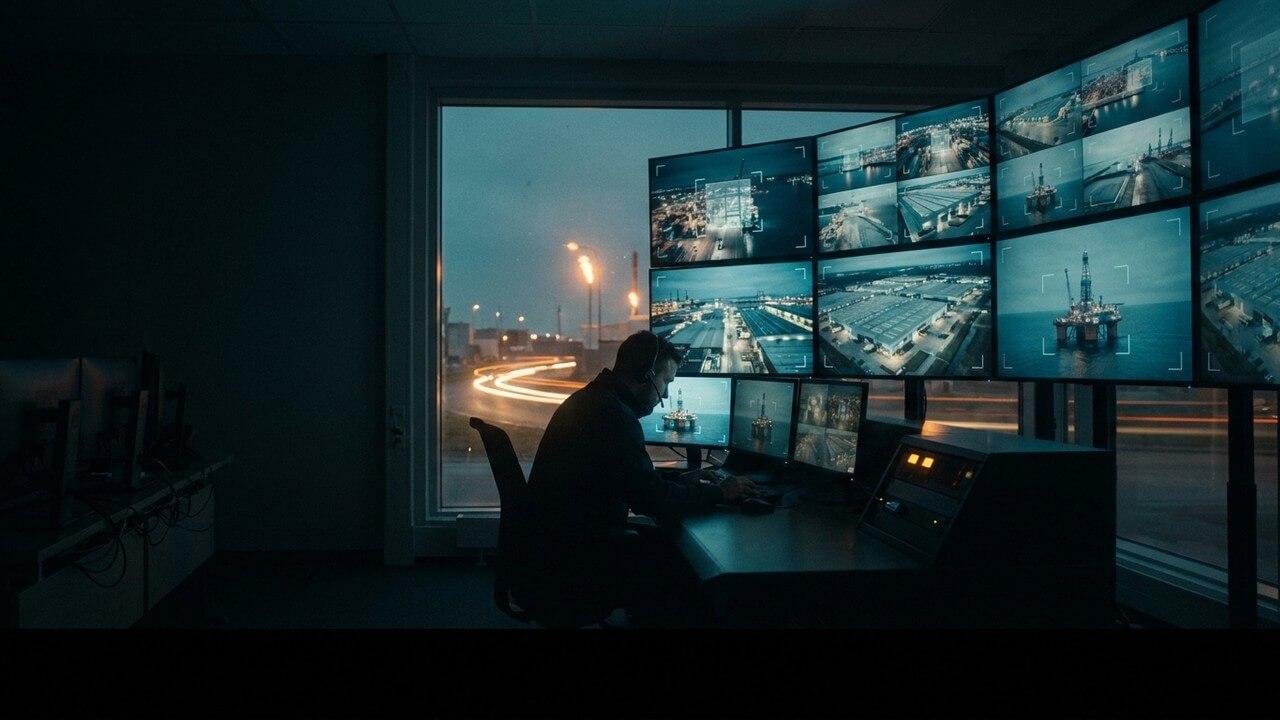
The camera infrastructure already deployed for quality monitoring, production flow and site security is the asset base for AI safety monitoring. SecureSafety adds an analytical layer to the feeds already running, converting passive surveillance into continuous hazard detection without a camera installation project.
The problems AI solves here.
Human-machine segregation at machine zones
Production machinery creates fixed exclusion zones that must be enforced every time maintenance, jam-clearing or quality checks bring a worker close to an energised machine. SecureSafety enforces each zone boundary continuously, alerting when a worker enters without triggering the required isolation — and logging every entry for audit.
Forklift near-misses in production aisles
Forklifts carrying stock and materials share aisles with pickers, line workers and maintenance personnel in most manufacturing facilities. The platform monitors every aisle end and crossing, alerting when a vehicle and pedestrian are on a convergence course and tracking vehicle speed against the site limit.
PPE compliance by production area
Different production areas carry different PPE requirements: welding areas require face shields, grinding areas require eye protection, chemical handling areas require gloves and RPE. The platform enforces the correct PPE set for each zone automatically, ensuring the right protection is worn in every area without relying on workers to self-supervise.
Vehicle proximity and machine-zone detection were developed in offshore oil & gas — the most demanding manufacturing-adjacent environment on earth — before being deployed in industrial facilities. The accuracy standards required on a drill floor exceed anything a factory environment demands, and the same models arrive on your production floor already proven.
Questions from industrial manufacturing.
Can the system detect when a machine guard has been removed or propped open?
Yes. Physical guard removal or displacement changes the camera view of the machine area. The platform can be configured to detect this change and alert immediately, treating the open guard as a zone boundary breach rather than waiting for a person to enter the unguarded area.
How does the platform handle the noise and camera interference typical of heavy manufacturing?
The models are trained on industrial footage including environments with vibration, steam, smoke, dust and variable lighting. Specific camera performance in your facility is reviewed during the Discovery phase to identify any cameras where environmental conditions require configuration adjustment.
Can the system monitor multiple production buildings on the same site?
Yes. The platform consolidates all cameras across a site on a single edge device or a scaled deployment, with a unified management view covering all buildings. Each building can carry its own zone rules and PPE requirements.
What is the impact on production if the system generates too many false alerts?
The platform operates at a sub-0.05% error rate, a standard proven at operational scale across 18,000 events per day. Zone configuration is tuned during implementation to match the specific layout and movement patterns of your facility, minimising false alerts before go-live.
Can the system monitor both fixed machinery guards and the areas around them?
Yes. The platform monitors the zone adjacent to a machine guard — the approach area, the maintenance access route, and the guard itself if it is visible in the camera frame. A guard defeat (propped open or removed) can be detected visually; unauthorised approach to the guard boundary triggers a zone alert. The combination of guard-adjacent zone monitoring and machine-interlock integration provides a two-layer protection around high-hazard machinery.
How does the system handle the noise, vibration and heat of a production floor?
The platform hardware is selected for the environmental conditions of the specific facility during the Discovery phase. Production floor environments typically require fanless edge compute nodes rated for elevated ambient temperatures, and camera selections that handle the vibration and thermal conditions of heavy manufacturing. The detection models are robust to the visual noise of production environments — steam, dust, motion blur from machinery — as these conditions were present in the industrial environments where the models were developed.
Can the platform detect ergonomic risk factors — for example, repetitive manual handling postures?
Current detection focuses on acute safety events (zone breaches, falls, PPE non-compliance, speed violations) rather than ergonomic risk factors that develop over time. Ergonomic posture analysis is a developing capability that is available as a research integration rather than a standard deployment at present. For sites with a specific ergonomic risk assessment requirement, this is discussed during Discovery.
What is the approach to operator privacy in a production environment where workers are under continuous camera monitoring?
The platform is configured to generate alerts on safety events rather than to monitor productivity or individual performance. The footage associated with alerts is retained; continuous footage is not accessible to management for review. Configurable anonymisation options include facial blurring and role-only identification. A DPIA framework is provided during Discovery that addresses the specific privacy obligations for a production floor deployment, including any consultation required with employee representatives or works councils.
Tell us the hazard. We'll detect it.
Book a demo and we'll show SecureSafety running in a industrial manufacturing environment. Then scope your site with a fully-costed Discovery phase.