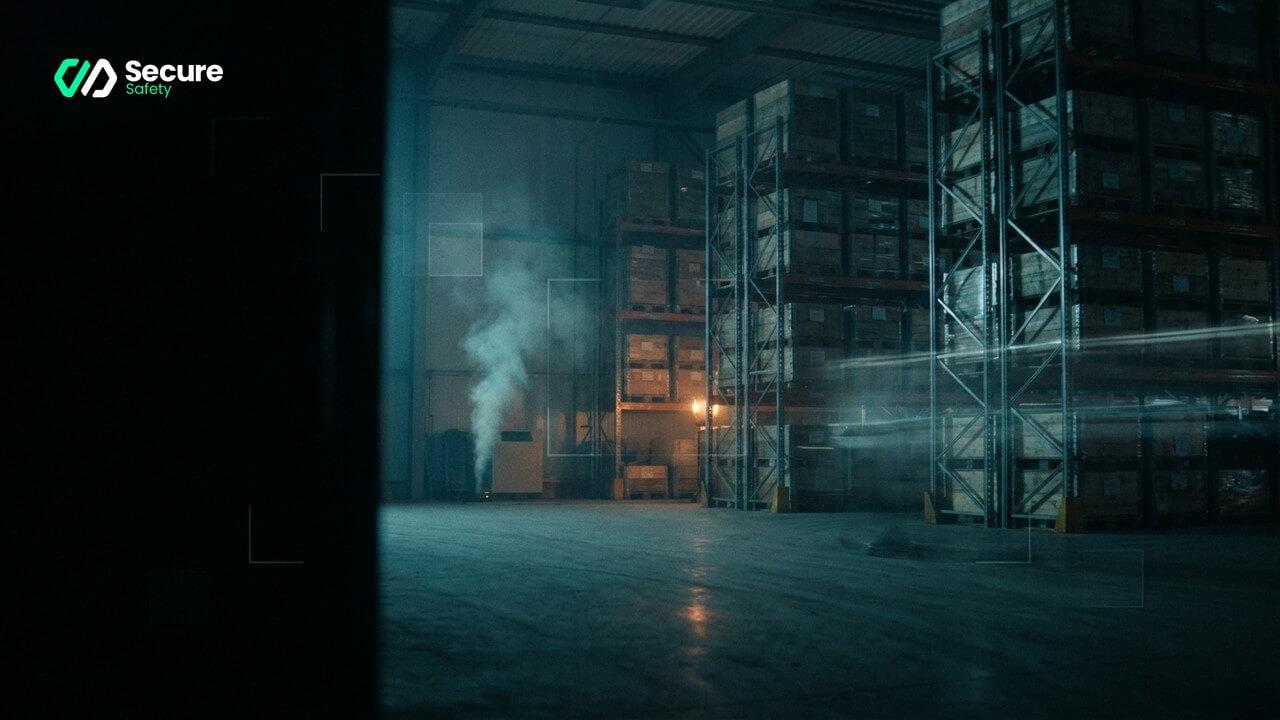
Fire, load & environment. Seconds matter before an incident escalates.
Early fire and smoke detection, people working under suspended loads, tensioned cable, blocked escape routes and unattended objects. These are the environmental hazards that turn from a near-miss into a catastrophe in moments.
The hazard
In fire and smoke incidents, the difference between a controlled evacuation and a mass casualty event is often measured in the first two minutes. Traditional fixed-point heat and smoke detectors respond to conditions at the sensor location — by the time they activate, visibility may already be compromised and evacuation routes affected. Camera-based fire detection recognises the visual signature of smoke and flame at the earliest stage, often before fixed sensors trigger, and fires alerts while escape routes are still clear.
Suspended load incidents are one of the leading causes of fatal injury in construction, ports, and offshore operations. A dropped object from height carries enormous kinetic energy, and anyone beneath a suspended load when it fails has no protection. The risk compounds because the area directly beneath a lift is often poorly enforced: workers pass through, stop to speak, or set down equipment without considering that they are in the drop zone.
Environmental hazards — blocked escape routes, spills, unattended objects in travel paths — create conditions for secondary incidents. A spill that is not flagged in time becomes a slip; a blocked fire exit that goes unnoticed becomes a bottleneck during evacuation. Continuous camera monitoring catches these conditions the moment they develop, rather than waiting for a scheduled inspection or a near-miss report.
From camera to alert in under a second.
Visual fire and smoke signatures are recognised early
The platform analyses camera feeds for the colour, movement and texture patterns associated with incipient fire and smoke, operating independently of fixed heat sensors. Detection at the visual stage — before a detector activates — gives control rooms the time to initiate evacuation and alert site fire response while the situation is still manageable.
Drop zones are enforced continuously
Every lift operation involves a defined drop zone beneath the load path. The platform monitors these zones in real time and alerts the moment a person enters the area while a load is suspended. Combined with tensioned-cable monitoring, the platform provides full awareness of overhead hazards across crane lanes, loading areas and drill-floor operations.
Environmental conditions are flagged as they develop
Escape-route obstructions, spills and unattended objects are detected and flagged before they become incident causes. Each event is time-stamped and camera-referenced, giving both the immediate alert and the audit record for subsequent investigation or regulatory reporting.
Fire detection and suspended-load monitoring were hardened on offshore drilling rigs — environments where a fire on the drill floor or a dropped object above the moonpool can escalate to a catastrophic event within seconds. The same platform now monitors suspended loads in port operations and fire risk in manufacturing environments with the same sub-0.05% error rate.
What people ask about this detector.
How much earlier than a fixed smoke detector does the camera-based system activate?
Activation time depends on the specific incident and environment, but camera-based detection typically identifies the visual smoke signature one to three minutes before a ceiling-mounted detector activates. That window is the evacuation time the system is designed to preserve.
Can the system detect fire outdoors, where smoke disperses quickly?
Yes. Outdoor fire detection uses flame signature recognition as well as smoke pattern analysis, making it effective in open yards, stockpile areas and above-deck offshore environments where smoke disperses before reaching a fixed sensor.
How are drop zones configured for a site with multiple lifts?
Each lift operation or crane lane is configured as a separate zone. The platform can monitor multiple concurrent lifts across different cameras, with each drop zone active independently. Zone boundaries are updated during the Discovery phase to match your lifting plan and site layout.
Does the system integrate with our existing fire alarm panel?
Yes. Camera-based fire detection is designed to complement, not replace, existing fixed infrastructure. Integration with fire alarm panels, control room systems and PA speakers is scoped during the Discovery phase and delivered without changes to your existing alarm architecture.
How does camera-based fire detection compare to VESDA (very early smoke detection apparatus)?
VESDA systems aspirate air to a central detector, providing very early warning but requiring specialist installation and maintenance. Camera-based detection covers any area with a camera already installed, without additional infrastructure or air sampling pipework. The two approaches are complementary: VESDA excels in enclosed spaces where air can be sampled continuously; camera detection is more practical and cost-effective for open industrial areas where VESDA installation is impractical.
Can the fire detection system identify the source location as well as the existence of fire?
Yes. Because detection is camera-based, every fire alert includes the camera reference and the location within frame where the signature was detected. For sites with overlapping camera coverage, the platform can triangulate a more precise source location. The camera clip attached to every alert gives the control room immediate visual confirmation and location context.
How does the system handle steam and dust that can visually resemble smoke in industrial environments?
The detection models were trained on industrial environments with steam, dust and other visual noise common in manufacturing, offshore and port environments. Smoke detection uses a combination of colour analysis, motion pattern recognition and temporal persistence — smoke moves and develops differently from steam or dust dispersal. Specific industrial environments with high false-alert potential from natural vapour are reviewed during the Discovery phase.
Does suspended-load monitoring require any integration with the crane control system?
No integration with crane controls is required for zone activation. The platform detects the presence of a suspended load visually and activates the drop zone accordingly. For sites where the crane schedule is known in advance, the zone can also be pre-activated manually by the control room. Integration with crane PLC systems for automatic zone activation is available as a configuration option during Discovery.
What is the response time between a fire detection alert and the site fire team being mobilised?
The alert fires to the control room within two to four seconds of the visual signature being confirmed. Automatic PA activation, if configured, can begin the evacuation announcement simultaneously. The total elapsed time from ignition to evacuees beginning to move depends on your site response procedure, but the technology contributes the minimum possible latency between detection and action.
Can the system detect escape-route obstructions on a 24/7 basis, not just during operational hours?
Yes. The platform operates continuously and independently of operational hours. An escape-route obstruction created at 2am during a night-shift stocktaking operation is detected and logged when it occurs, not when the day-shift safety manager arrives the next morning. The alert can be routed to on-site security or a night-shift supervisor for immediate clearance.
How does the system distinguish early smoke from steam, dust or vehicle exhaust in a mixed industrial environment?
Smoke, steam, dust and vehicle exhaust all have different visual signatures in terms of colour, opacity, dispersion pattern and movement behaviour over time. The detection models were trained on industrial environments that include all of these sources, learning the specific visual characteristics of incipient smoke as distinct from the common false-positive sources in each environment type. Site-specific calibration during the commissioning phase characterises the specific noise sources at each camera location and adjusts the detection sensitivity accordingly. For environments with particularly high false-positive potential, a longer confirmation window can be configured — requiring the smoke signature to persist for multiple frames before an alert fires — at the cost of a small increase in alert latency.

Tell us the hazard. We'll detect it.
Book a demo and we'll show the detectors running live, on-premise, and scope the ones that fit your site.