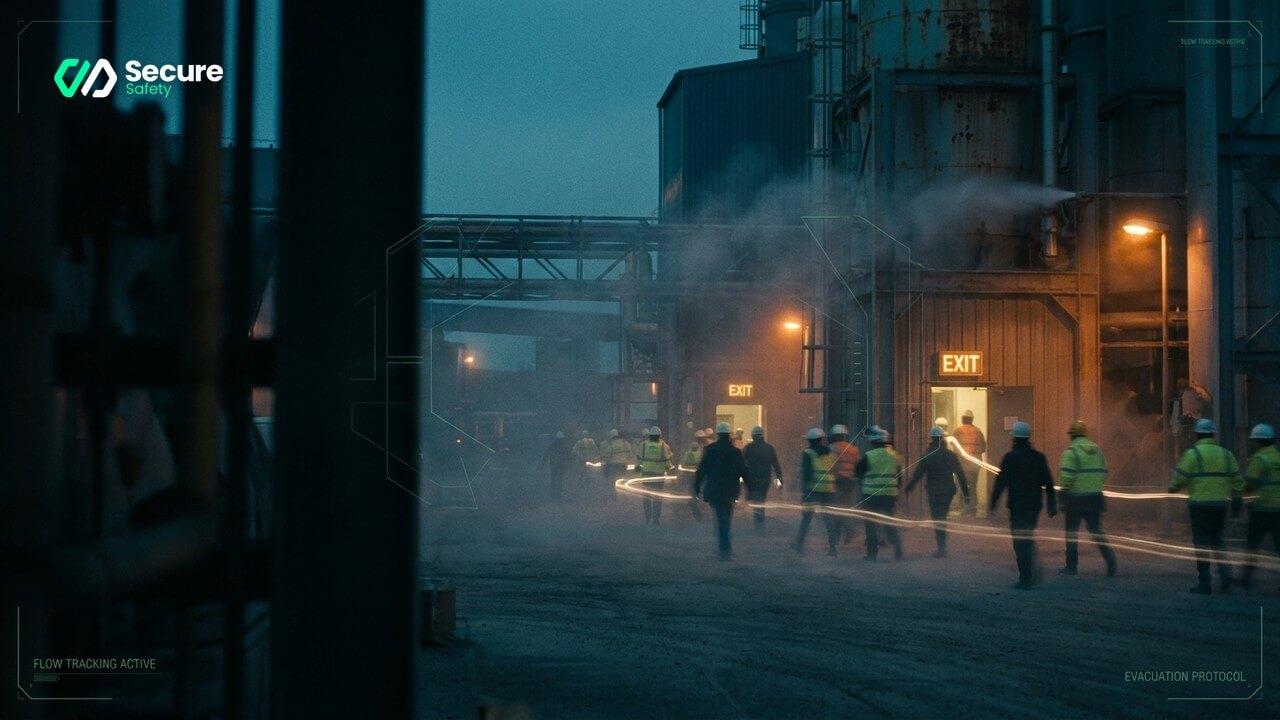
Every site manager knows the sound. The alarm cuts through the noise of the shift, and in an instant the whole building becomes a question. Where is everyone? Who has moved, who has frozen, who is still at the far end of a process line that nobody can see from the muster point? For the next few minutes, the people responsible for the emergency are working almost blind — trusting a headcount taken on a clipboard, a radio call that may not be answered, and the assumption that everyone knows the way out.
Most evacuation plans are written for a building on paper. The real building is messier. Doors get propped open and then blocked. A pallet truck is parked across a fire route "just for a minute". Fog, dust or smoke swallows the signage. And the one thing the plan depends on most — knowing, in real time, how many people are inside and where they are going — is the one thing a printed procedure cannot give you.
This is where a computer-vision layer on your existing cameras changes the arithmetic of an emergency.
The first ninety seconds decide the outcome
Emergency response is governed by time. The gap between the alarm and the moment the last person clears the building is where injuries either happen or don't. Yet in most facilities the early minutes are lost to uncertainty: confirming the alarm is real, working out roughly how many people are affected, and deciding whether to send responders in.
AI evacuation monitoring compresses that uncertainty. Because the system already understands what it is seeing — people, vehicles, movement, direction — it can tell an incident controller things a siren never could. How many people were in the building when the alarm triggered. Which zones are emptying and which are not. Whether anyone is moving towards the hazard rather than away from it. None of this requires new sensors or a control-room refit. It reads the cameras you already own and turns them into a live map of the evacuation as it unfolds.
The value is not the alert. It is the removal of doubt at the exact moment doubt is most expensive.
Blocked exit detection: the hazard that hides in plain sight
The most dangerous fault in any evacuation is an exit that is not there when you need it. Fire routes are inspected on a schedule — monthly, quarterly — and then quietly degrade in the weeks between. A stack of stock creeps across a doorway. A roller shutter is left down. A fire door is chocked open, defeating the compartmentation the whole plan relies on.
Continuous blocked exit detection watches those routes every hour of every day, not just on inspection day. If an escape route is obstructed, a door that should be clear is fouled, or an emergency exit is blocked by a vehicle or a load, the system flags it while it is still a housekeeping problem — long before it becomes the reason people cannot get out. The failure is caught in the ordinary run of the day, so the emergency never inherits it.
Muster verification without the clipboard
The roll call is the ritual at the end of every evacuation, and it is where the plan most often stalls. Paper lists go out of date. Contractors and visitors slip through the gaps. Someone is marked absent who actually left early, and responders are sent back into a hazard to look for a person who was never there.
AI-assisted muster verification approaches the count from the other direction. Instead of asking "who ticked the list?", it works from what the cameras saw: how many people were on site, how many have reached the assembly points, and therefore how many are unaccounted for. That single number — the gap between expected and mustered — is the most important figure in the whole event. It tells an incident controller whether the building is clear or whether a search is needed, and it tells them in seconds rather than in the long, anxious minutes of a manual reconciliation.
Get that number right and you avoid the two worst outcomes at once: standing down too early with someone still inside, and sending crews back into danger to hunt for someone already safe.
Forged where the stakes were highest
This is not a capability we imagined in a workshop. The detection was built and hardened offshore, on the drill floors of oil and gas — an environment with heavy moving equipment, confined escape routes, and no tolerance for a headcount that is even one person wrong. It has since run in national oil-major operations, a major international port and an international airport, with a field-measured error rate below 0.05% and reductions of around 90% in unsafe behaviour. A muster count you can trust when the sea is rough and the deck is crowded is a muster count you can trust anywhere. Because the analysis runs on-premise, the footage never leaves your site — the evacuation is watched, but nothing is exported.
From evidence to a better plan
The benefit does not end when the all-clear sounds. Every drill and every real event leaves a record of how the building actually behaved: which routes filled and which stayed empty, where people hesitated, how long each zone took to clear. That is evidence most organisations never capture — and it is exactly what turns an evacuation plan on paper into one calibrated to the building you really have.
Run a drill and you find out whether the plan works. Run it with a system watching, and you find out why it works — or where it quietly doesn't — so the next one is faster.
The point of it all
An evacuation is the moment a safety programme is tested in public, with no second attempt. The organisations that come through it well are not the ones with the thickest procedures. They are the ones who, when the alarm sounds, can answer the only questions that matter — how many, where, and is everyone out — without guessing.
Evacuation AI in practice: what changes from day one
The first 60 seconds
The first minute of an evacuation is when the difference between a prepared and unprepared organisation becomes visible. AI-assisted evacuation monitoring changes the first 60 seconds by providing the control room with a live count of personnel by zone the moment the alarm sounds — not a count assembled by radio check-in over the next five minutes, but a real-time visual count from the cameras already watching the muster routes. That number tells the emergency coordinator whether the evacuation is progressing as expected or whether someone has not moved, has gone in the wrong direction, or has not been seen since the alarm.
Muster accounting without clipboards
The traditional muster headcount — clipboards, supervisors counting hands, radio reports from each muster point — takes four to six minutes in a smooth, practiced evacuation and much longer in a real emergency where people are frightened and routes are crowded. Camera-based people-counting at muster points provides an automated count that updates continuously as people arrive, flagging a discrepancy immediately rather than after the warden has worked through a paper roster. The time saving in a real event is the margin that determines whether a re-entry search begins before or after the situation inside the building deteriorates.
Integration with emergency response teams
The value of AI evacuation monitoring is not limited to the initial headcount. As the emergency develops, the control room needs to know whether the re-entry team can safely access the building, whether the muster areas are clear of hazards, and whether everyone has been accounted for before the building is handed back to operations. The camera layer that monitors the evacuation process continues to provide visual confirmation of these states throughout the incident, reducing the dependency on radio communications from people who may be in difficult conditions.
Implementation checklist for evacuation and emergency response monitoring
- Muster point camera coverage: confirm that every primary and secondary muster point has camera coverage sufficient for automated people-counting; add cameras to muster points without coverage as part of the deployment scope
- Evacuation route monitoring: identify all evacuation routes and confirm camera coverage of the key decision points — the exits, the stairwells, the assembly point approaches — where route compliance monitoring is most valuable
- Emergency coordinator alert routing: define specifically who receives emergency response alerts (person-on-ground, fire detection, evacuation trigger) and confirm the contact method is appropriate for an emergency context — radio is typically the right channel, not email
- Integration with PA system: confirm that fire detection and evacuation alerts can trigger specific PA announcements for the zone where the event is detected rather than a site-wide announcement that does not direct people to the specific hazard or assembly route
- Integration with visitor management: for sites with a visitor management system, confirm how visitor counts are incorporated into the automated muster total — visitors who are not on the employee register must be counted at the muster point itself
See what your cameras have been missing — book a demo.