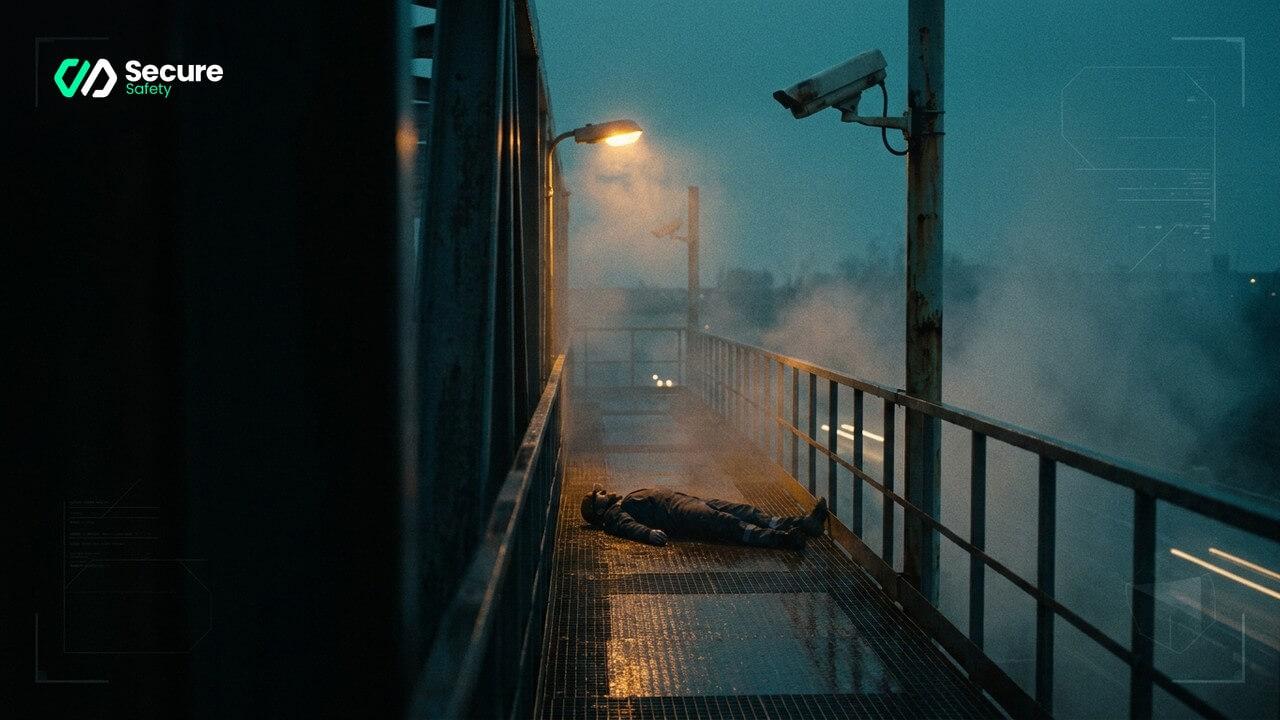
Every shift supervisor knows the sound of the phone that comes too late. A worker has been found on the floor of a plant room, or at the foot of a ladder, or in an aisle between two racks. Nobody knows how long he has been there. The last time anyone saw him upright was forty minutes ago. And in the space between his collapse and his discovery, the odds quietly turned against him.
That gap — the interval between the fall and the first pair of hands on the scene — is the single most decisive number in any medical emergency at work. It is also the number almost nobody measures, because until recently there was no way to measure it. A man goes down alone, and the clock starts running in a room where no one is looking.
The problem is not the fall. It is the silence that follows.
Slips, trips and falls remain the most stubborn category in workplace safety. In the UK they account for the largest single share of non-fatal injuries reported to the HSE year after year, and a meaningful share of the fatal ones. You can lay anti-slip flooring, issue harnesses, paint the edges of every step, and still a worker will lose his footing on a wet gantry, take a seizure, or suffer a cardiac event that has nothing to do with the floor at all.
What turns a fall into a fatality is rarely the impact. It is the time spent unattended afterwards. A person who is unconscious, concussed or in cardiac arrest cannot raise the alarm. A lone worker in a compressor house or a cold store may be out of sight of every colleague on the site. The tragedy is almost never that the accident happened. It is that it happened where no one could see, and stayed unseen.
Why the current safety net has holes
Most sites rely on three defences, and each has a blind spot.
Manual observation depends on someone happening to walk past. On a large site, a worker can lie undiscovered for the length of a shift.
Wearable panic buttons and man-down pendants only work if the worker is conscious enough to press them, or if the device's tilt sensor is calibrated tightly enough to catch a genuine collapse without crying wolf every time someone bends to pick up a tool. Alarm fatigue sets in fast, and a device left in a locker protects no one.
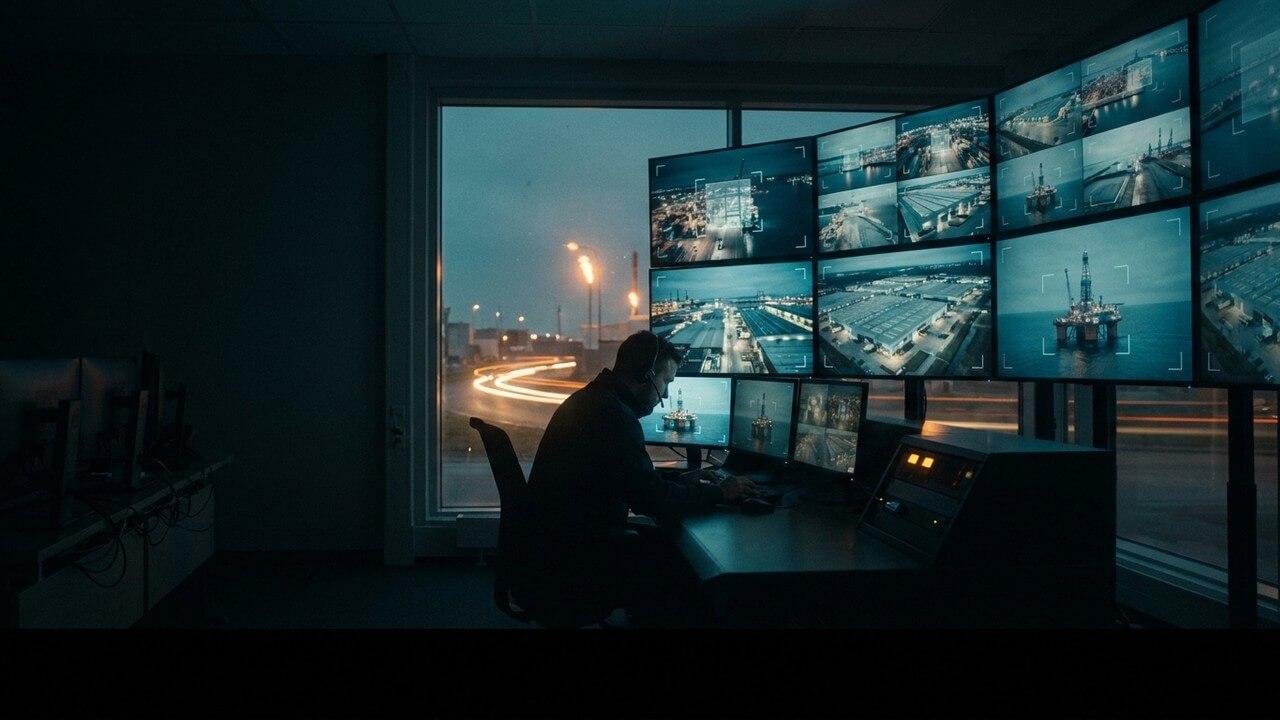
CCTV records everything and watches nothing. The footage is perfect — for the inquiry afterwards. In the moment that matters, a bank of monitors in a gatehouse is only as vigilant as the one guard trying to watch forty screens at once.
None of these close the gap. They simply move it around.
What AI fall detection actually does
Person-on-ground detection puts a set of tireless eyes on the feeds you already have. A computer-vision layer sits on top of your existing CCTV and watches the shape and posture of every person in frame. It understands the difference between someone crouching to inspect a valve and someone who has fallen and not got up. When a body goes horizontal and stays horizontal, the system does not wait for a shift to end or a colleague to wander by. It raises the alarm in seconds — to the control room, to a supervisor's phone, to whoever needs to move.
The distinction that matters is between recording and watching. Ordinary CCTV is a passive archive. AI fall detection is an active sentinel. One tells you what happened. The other tells you it is happening now, while there is still time to act.
Good systems separate a genuine collapse from the hundred ordinary reasons a person might be low to the ground — kneeling, sitting, reaching into a low cabinet. They factor in how long the person has been down and whether they are moving. The goal is a signal you can trust: few enough false alarms that people still respond to the real one, fast enough that the response begins while the outcome is still in play.
Forged where the margin for error is zero
This capability was not built in a lab. It was built offshore, on the drill floors of national oil-major operations, where a person on the ground beside heavy rotating equipment is not a statistic but an immediate, catastrophic risk. The same detection now runs in a major international port and an international airport, at a field-measured error rate below 0.05 percent, and has delivered reductions of around 90 percent in unsafe behaviour where it has been deployed. When a system has proven itself in the most demanding safety environment there is — heavy moving equipment, zero tolerance, lives genuinely at stake — the warehouse aisle and the plant room hold no surprises for it. It runs entirely on-premise, so the footage of your people never leaves your site.
Minutes, not hours
Consider the arithmetic of a cardiac arrest. Survival falls by roughly ten percent for every minute that passes without intervention. A collapse discovered at four minutes and a collapse discovered at fourteen are, in practical terms, two different outcomes for two different families. Automatic detection does not administer the CPR. What it does is start the clock on the response the moment the person hits the floor, instead of the moment someone happens to find them.
That is the whole proposition. Not to prevent every fall — no system can promise that — but to abolish the silent interval that turns a survivable fall into a fatal one. To make sure that when a worker goes down, somebody knows within seconds, not at the end of the shift.
Where it earns its keep
The value is highest wherever people are, at least some of the time, alone and unseen: lone-worker zones, plant and compressor rooms, cold stores, stairwells, mezzanines, pump houses, remote gantries, out-of-hours shifts. Anywhere a person could fall and lie undiscovered, a camera that already exists can be taught to notice.
You have already paid for the cameras. They are watching your site right now, seeing everything and understanding nothing. Teaching them to recognise a fallen worker is the difference between a recording for the coroner and a rescue for the family.
Where fall detection earns its keep across industries
Manufacturing and production floors
Production floors generate a particular kind of person-on-ground risk that most sites underestimate: the fall that happens beside moving machinery. A worker who collapses next to a conveyor, a press or a bottling line does not just need medical response — they need to be cleared of the machine before the machine causes a second injury. AI fall detection in a production environment can be configured to trigger an emergency machine stop alongside the control room alert, removing the dependency on someone physically reaching the stop button in time. In food and beverage facilities, where wet floors are a structural feature of cleaning routines, the fall rate is significantly higher than in dry environments, making continuous monitoring particularly valuable.
Cold storage and warehousing
Cold stores are among the highest-risk environments for person-on-ground events because they combine physical fall hazards (condensation on floors, the disorientation of near-zero temperatures) with the operational reality that most cold stores run with skeleton crews, often at unsociable hours, with large sections that see foot traffic only once or twice per shift. A worker who goes down in a cold store faces the additional risk that the ambient temperature will accelerate the deterioration of their condition. AI fall detection in these environments is not a convenience — it is the difference between a worker being found in the first three minutes and a worker being found in the first three hours.
Construction sites
The construction environment adds the variable of height. A person on the ground after a fall from height presents a different medical profile than one from a slip on a level surface, and the response needs to be immediate. Camera coverage on construction sites is often incomplete, and temporary structures mean camera positions change over time. The combination of camera-based detection with wearable man-down devices closes the coverage gaps on sites where complete camera coverage of every working area is impractical.
Implementation checklist
Before deploying AI fall detection, consider the following to maximise both detection accuracy and operational uptake:
- Camera survey: identify all areas where a person could fall and be unobserved; map these against current camera coverage to identify blind spots
- Dwell-time configuration: set per-zone dwell thresholds to match what counts as a genuine fall in each area versus normal working positions
- Alert routing: define who receives the alert, in what order, and how quickly the escalation chain fires if the first recipient does not acknowledge
- Lone-worker register: identify which roles routinely work in isolation and ensure those areas are prioritised in the camera coverage plan
- Wearable gap-fill: for areas without camera coverage, define which workers need wearable man-down devices and what the check-in interval should be
- Response protocol: confirm that the first responder to a fall alert is trained in first aid and knows the correct procedure for a suspected spinal injury before moving the casualty
- Integration with emergency services contact: define the point in the alert flow at which external emergency services are called, rather than leaving this to the discretion of the first responder
Common challenges and solutions
Challenge: False alerts from workers doing floor-level maintenance
The most common source of false alerts in a fall detection deployment is workers who are intentionally on the floor for maintenance, inspection or cleaning. The solution is zone-specific dwell-time configuration. A cleaning team that will be on the floor in the wet room for thirty minutes is handled by an extended dwell threshold for that zone during the cleaning window, or a manual zone suspension activated by the control room at the start of the task. The critical principle is that the solution is configuration, not a lower sensitivity setting — reducing overall sensitivity to eliminate maintenance false alerts will also increase the time-to-alert for a genuine emergency.
Challenge: Camera blind spots in legacy-equipped sites
Most industrial sites were not planned with fall-detection coverage in mind. Stairwells, mezzanine edges and remote plant rooms are often at the edge or outside of camera coverage. The mitigation is a two-layer approach: camera relocation or addition to cover the highest-priority blind spots (identified during the Discovery phase), combined with wearable man-down monitoring for workers in areas where camera addition is not practical or cost-effective.
Challenge: Getting buy-in from the workforce
Fall detection uses the same cameras that workers are accustomed to being monitored by, but the application — watching whether they have collapsed — is different in kind from access control. Communication matters: explaining that the system watches for falls and medical emergencies rather than for productivity or disciplinary purposes, and that footage is not viewed by management unless an alert is generated, addresses the most common concern before it becomes a resistance. Sites that have run the explanation correctly routinely find that workers actively want the protection.
See what your cameras have been missing — book a demo.