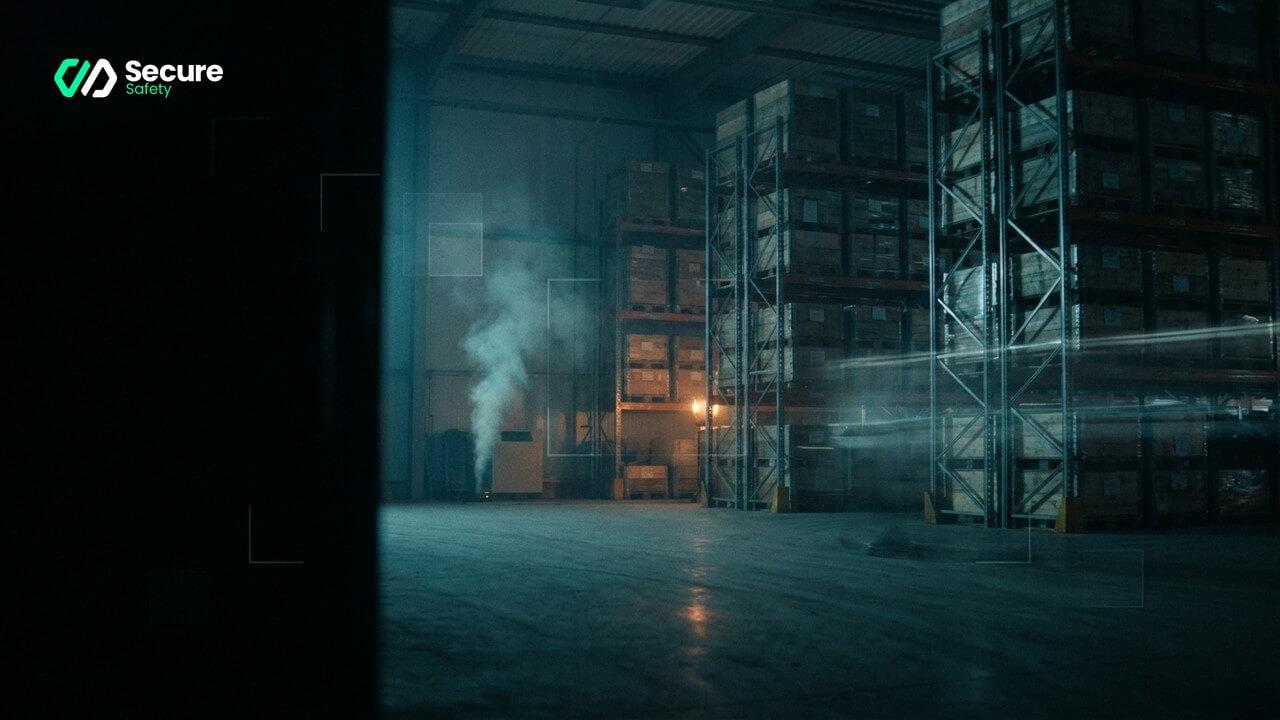
Every plant manager knows the sound they dread most. Not the alarm itself — the silence before it. A pallet of packaging smoulders in a far aisle. A frayed cable arcs behind a switchboard. For three, four, sometimes eight minutes, the fire is real but invisible to the building. It is producing heat and a thin grey ribbon of smoke, and not one sensor has noticed. The alarm, when it finally comes, is not the beginning of the emergency. It is the confirmation that you are already late.
This is the uncomfortable truth about most industrial fire protection. It is designed to react, not to watch.
Why traditional detection is always a step behind
A ceiling-mounted smoke detector is a patient device. It waits for combustion products to rise, travel across a wide volume of air, and accumulate at its exact position in sufficient concentration to trip. In a small office that takes moments. In a 12-metre-high warehouse, a turbine hall, or an open process area with forced ventilation, it can take minutes — and minutes are the entire game.
Heat detectors are slower still, by design. They will not respond until the fire is large enough to raise the temperature of a specific point on the ceiling. By then you no longer have an incipient fire. You have a fire.
The physics is unforgiving. Fire roughly doubles in size at regular intervals in its early growth phase. The gap between "a wisp near a pallet" and "a stack fully involved" is measured in seconds, and every one of those seconds you spend waiting for smoke to reach a sensor is a second you will never get back for evacuation, suppression, or a fire warden with an extinguisher.
Cameras see the fire where it starts
AI fire and smoke detection works from a different principle entirely. It does not wait for the fire to come to a sensor. It watches the place where the fire begins.
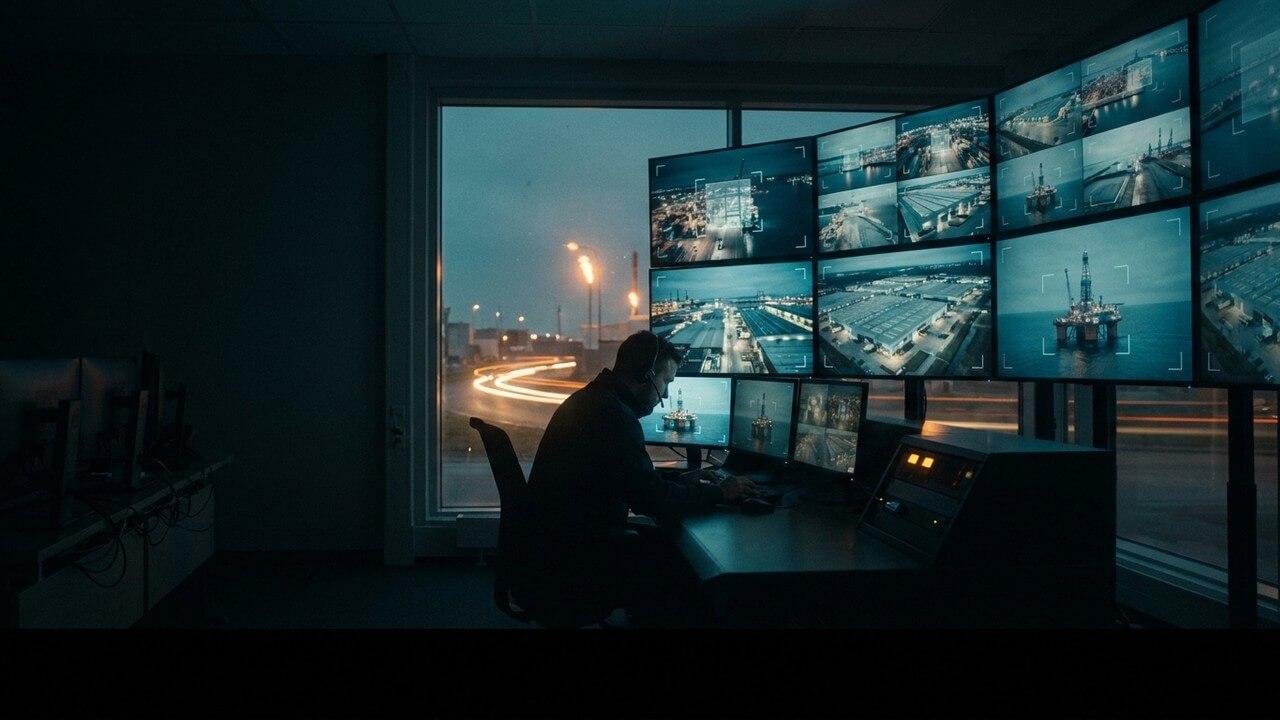
Your site is already covered by CCTV. Those cameras see the aisles, the racking, the loading bays, the electrical rooms, the yard. A computer-vision layer reads that same video feed, frame by frame, and looks for the visual signatures of fire long before a physical sensor could ever respond: the particular way smoke curls and disperses, its translucency and drift against a background, the flicker frequency and colour temperature of flame, the faint heat-shimmer above a hot surface.
Where a ceiling detector asks "has enough smoke reached me yet?", the camera asks "is that a wisp of smoke rising near the pallets?" — and it asks it thirty times a second, on every frame, across every camera, without blinking, without a coffee break, at three in the morning when the night shift is thin.
Because it is watching the source, it does not need the fire to grow first. It can raise the alarm at the first visible wisp, while the event is still small enough for one person with an extinguisher to end it.
Seeing what a smoke detector structurally cannot
Vision-based detection also reaches places conventional sensors struggle to serve. High-ceiling warehouses where smoke stratifies and never reaches the roof. Outdoor and semi-open areas — yards, jetties, fuel stores — where there is no ceiling to mount a detector on and the wind carries smoke away. Large volumes where a single point sensor is simply too far from too much. If a camera can see the space, the space can be watched.
Forged where getting it wrong is not an option
This capability was not built in a laboratory. It was proven offshore, on the drill floors of oil and gas operations — arguably the most demanding fire-risk environment there is, dense with hydrocarbons, heavy moving steel and zero tolerance for a missed event. Detection that earns its place there has to distinguish a genuine ignition from steam, exhaust haze, spray and the constant visual noise of a working platform. That same technology now runs in a national oil major's operations, a major international port and an international airport, holding a sub-0.05% error rate and, in the field, contributing to roughly 90% reductions in unsafe behaviour. It runs entirely on-premise. The footage of your site never leaves your site.
The false-alarm problem, honestly addressed
Every EHS leader reading this has the same instinct, and it is the right one: an early detector that cries wolf is worse than useless, because a team that learns to distrust the alarm will hesitate on the day it matters.
Naïve motion detection is exactly that problem. Sunlight through a doorway, a puff of exhaust from a forklift, dust kicked up by a sweeper, steam off a wash-down — each can look, to a crude system, like the start of a fire. This is precisely why a model trained on real industrial conditions matters more than the promise of "AI". Distinguishing genuine smoke from a hundred innocent look-alikes is the entire discipline. It is the difference between a warning your team acts on instantly and one they have quietly learned to ignore.
What early warning actually buys you
The value of AI fire detection is not really about the fire. It is about time — and what those extra seconds and minutes let human beings do.
- Intervene while it is still small. A wisp is an extinguisher job. A blaze is an evacuation and an insurance claim.
- Evacuate with margin. Earlier warning means calmer, safer movement of people, not a scramble.
- Protect assets and continuity. The difference between a scorched pallet and a gutted warehouse is measured in the minutes you claw back.
- See everywhere at once. Every camera becomes a fire sensor, including the corners a fixed detector never covered.
None of this replaces your alarm panel, your sprinklers, or your fire strategy. It works alongside them — as the early-warning layer that speaks first, at the wisp, so the rest of your systems and your people are never again the ones playing catch-up.
Fire does not announce itself politely. But it does show itself, in that first thin ribbon of smoke, to anything patient enough to be watching.
Where visual fire detection adds the most value by site type
High-bay warehousing and distribution
The physics of smoke in a high-bay warehouse make conventional detection particularly slow. A 12-metre ceiling means smoke must rise through 12 metres of air before reaching a detector — during which time the fire has been growing, undetected, at the base of the stack. Camera-based detection watches the floor level, where the fire starts, and can recognise the visual signature of incipient smoke within seconds of ignition regardless of ceiling height. In warehousing environments with lithium-ion battery charging stations — an increasingly common fire hazard in logistics facilities — the early detection window is the critical advantage: lithium battery fires progress extremely rapidly once ignition occurs, and early detection is the difference between a fire extinguisher response and a full evacuation.
Manufacturing and process facilities
Manufacturing environments add the challenge of distinguishing fire signatures from process-related smoke, steam, and exhaust. The models behind visual fire detection were trained on industrial environments with exactly this noise — the exhaust from a forklift propane system does not look the same to a trained model as incipient smoke from smouldering packaging, even though both appear similar to an untrained eye. Process-related visual noise is characterised during the Discovery phase so that the system can be calibrated to the specific conditions of the facility, minimising false alerts from normal operations while maintaining sensitivity to genuine ignition events.
Chemical and high-hazard facilities
Chemical facilities under DSEAR (Dangerous Substances and Explosive Atmospheres Regulations) have the most demanding early-detection requirement: a fire in a solvent storage area or a gas-containing process can escalate to an explosion within minutes of ignition. Camera-based detection in these environments is not supplementary to fixed detection but a critical additional layer that provides a visual confirmation and location reference that a point smoke detector cannot. The combination of early visual detection with automatic PA activation and fire response team notification compresses the response window to the point where suppression before escalation is achievable.
Implementation checklist for fire and smoke detection
- Camera coverage audit: identify the highest-risk areas for fire (electrical rooms, battery charging areas, chemical storage, high-value stock areas) and confirm camera coverage of each — add cameras to critical areas without coverage
- Background characterisation: during the Discovery phase, identify sources of visual noise (process steam, exhaust, dust) in the monitored areas that will need to be characterised so the system can distinguish them from genuine smoke
- Alert routing to fire response team: ensure the fire alert goes directly to the person or team responsible for first response, not only to the control room, and that the routing includes out-of-hours coverage for night shifts and weekends
- Integration with fire alarm panel: define how the camera-based detection relates to the existing fire alarm panel — most deployments use camera detection as an early-warning layer that allows the control room to investigate before the panel triggers the full evacuation alarm, buying time for a controlled response
- PA and evacuation integration: if PA-based early warning is desired, define the zones and the message for each area — a fire alert in the battery charging area should trigger a different PA response than one in the loading bay
- False alert response protocol: agree in advance what the control room does with a fire alert — how they verify it using the camera clip, when they escalate to a full evacuation versus a targeted investigation, and how false positives are logged and reviewed
Common challenges and solutions
Challenge: Steam and dust generating false alerts
This is the most common challenge in industrial fire detection, and it is solved by site-specific model calibration during the Discovery phase. The model is exposed to the specific visual noise patterns of the site before go-live, allowing it to characterise and suppress normal process-related visual events while remaining sensitive to genuine smoke signatures. Sites with particularly challenging environments (steam-intensive food processing, high-dust aggregate handling) may benefit from a longer calibration period or additional camera angles that provide clean background separation.
Challenge: Night-shift detection in low-light or infra-red camera environments
Many industrial sites run infra-red cameras for night vision coverage. Fire detection on IR camera feeds uses different signature characteristics than on standard colour cameras — the flame colour signal is absent, and detection relies on the visual motion and pattern of smoke in the IR image. The Discovery phase identifies the camera types on site and confirms the detection approach for each. For sites with a mix of IR and colour cameras, detection is calibrated per camera type.
Challenge: Integration with an existing fire safety regime
Large sites typically have a fire safety regime already in place — fixed detection, a fire alarm panel, an evacuation procedure and a fire warden network. Visual fire detection adds a layer to this regime rather than replacing any of it. The integration challenge is defining how the camera-based early warning relates to the existing procedure: specifically, what actions the control room takes in the window between a camera alert and a potential panel alarm, and how that is documented in the site fire safety log. This is a procedural and documentation question more than a technical one, and it is addressed during the Discovery phase.
See what your cameras have been missing — book a demo.