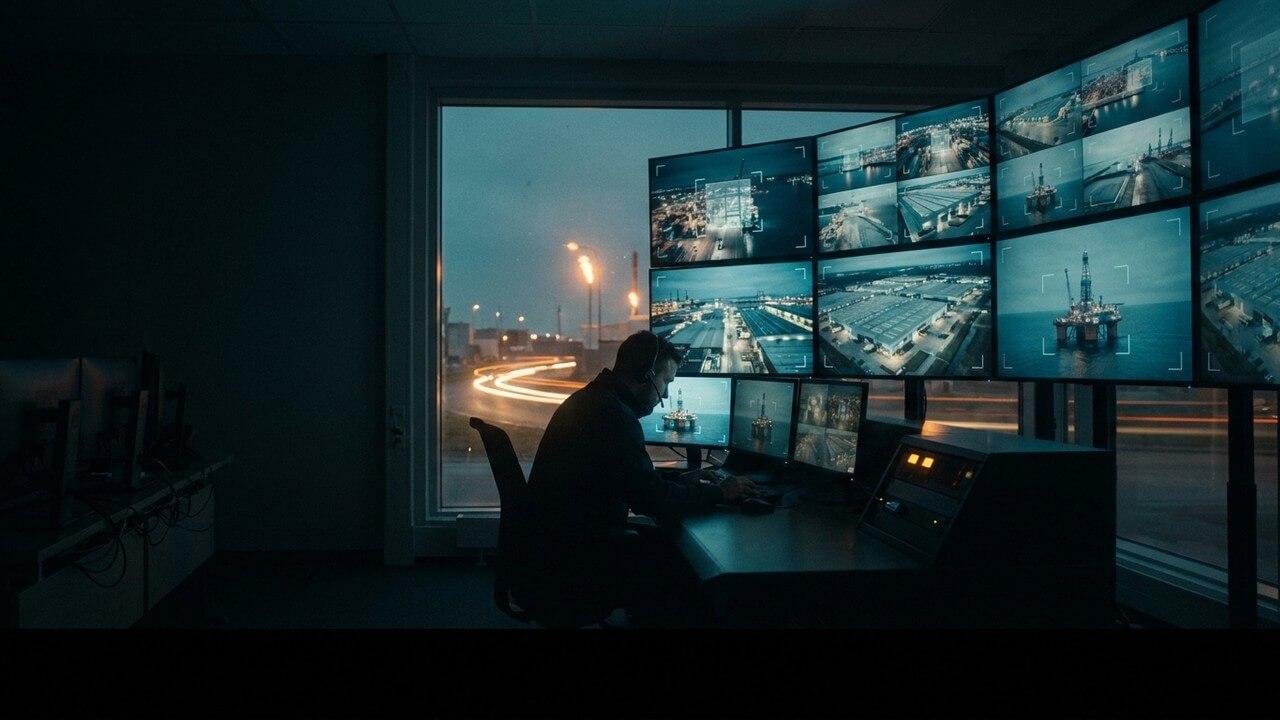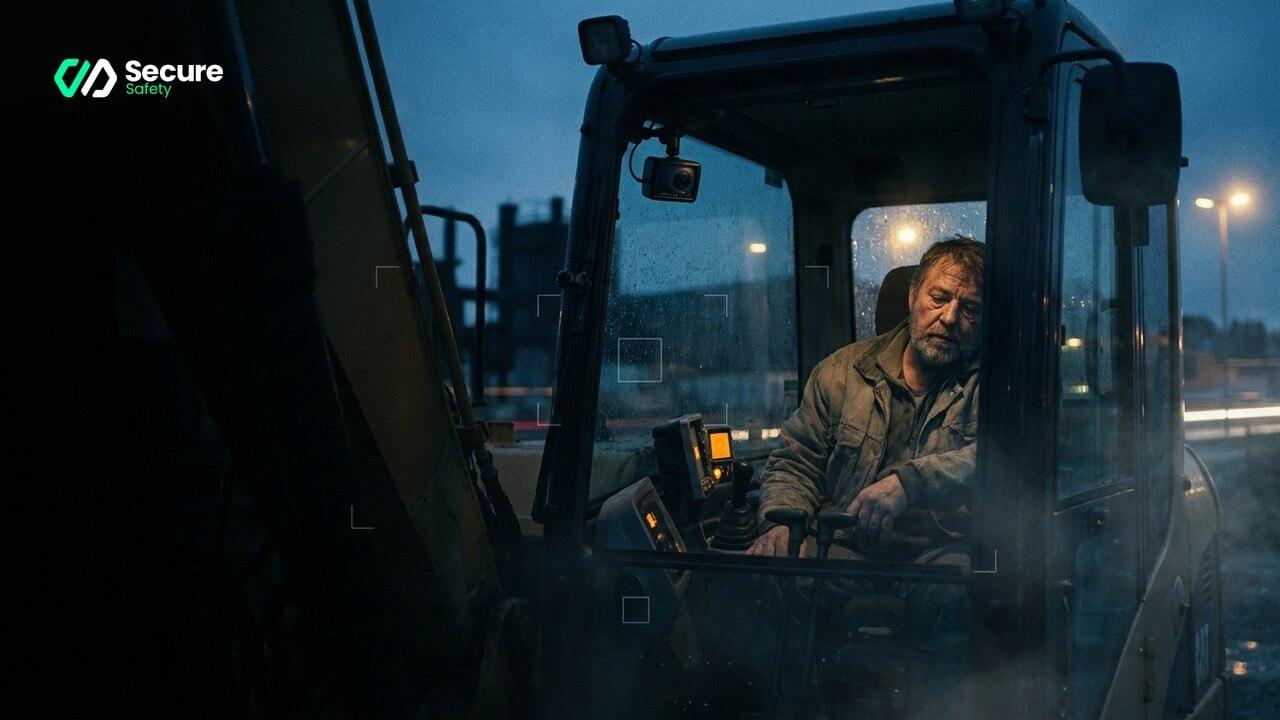
It lasts perhaps three seconds. A crane operator on the back half of a double shift feels his eyelids grow heavy, and for three seconds the world goes dark behind them. He does not slump. His hands stay on the levers. To anyone watching the yard below, nothing has happened. But for the length of those three seconds, the man in control of forty tonnes of moving steel was, in every meaningful sense, asleep.
This is the microsleep, and it is one of the most under-recognised hazards in heavy industry. It leaves no skid marks and no witnesses. It does not show up on a timesheet or a toolbox talk. And it is happening, right now, in cabs and control rooms across every sector that runs shifts through the small hours.
Why fatigue is the hazard no one clocks
Most safety systems are built to catch things that are obvious after the fact. A missing helmet. A person in a red zone. A speeding vehicle. Fatigue is different. It is invisible until the moment it isn't, and by then the incident has already begun.
The physiology is unforgiving. After roughly seventeen hours awake, human performance degrades to a level comparable with being over the legal drink-drive limit. A worker who has slept badly, commuted an hour, and is now four hours into a night shift is not a marginal risk. He is impaired, and he almost certainly doesn't feel it. That is the cruelty of fatigue: the more tired you are, the worse you become at judging how tired you are.
Inattentiveness is fatigue's quieter cousin. It doesn't require sleep debt at all. It is the operator glancing repeatedly at a phone, the driver whose head has turned away from the road for longer than the task allows, the monitor watching a bank of screens whose gaze has simply drifted. The result is the same: a person nominally in control who is, for critical seconds, not paying attention to the thing that can hurt someone.
What the eyes give away
The reason artificial intelligence can catch what a supervisor cannot is that fatigue and inattention have reliable physical tells, and cameras never blink.
The most studied is eye closure. A metric known as PERCLOS — the proportion of time the eyes are closed over a rolling window — is one of the most validated indicators of drowsiness in the human-factors literature. A momentary blink is nothing. Eyelids that stay at half-mast, or that close for longer and longer intervals, are a signature no amount of willpower fully hides.
There are others. The slow, heavy nod of the head as it drops and jerks back. The rate and duration of blinks lengthening as the brain fights to stay online. The frequency of yawns. For inattention specifically, the direction of the gaze and the angle of the head: how long, and how often, the operator is looking away from where the task demands.
None of these is conclusive on its own. Read together, in real time, they draw a remarkably clear picture of a person losing the fight to stay alert — minutes before that person would ever admit it, and long before a colleague across the yard could possibly notice.
From private tell to timely nudge
Detection is only useful if something happens with it. The point of an AI fatigue system is not to build a dossier on tired workers. It is to intervene inside the window that matters.
When the pattern crosses a threshold — eyes closing too long, head nodding, gaze off-task past a set tolerance — the system raises an alert in the moment. That might be a discreet prompt to the operator to take a break, a notification to a control-room supervisor, or an entry in a shift-fatigue log that helps managers see which rosters and which hours are quietly grinding people down. The best outcome is the boring one: a tired operator stands down for ten minutes and nothing happens at all, because nothing was allowed to.
This is also where the question of trust arrives, and it deserves a straight answer. A camera trained on a worker's face is a serious thing. It works only where the intent is unambiguous — protecting the operator, not policing them — and where the data stays where it belongs. Our platform runs entirely on-premise. The footage never leaves the site; it is analysed on the customer's own infrastructure, the alert is raised, and nothing is shipped to a cloud or a third party. Fatigue monitoring done any other way is not worth the mistrust it earns.
Proven where the margins are thinnest
We did not learn this in a laboratory. The detection was forged offshore, on the drill floors of oil and gas — an environment with heavy moving equipment, round-the-clock shift patterns, and no tolerance for a lapse. It has since run in the operations of a national oil major, at a major international port and at an international airport, at a sub-0.05% error rate, and it has been field-measured to cut unsafe behaviour by roughly ninety per cent. When the cost of a missed microsleep is measured in lives, the system has to work at three in the morning, not just in a demonstration. That is the standard it was built to.
The layer you already have the cameras for
Perhaps the most persuasive thing about vision-based fatigue detection is what it does not require. No wearables to charge and lose. No steering-wheel sensors to retrofit. No new hardware bolted into cabs. It adds a software layer to the CCTV a site already runs — the same cameras that watch for red-zone entry and PPE compliance can watch for the operator who is fading.
The microsleep will always be invisible to the human eye. It is over before anyone could shout. But it is not invisible to a system that watches the eyes themselves, patiently, every second of every shift, and speaks up in the three seconds that count.
Fatigue detection in industrial operations: the specific use cases
Machine operator stations
The highest-value application of fatigue and inattentiveness detection is at machine operator stations where a lapse in attention has an immediate consequence. A conveyor sorter operator who loses focus at a reject station creates a different risk from an office worker who loses concentration. A forklift driver who is nodding off in the cab is a risk to everyone in the yard. Camera monitoring of operator posture, head position and eye direction at machine stations — detecting the characteristic signs of fatigue before the operator becomes fully non-responsive — provides a precursor alert that allows a supervisor to initiate a rest break before an incident occurs.
Drill floor and offshore watch-keeping
Offshore watch-keeping operations are subject to the fatigue management requirements of the Maritime Labour Convention and sector-specific guidance from the Oil & Gas UK safety guidelines. AI-based fatigue detection at watch-keeper stations on offshore rigs provides objective monitoring of the fatigue state of personnel at critical control positions, supplementing the subjective peer observations that watch-keeping arrangements rely on. The detection capability developed for the offshore environment translates directly to any industrial control room or monitoring station where continuous watch-keeping is required.
Night shift management
Fatigue-related incident rates peak in the early morning hours of night shifts — typically between 3am and 5am — and in the late afternoon of the following day. AI monitoring that is calibrated to detect fatigue signals at these high-risk periods, and that routes alerts to the on-call supervisor for prompt follow-up, provides a monitoring layer that self-activates at the times when human supervisory cover is thinnest and the fatigue risk is highest.
Implementation considerations for fatigue detection
- Camera placement at operator stations: fatigue detection requires a camera positioned to capture the operator's face and posture — forward-facing at the station, not side-angled or overhead; the Discovery phase confirms the camera position for each monitored station
- Baseline characterisation: fatigue detection models need to be calibrated to the normal posture and movement patterns of operators at each specific station type — a conveyor operator and a forklift driver have different normal head and body positions; calibration is part of the commissioning process
- Alert routing and response protocol: a fatigue alert should route to the supervisor responsible for the affected operator's welfare, with a defined response protocol that prioritises worker support over disciplinary action — the response to a fatigue alert is a welfare check, not a disciplinary event
See what your cameras have been missing — book a demo.