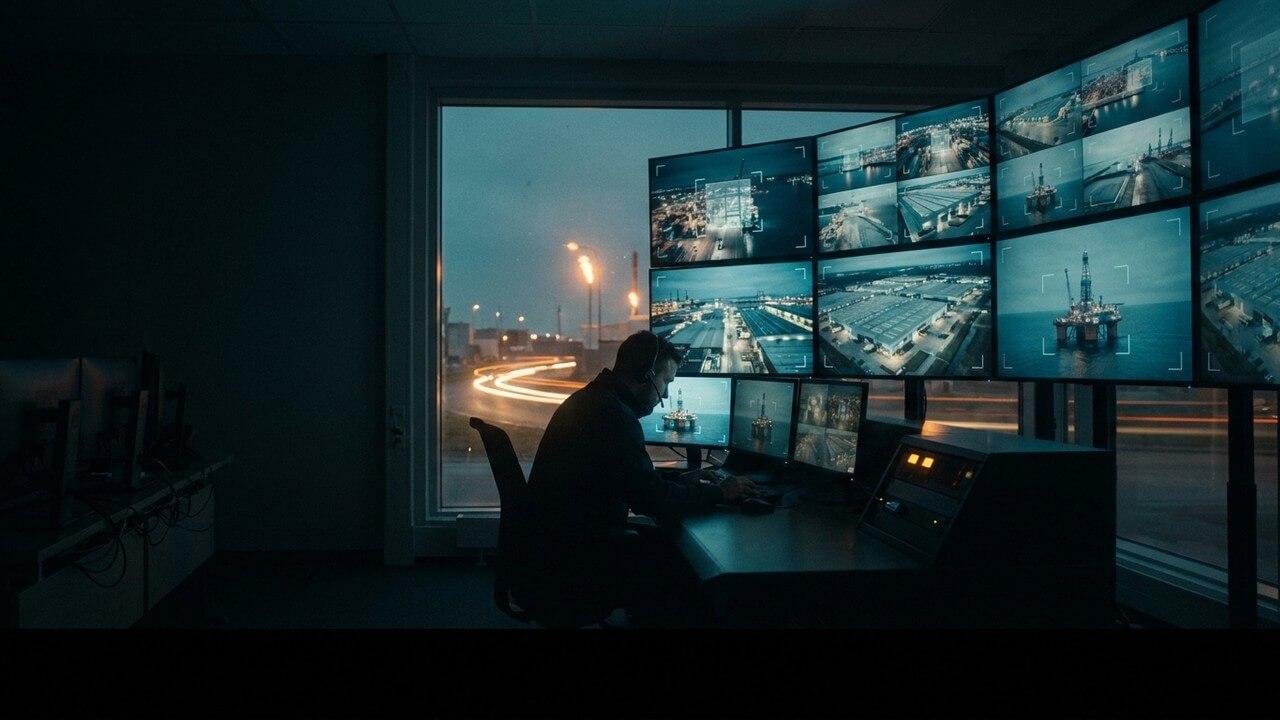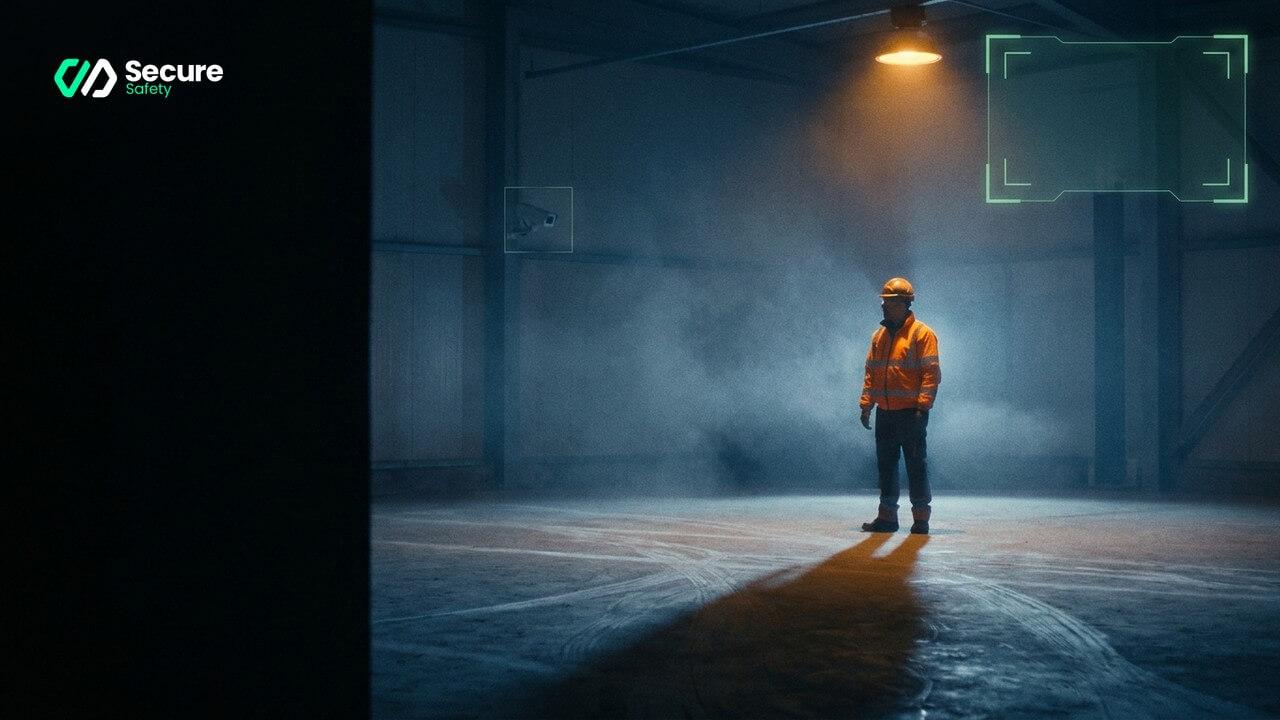
It is 2 a.m. in a water treatment plant on the edge of town. A single maintenance technician has come in to clear a fault on a pump. The lights are on only where he stands. The car park holds one car. If he slips on a wet gantry, or the confined space he is inspecting quietly fills with gas, there is no colleague to hear him fall, no supervisor to raise the alarm. He is entirely alone — except for the camera on the wall above him, which, until recently, was simply recording a scene that no one would watch until Monday.
That gap between something going wrong and someone knowing about it is the whole of the lone worker problem. And for most of industrial history, we have tried to close it with procedure: check-in calls, buddy systems, panic buttons worn on a lanyard. These help. But they all share a fatal assumption — that the worker in trouble is still conscious and able to act.
The moment a worker cannot call for help
The dangerous incidents are precisely the ones that take the worker's ability to summon aid. A fall from a ladder. A cardiac event on a night shift. A blow to the head. A slow slide into unconsciousness from a leak they never smelled. In each case the man-down alarm on the belt is only as good as the hand that can press it — and by definition, that hand often cannot.
This is why lone worker monitoring built purely on wearables leaves a hole in the middle. The technology waits to be triggered. What is missing is something that watches continuously and reasons about what it sees, so that the absence of a signal is itself a signal.
Turning the cameras you already own into a witness
Most sites already have the answer bolted to their walls. CCTV is nearly universal in industrial premises, yet it spends almost all of its life as a passive archive — useful for the inquiry after the event, useless during it. Lone worker safety AI changes the tense of the camera from past to present.
By adding a computer-vision layer to existing cameras — no new hardware, no cabling, no rip-and-replace — the feed becomes an active observer. The system understands the difference between a person crouching to work and a person who has collapsed. It knows when someone has been motionless on the floor for longer than any task would explain. It sees a worker enter a restricted zone alone, or approach moving plant with no one nearby to intervene. And when it sees these things, it does not file them away. It raises the alarm in seconds, to a phone, a control room, or a duty manager who may be miles away.
This is remote worker detection in the literal sense: the ability to know the state of a person on an unmanned site without a human being there to look.
What the machine actually watches for
The value is not one clever trick but the breadth of what a single camera feed can now interpret:
Falls and person-on-the-ground
The clearest lone-worker case. The system distinguishes a genuine collapse from ordinary crouching or kneeling, and flags a body that stays down. In an empty building at night, those seconds are the difference between a rescue and a fatality.
Prolonged inactivity in the wrong place
A worker slumped at a control desk, or motionless in a walkway, reads as an anomaly against the normal rhythm of movement. The camera notices stillness that a human observer, watching forty screens, never would.
Hazard proximity when no one can intervene
Approaching energised equipment, straying into a red zone, working at height with no spotter — behaviours that are merely risky with a colleague present become acute when the worker is alone. The system weights them accordingly.
Fire, smoke and environmental change
On an unmanned site, a small fire has hours to grow before anyone arrives. Visual fire and smoke detection shortens that to the moment of ignition.
Forged where being alone is most unforgiving
This capability was not built in a laboratory. It was proven offshore, on the drill floors of oil and gas operations — an environment of heavy moving equipment, unforgiving weather and zero tolerance for error, where a person out of position for a few seconds can be a person about to be hurt. From there it has been deployed across a national oil major's operations, a major international port and an international airport, running at a sub-0.05% error rate and, in the field, cutting unsafe behaviour by around 90%. The discipline required to watch a drill floor is exactly the discipline a lone worker deserves: patient, accurate, and awake at 2 a.m.
Privacy, and the objection you should raise
Any honest discussion of watching workers must address the discomfort of being watched. It is a fair objection, and the architecture answers it directly. The detection runs on-premise. Footage is processed on site and never leaves it — nothing is streamed to a cloud, sold, or pooled. What travels off site is not video but an alert: a signal that a person may need help, at the moment they need it.
There is a version of this technology that is surveillance. This is not that. The purpose is narrow and stated plainly — to notice when a lone worker is in trouble and to raise the alarm faster than a human rota ever could. A worker on a night shift is not being policed. He is being accompanied.
From archive to guardian
The cameras on your walls have always seen everything. They simply had no way to understand it, and no one watching in real time. Closing the lone worker gap does not require a new control room or a bank of night-shift monitors. It requires giving the eyes you already own the judgement to know when something is wrong, and the reflex to speak up.
For the technician clearing a fault at 2 a.m., that is the whole difference — not a camera that will explain, on Monday, how he came to be lying there, but one that noticed on Saturday night and sent help while it still mattered.
Lone worker protection in practice: what a complete solution looks like
The three layers of lone worker monitoring
Effective lone worker protection for an industrial environment requires three layers working together. Camera coverage provides continuous visual monitoring of the areas where lone workers typically operate. Wearable devices provide man-down detection, no-motion alerts and panic alarm for workers who move beyond camera coverage. Check-in systems provide periodic confirmation of worker status for workers in areas where neither camera nor wearable can provide continuous monitoring. The Discovery phase for a lone-worker deployment identifies which combination of layers is appropriate for each area of the site and each category of lone worker.
The cold-store scenario
Cold stores are the highest-risk lone-worker environment in most logistics and food processing operations. The combination of low temperatures (which accelerate physiological deterioration after a fall or medical event), skeleton crew operation, and the routine nature of stock-checking tasks that workers carry out alone creates a scenario where extended undiscovered incidents are more likely and more harmful than in an ambient temperature environment. Check-in intervals for cold-store lone workers should be shorter — 5-10 minutes — than for ambient environments, and the alert escalation from a missed check-in should be faster.
Remote and field-based workers
For utilities, infrastructure and field-maintenance workers operating at remote sites or in the field, the challenge is not just detection but response time. A man-down alert from a worker in a remote substation means a significant travel time for the first responder. The monitoring system must therefore detect the event faster and escalate the alert more quickly to compensate for the longer response time. Wearable man-down devices with GPS location transmission, combined with automatic alerting to the nearest available responder rather than a central coordination point, is the appropriate architecture for genuinely remote lone-worker scenarios.
Implementation checklist for lone worker monitoring
- Lone worker register: create a formal register of all roles that involve lone working, categorised by risk level (high-risk: confined spaces, cold stores, remote locations; standard-risk: night shifts, remote areas of a larger site; low-risk: occasional solo tasks in a normally occupied area)
- Check-in interval by risk category: define the check-in interval for each risk category — this should be agreed with the safety team and with employee representatives before deployment
- Escalation chain per worker: define who receives the first alert when a lone worker misses a check-in, who receives the escalation if the first recipient does not acknowledge, and at what point external emergency services are contacted
- Wearable specification by environment: select wearable devices appropriate for the specific environmental conditions — cold-rated devices for cold store workers, ATEX-rated devices for chemical plant lone workers, ruggedised devices for outdoor or industrial maintenance workers
- Integration with shift end confirmation: define the process for confirming that a lone worker has safely ended their work session — a check-in system that monitors during a shift must also confirm the worker has left the monitored area safely at the end
See what your cameras have been missing — book a demo.