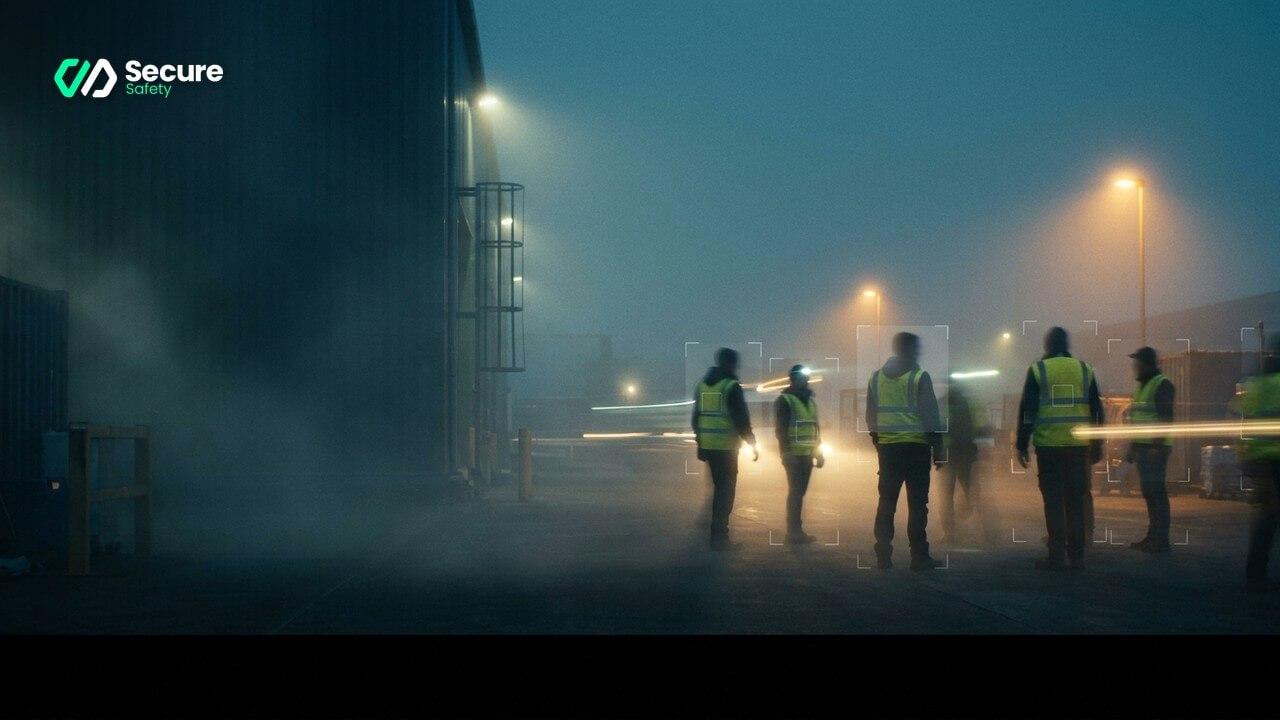
Every site manager knows the worst three minutes of a fire drill. The alarm sounds, people file out into the cold, and the wardens start counting heads against a clipboard. One list says forty-two. The other says forty-four. Somebody remembers that two contractors signed in at the gate but nobody saw them leave. And now, at the very moment you most need certainty, you have doubt — the question of whether to send someone back into a building you have just evacuated.
Counting people sounds like the simplest task in safety. It is, in practice, one of the hardest to get right when it matters most.
The roll-call gap
Most sites still reconcile who is present through a patchwork of methods: a sign-in book at reception, an access-control turnstile, a visitor log, a contractor permit, and the memory of whoever is holding the muster board. Each is accurate in isolation and unreliable together. People tailgate through doors. Badges get shared. Someone props a fire exit open and walks out a different way than they came in. By the time an emergency forces you to add it all up, the numbers have quietly drifted apart.
The gap between the roll and reality is not a paperwork problem. It is a decision problem. An accurate muster headcount tells the incident commander one thing they cannot get anywhere else: whether everyone is out. Get that wrong in either direction and the cost is severe — a search team sent into danger for someone who is already safe, or worse, an all-clear given while someone is still inside.
What AI people-counting actually does
AI people-counting adds a vision layer to the cameras you already have. It watches the frame, identifies each person as a distinct tracked object, and maintains a live tally — not a snapshot, but a running count that updates as people move through the scene. Point it at a muster point and it counts heads as they arrive. Point it at a doorway and it counts directional flow: in versus out. Point it at a zone and it tells you the occupancy of that zone, right now, without anyone clocking in.
Because it works on standard CCTV, there are no wearables to issue, no badges to scan, no app for a contractor to forget to install. A visitor who has never set foot on site is counted the same as an employee of twenty years. That matters, because the people most likely to be missed in an evacuation are precisely the ones outside your normal systems: delivery drivers, maintenance crews, the auditor who arrived that morning.
Three jobs, one capability
The same underlying count serves three distinct safety needs.
Muster and evacuation. During a drill or a real event, the system compares the number of people who have reached the assembly area against the number known to be on site. The reconciliation that used to take wardens several tense minutes becomes a live figure on a screen. If the count at the muster point is short, you know before you commit anyone to a search.
Occupancy monitoring. Many spaces carry a legal or practical limit on how many people may be inside — a confined workshop, a control room, a plant area under a permit, a venue floor. Continuous counting lets you hold that limit as a live threshold rather than an honour system, and to flag the moment a space tips over it.
Flow and density. Counting movement through choke points reveals where crowds build and where evacuation routes bottleneck. It turns your drill debriefs from anecdote into measurement — you can see exactly how long it took the north stairwell to clear.
Proven where the counting is hardest
This detection was not built in a laboratory. It was forged offshore, in oil and gas, on drill floors — an environment with heavy moving equipment, deep shadows, spray, shift changes in near-darkness and absolutely no tolerance for a miscount, because a helicopter evacuation depends on knowing exactly who is aboard. From there it went into a national oil major's operations, a major international port and an international airport, and has held a sub-0.05% error rate with field-measured reductions of around 90% in unsafe behaviour. A muster point in daylight is, frankly, an easier problem than a drill floor at night. If the counting holds there, it holds where you are.
The privacy question, answered plainly
Any system that watches people invites a fair question about surveillance. The honest answer is architectural. SecureSafety runs on-premise: the video is processed on your own site and never leaves it. What the system needs is a count and a position, not an identity — it distinguishes person from non-person, not one named individual from another. You get the operational truth of how many and where, without building a dossier on who. For a safety function, that is exactly the right trade: maximum situational awareness, minimum personal data.
From clipboard to live picture
The shift here is quieter than it sounds. You are not replacing your wardens or your procedures; you are giving them a source of truth they never had. The muster board stops being the primary record and becomes a cross-check against a count that has been running continuously, accurately, in every corner a camera can see.
Consider what that changes on the day it matters. The alarm sounds. People move to assembly. Instead of two wardens comparing two lists and arriving at doubt, the incident commander sees a single number climbing towards the number known to be on site — and the moment it matches, the all-clear is not a hope but a fact. If it stalls two short, the search is not a guess about the whole building; it is directed to the zone where the count says two people remain.
That is the real product of people-counting done well. Not data for its own sake, but the removal of doubt from the moment doubt is most dangerous. The clipboard asks you to trust a memory. A live count lets you know.
People counting across different operational contexts
Drill floor and offshore exclusions
People counting was one of the first operational capabilities developed for the offshore environment, where the number of personnel on the drill floor during specific operations is subject to strict limits. A drill floor in operation permits only a defined number of personnel in each zone, and the count must be maintained in real time as the operation progresses. The platform's people-counting capability on offshore deployments enforces both total headcount limits and role-specific counts (one toolpusher, two floormasters, defined number of helpers), alerting immediately when any limit is exceeded.
Confined space and permit-to-work integration
Confined space entries under the Confined Spaces Regulations 1997 require a known number of entrants at all times. Camera-based people counting at the confined space entry point provides an automated count of personnel currently inside, which can be compared against the permit-to-work register. A discrepancy between the registered entrant count and the camera-detected count — whether a person has entered without registering or the count has changed unexpectedly — is an immediate alert condition.
Emergency muster and headcount
The evacuation and mustering application of people counting is covered in the emergency response capabilities. The distinctive value in muster scenarios is speed: an automated count that updates in real time as people arrive at the assembly point removes the manual headcount step that is the main source of delay in a traditional evacuation. Combined with a personnel register, the system can present the emergency coordinator with a list of unaccounted personnel rather than a count discrepancy, accelerating the determination of whether a re-entry search is needed.
Implementation checklist for people counting
- Zone occupancy limit definition: for each zone where an occupancy limit applies, define the limit, the conditions under which it applies (all times vs. specific operations) and the alert threshold (alert at limit, or warn at 80% of limit)
- Camera coverage for counting accuracy: people counting accuracy depends on a clear overhead or angled view of all entry and exit points for the counted zone — confirm camera positions provide this before configuring the counting rule
- Role-differentiated counting: for zones with role-specific limits, define the visual identifiers (PPE colour, uniform type) that distinguish each role in the camera scene, and configure the count rule accordingly
- Muster zone camera survey: specifically for emergency mustering, confirm that muster areas have camera coverage that captures all arriving personnel — muster areas are often open outdoor spaces that may not have existing camera coverage
See what your cameras have been missing — book a demo.