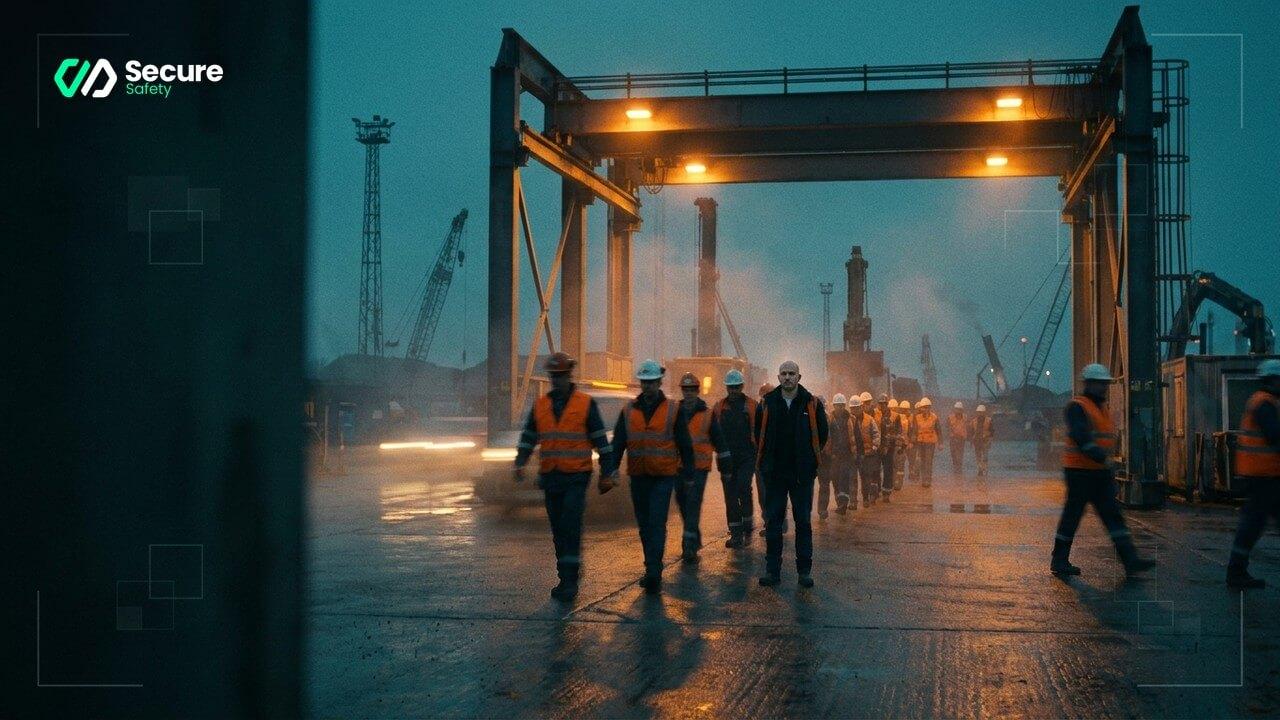
Every shift supervisor knows the feeling. It is 6:40 in the morning, forty people are streaming through the gate, and somewhere in that crowd is one man who left his hard hat in the cab, or a contractor whose high-vis is slung over his shoulder rather than on his back. You catch some of them. You cannot possibly catch all of them. And so the day begins, as most days do, with a small silent gamble: that the one you missed will not be standing under the wrong load at the wrong moment.
PPE is the last line of defence a worker has when everything else has failed. Yet enforcing it is left almost entirely to human eyes that are tired, distracted, and outnumbered. This post is about closing that gap.
Why PPE compliance is so hard to hold
The rules themselves are not complicated. Hard hats in the yard. High-vis on the ground. Gloves on the line, glasses at the grinder. Any competent worker can recite them.
The difficulty is not knowledge. It is consistency, across hundreds of people, thousands of movements, and every hour of every shift.
Consider the ways compliance quietly erodes:
- The habituation problem. A vest worn every day for ten years stops feeling like safety equipment and starts feeling like a uniform. People take it off when it is hot, or when the job is "only two minutes".
- The blind-spot problem. A supervisor can watch one entrance or one work front. The moment their back is turned, the standard drifts.
- The visitor and contractor problem. The people least familiar with your site rules are often the ones moving through it, and they are the hardest to police.
- The evidence problem. When an inspector or an insurer asks how you know compliance is being maintained, "we tell everyone at induction" is not an answer that holds up.
Toolbox talks and posters raise awareness. They do not create eyes. And awareness, on its own, has never stopped a helmet from being left in a locker.
What AI PPE detection actually does
Automated PPE detection is a computer-vision layer that watches your existing CCTV and understands what it is seeing. It does not simply record; it recognises.
For each person in frame, the system asks a series of plain questions. Is there a head? Is there a hard hat on that head? Is the torso covered by high-vis? It answers many times per second, on every camera at once, and it never blinks, never gets bored, and never looks the other way because it is nearly the end of the shift.
When someone crosses into a hard-hat zone without a hard hat, the system flags it in real time. That flag can drive a discreet alert to a supervisor's phone, a message on a display board at the entrance, or an entry in a compliance log, depending on how you want to run your site. The point is that the gap between non-compliance and someone knowing about it shrinks from hours, or never, to seconds.
Two things matter about how this is built. First, it runs on the cameras you already own, so there is no new hardware to bolt to gantries and no capital project to approve. Second, it runs on-premise. The footage never leaves your site, which keeps both your security team and your workforce comfortable that this is a safety tool, not a surveillance one.
Detection that survives the real world
A demo in a clean room proves nothing. The hard part of PPE detection is the ordinary chaos of an industrial site: rain on the lens, low winter light, a worker half-hidden behind a pallet, a vest that has faded to the colour of the wall behind it, a hat tilted at an angle no training image ever captured.
This is where the pedigree of the detection matters. Ours was forged offshore, on the drill floors of oil and gas — an environment with heavy moving steel, zero tolerance for error, and lives in the balance on every tour. It has since run in national oil-major operations, a major international port and an international airport, holding a sub-0.05% error rate and, on sites that have measured it, reductions of around 90% in unsafe behaviour. A system that can pick out a missing helmet through sea spray on a pitching platform handles a warehouse entrance without breaking stride.
From catching people to changing behaviour
It would be easy to imagine this as a machine for issuing reprimands. The more interesting outcome is quieter, and more valuable.
When people know, calmly and consistently, that PPE lapses are noticed every single time, the lapses stop. Not because anyone is punished, but because the social physics of the site changes. The vest goes back on because putting it on is simply what happens here now. Enforcement that is perfectly consistent, and visibly not personal, does what sporadic human enforcement never can: it makes the safe choice the default choice.
There is a management dividend too. Instead of arguing about whether compliance is "generally pretty good", you have a number. You can see which gate, which shift, which contractor firm accounts for most of the lapses, and you can direct your attention where it will actually move the figure. Safety stops being a matter of impression and becomes a matter of record — which is precisely what an inspector, an insurer or a board wants to see.
The honest limits
AI PPE detection is not a replacement for a safety culture, and any vendor who tells you it is deserves suspicion. It will not conduct your risk assessments or run your toolbox talks. It watches for the specific, visible failures it has been trained to see, and it hands that information to the people whose job is to act on it.
What it removes is the impossible expectation that a handful of supervisors can watch everyone, everywhere, all the time. It gives them a tireless second set of eyes, so that the daily gamble stops being a gamble at all.
Your cameras are already pointed at the problem. They just cannot see it yet.
How PPE detection applies across different industrial sectors
Offshore oil and gas
Offshore PPE requirements are among the most complex in any industry: hard hat colour-coding by role and watch, specific coverall classes by task area, harness requirements that change based on whether a worker is on the main deck, the drill floor, or above the handrail height. A system that can only detect "wearing/not wearing a hard hat" is insufficient for an offshore environment where the colour of the hat indicates role classification and access rights. SecureSafety verifies hard hat colour, coverall type, harness presence, and eye and ear protection simultaneously, enabling the full offshore PPE scheme to be enforced on every camera from a single deployment.
Chemical and process industries
Chemical processing facilities frequently require zone-specific PPE that goes beyond standard hard hat and hi-vis: chemical-splash goggles and face shields, respirators in certain atmospheres, specific glove classes for corrosive material handling, chemical-resistant boots and coveralls. The zone-specific rule configuration allows each of these requirements to be enforced at the correct camera zone, with different rules for the general plant area, the chemical storage zone, and the emergency shower area. COSHH (Control of Substances Hazardous to Health) compliance documentation is supported by the continuous compliance log.
Construction sites
Construction sites present the challenge of a constantly changing workforce: the number of workers on site varies daily, contractors rotate frequently, and the hazard profile of different areas changes as the project progresses. AI PPE monitoring handles this without needing to register individual workers — it checks every person in frame against the rule for the zone they are in, regardless of their employer or their previous visits. This makes it particularly effective for contractor PPE enforcement, which is consistently the weakest link in construction site compliance programmes.
Implementation checklist for PPE detection deployment
- Zone PPE rules matrix: before configuring the system, create a written matrix of each camera zone and the specific PPE items required in it — this becomes the configuration reference document
- Colour code documentation: document the full colour code scheme for your site (hard hat colours by role, vest colours by tier, etc.) so the system can be calibrated to enforce it correctly
- Camera placement review: PPE detection accuracy depends on the camera angle relative to the worker — a camera directly above an entry point provides better head-and-shoulder coverage than one mounted at the far end of an aisle; the Discovery phase reviews placement and recommends changes where needed
- Visitor and contractor briefing update: update the site induction for visitors and contractors to explain that PPE compliance is monitored automatically on every entry, not by periodic supervisor checks
- Non-compliance response process: define the response when a non-compliance alert fires — who acknowledges it, how the worker is contacted, whether the alert is closed-out in the system, and how repeat non-compliance is escalated
- Compliance reporting cadence: agree the frequency and format of compliance reports — daily for supervisors, weekly for site management, monthly for the board — and define the format that maps to your existing safety reporting structure
Common challenges and solutions
Challenge: Workers wearing non-standard PPE that is technically compliant but looks different from the training data
On sites where workers source their own PPE or where different contractor firms use different brands, the visual appearance of compliant equipment can vary significantly. The system handles this through the characterisation phase during Discovery, where examples of the specific PPE items used on the site are provided to improve model accuracy for those items. For sites with very non-standard equipment, a short on-site model refinement period during the pilot phase addresses the gap.
Challenge: Low camera resolution at long range from gate entry points
Some gate entry cameras are positioned to cover a wide field of view, which reduces the effective resolution of a single worker at a distance. The Discovery phase assesses resolution adequacy for each camera and identifies where either a supplementary close-up camera at the entry point, or a change in camera angle, would improve detection accuracy. In practice, most modern IP cameras provide adequate resolution for PPE detection at standard gate entry distances.
Challenge: Night shift PPE enforcement with IR cameras
Infrared cameras in night mode present different image characteristics for PPE detection: colour-coded items lose their colour information, and the detection must rely on shape and texture rather than colour. For sites with colour-coded PPE schemes that need to be enforced on IR camera feeds, the Discovery phase determines the best approach — which may be IR-compatible verification logic, supplementary white-light cameras at key entry points, or a modified compliance rule that focuses on item presence rather than colour during hours when IR cameras are active.
See what your cameras have been missing — book a demo.