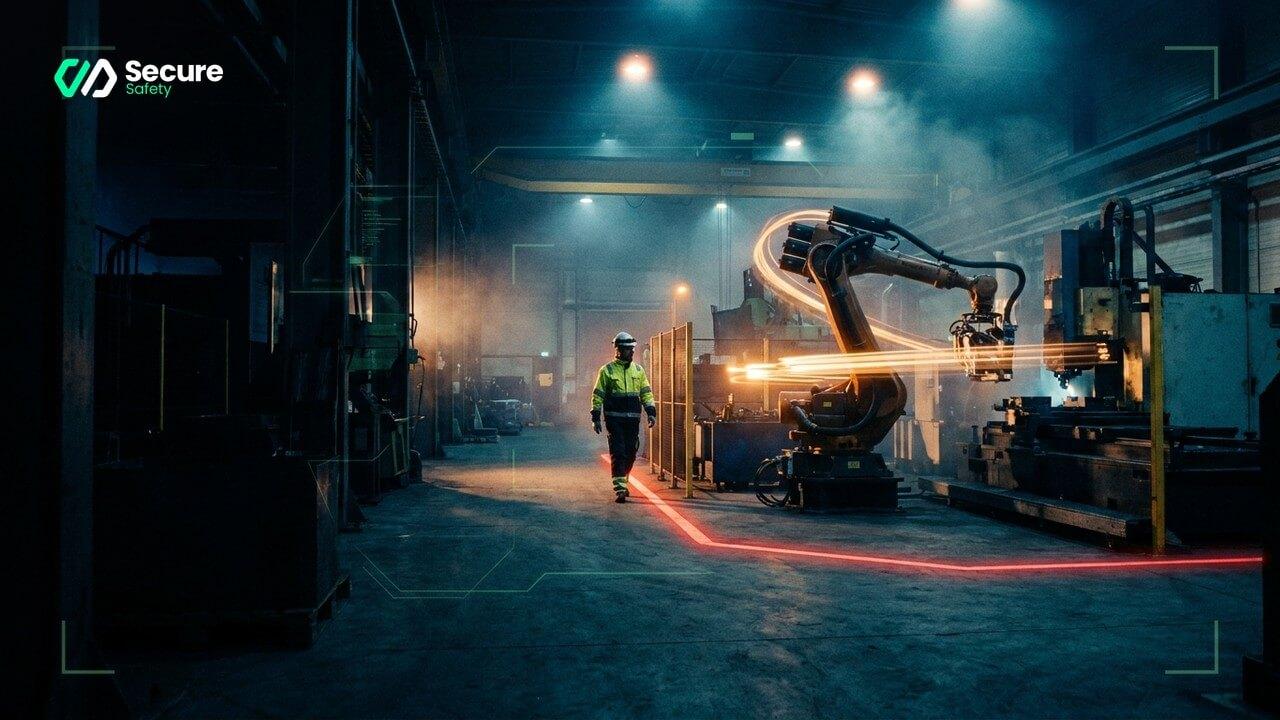
Every plant manager knows the line. It is painted on the floor in yellow and black, or marked with chain and a swing gate, or fenced with mesh and a laminated sign that has faded in the sun. On one side, ordinary work. On the other, a robotic cell mid-cycle, a press that cannot see, a slew crane arcing through its radius, a tank being purged of gas. The line is the difference between a normal Tuesday and a fatality.
The trouble is that a painted line has no memory, no voice, and no way to stop anyone. It relies entirely on the person about to cross it being alert, trained, unhurried and unhurt. On a good day that is enough. On the day someone takes a shortcut to save ninety seconds, or reaches past the barrier to clear a jam without isolating the machine, the line does nothing at all.
Why exclusion zones fail quietly
Restricted areas are not defeated by bad workers. They are defeated by good workers under pressure. The maintenance technician who steps inside the guard because the fault is intermittent and shutting the whole cell down means a two-hour restart. The banksman who drifts under a suspended load because that is where the best view of the landing is. The contractor who has never worked this site and does not yet know which yellow line is decorative and which one will kill him.
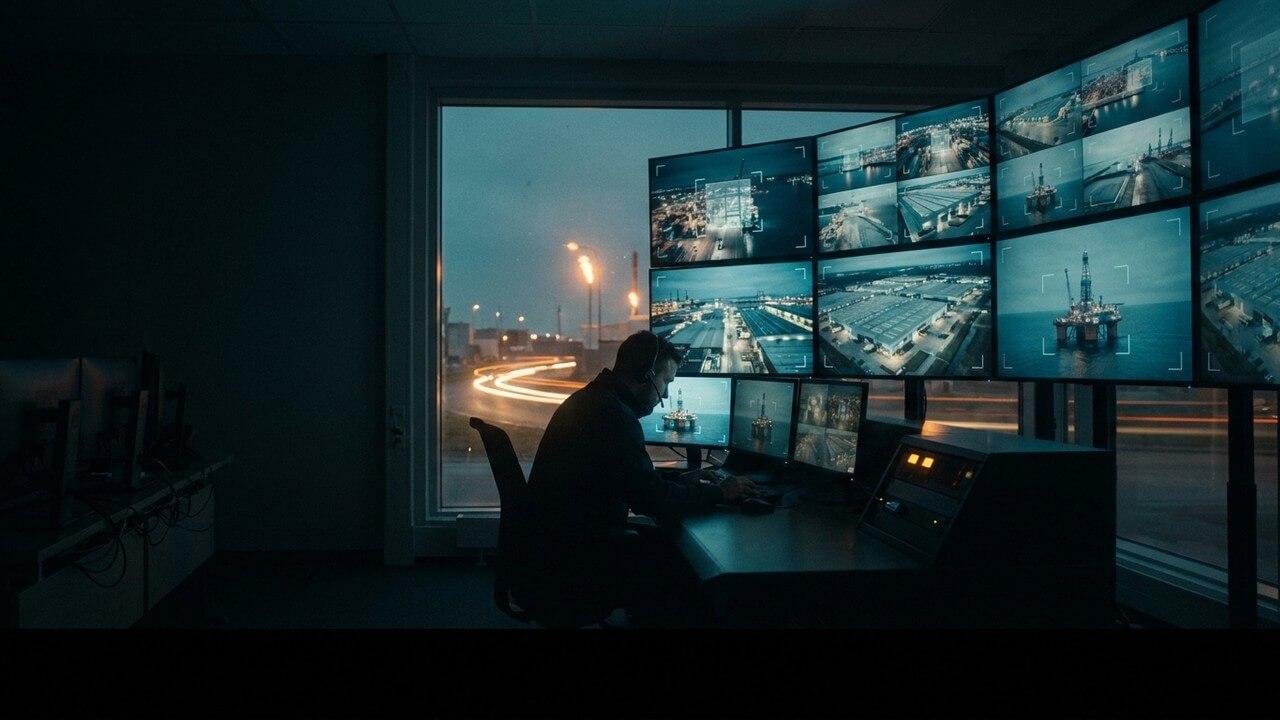
Static controls assume a level of constant vigilance that human beings cannot sustain across a twelve-hour shift. Interlocks and light curtains help, but they protect a machine, not an area, and they are routinely bypassed when they get in the way of production. CCTV records the breach beautifully — in high definition, from three angles — but only after it has happened, which is to say, too late to matter.
What AI restricted-zone monitoring actually does
This is the gap that AI restricted-zone monitoring is built to close. Rather than adding another physical barrier, it adds perception to the cameras you already have.
You define the zone once. Using a live camera view, you draw the boundary of a red zone, an exclusion radius, or a geofenced corridor directly onto the image — the digital equivalent of the paint on the floor, except this line watches back. From that moment the system continuously detects any person who enters, approaches, or lingers inside the area, and it does so in real time, frame by frame, without ever blinking or looking away.
When someone crosses, the response is immediate. An alert goes to the control room, a supervisor's phone, or a local beacon and sounder at the zone itself. The intervention happens in the seconds that decide the outcome, not in the incident review three weeks later.
Because the intelligence lives in software, the same camera can enforce rules that a physical barrier never could. A zone can be active only while a machine is energised and open the rest of the time. It can distinguish a momentary crossing from someone who has settled in to work where they should not be. It can hold different rules for different areas on a single site — a hard exclusion around the robot, a warning threshold around the forklift lane, a headcount limit inside the confined space. None of that requires a new gate. It requires software that understands what it is looking at.
Proven where the margin for error is smallest
It is worth saying where this capability was hardened, because restricted-zone monitoring is only as good as the environment that shaped it. Ours was forged offshore, on the drill floors of oil and gas — an environment with heavy iron in constant motion, overlapping red zones, and no tolerance for a false sense of safety. The discipline of watching a moonpool or a rotating table, where a single misstep is fatal, is unforgiving in a way that few industrial settings match. That work is now proven across a national oil major's operations, a major international port and an international airport, running at a sub-0.05% error rate and delivering field-measured reductions of around 90% in unsafe behaviour. A line that holds on a pitching rig will hold on your factory floor.
Fewer false alarms, more trust
The fastest way to kill a safety system is to cry wolf. A zone monitor that fires every time a shadow moves or a pallet is set down is switched off within a week, and rightly so. The value is not in raw detection but in accurate detection — knowing the difference between a person and a passing vehicle, between someone crossing the line and someone working safely alongside it.
That accuracy is what turns alerts into action. When operators learn that an alarm means something real, they respond to it. The monitoring stops being background noise and becomes a genuine layer of protection that supervisors come to rely on — a second pair of eyes on the areas that most deserve them.
Your footage stays yours
There is a natural worry about cameras that think. In heavy industry, footage of your operations, your processes and your people is sensitive, and no EHS lead wants it leaving the site. SecureSafety runs entirely on-premise. The analysis happens on your own hardware, behind your own firewall. Video is never streamed to an outside cloud. You get the vigilance of continuous AI monitoring without surrendering a single frame to anyone else.
The line that watches back
A restricted zone is a promise: cross here and you may not go home. For decades we have asked paint and signage to keep that promise, and then we have been surprised when they could not. AI restricted-zone monitoring does not replace your barriers, your permits or your training. It makes them enforceable — turning a passive line into an active watcher that never tires, never looks away, and never assumes today will be like yesterday.
The cameras are already there, pointed at the very areas that matter most. They have been recording the near-misses all along. It is time they started preventing them.
Where restricted-zone monitoring applies across industrial settings
Machine and robot cell exclusions in manufacturing
Automated machinery and robotic cells represent the clearest application of zone monitoring: the machine operates on a predictable cycle in a defined area, and the rule is absolute — no one enters while it is running. Physical guards and interlocks protect the machine perimeter, but the camera-based zone layer covers the approach area and the adjacent aisle, detecting when a worker is moving towards the guard in a way that suggests they intend to enter. This pre-entry detection gives the control room the option to intervene before the interlock is defeated, rather than after. For cells with slower approach distances — large press areas, paint booths, chemical dosing stations — the approach-zone warning is often more effective than the boundary alert because it buys more time for the intervention.
Crane and lifting exclusions in ports and construction
Dynamic lift operations create drop zones that change as the lift progresses, and these cannot be managed by static physical barriers. A camera-based zone that activates when the crane begins lifting and deactivates on completion provides continuous exclusion enforcement throughout the operation without requiring a banksman to physically hold the boundary. In port operations with multiple concurrent lifts, the camera system can manage multiple dynamic zones simultaneously, with each zone alerting independently. The audit trail from a port deployment — every zone activation, every entry event, every alert — provides the documentation that a port marine safety audit requires.
Confined space approaches
The area immediately outside a confined space entry point carries specific risks that most sites do not monitor continuously. Permit-to-work procedures control who enters the confined space, but the approach zone — where workers assemble, where atmospheric testing equipment is used, where rescuers would need to operate in an emergency — is rarely under continuous surveillance. Camera-based zone monitoring can enforce the approach zone: ensuring that the entry is only occupied by the authorised entry team, that the rescue equipment is in place, and that bystanders are not gathering in the area that needs to remain clear for emergency response.
High-voltage and electrical exclusions
Electrical switchgear rooms, transformer compounds and high-voltage cable runs carry absolute exclusion requirements that a painted line and a locked door can only partially enforce. Camera-based monitoring of the approach areas catches situations that a physical lock misses: a door left ajar after maintenance, a contractor who has let another person through an access door without registering them, or an emergency response team that is about to enter a still-energised area. The alert in these cases is not disciplinary — it is a safety intervention that may prevent an electrocution.
Implementation checklist for restricted-zone monitoring
- Hazard mapping: before drawing any zones, conduct a formal hazard mapping exercise to identify every area on site where unauthorised access creates a risk of serious injury — this becomes the prioritised list of zones to configure
- Zone priority classification: categorise zones as hard exclusion (alert on any entry), PPE-conditional (alert when entry without required PPE), or occupancy-limited (alert when count exceeds threshold) — this determines the detection configuration for each zone
- Dynamic vs. static activation: identify which zones need to be active continuously and which need to activate and deactivate based on an operation or schedule — document the activation trigger for each dynamic zone
- Alert routing per zone: define who receives the alert for each zone — a zone breach near a live crane should alert the crane operator and the banksman as well as the control room; a machine guard breach should alert the cell operator and the area supervisor
- Integration with permit-to-work: for zones that are controlled by permit, define how the zone monitoring relates to the permit system — who is authorised, how authorisation is communicated to the camera system, and what happens when someone enters without a permit
- Escalation protocol for unacknowledged alerts: if the control room does not acknowledge a zone breach alert within the configured window, define where the escalation goes — automatic PA, supervisor call, or emergency response team notification
Common challenges and solutions
Challenge: Workers who legitimately need to enter a zone temporarily
The most common tension in zone monitoring is between the enforcement goal and the operational reality that some legitimate entries happen in the zone. Maintenance windows, inspection tasks and emergency responses all involve authorised entries that would otherwise generate alerts. The solution is the zone management toolset: scheduled deactivation for planned maintenance windows, manual operator toggle for ad-hoc access, and the ability to grant temporary access that logs the authorisation alongside the entry event. The goal is that every entry is either authorised (and logged as such) or generates an alert — with no middle ground where access happens without a record.
Challenge: Zones with poor camera angles
Some physical areas — behind equipment, in corners, in stairwells — are poorly covered by existing cameras. The Discovery phase identifies coverage gaps and either recommends camera repositioning for the highest-priority zones or accepts that wearable proximity technology is the better solution for areas that cameras cannot cover adequately. The important principle is that the limitations of camera coverage are documented, so that both the safety team and any regulatory auditor understand the scope of the monitored zone system and where alternative controls are in place.
Challenge: Managing the volume of alerts in a complex facility
A large facility with many zones and high foot traffic can generate a significant alert volume, particularly in the early stages of deployment when zone configurations are being refined. The risk is that the alert volume creates fatigue before the system has time to prove its value. The mitigation is phased rollout: begin with the two or three highest-risk zones, demonstrate reliable and meaningful detection on those zones, then expand to the next tier. This approach builds operator confidence in the system before the alert volume scales to the full site.
See what your cameras have been missing — book a demo.