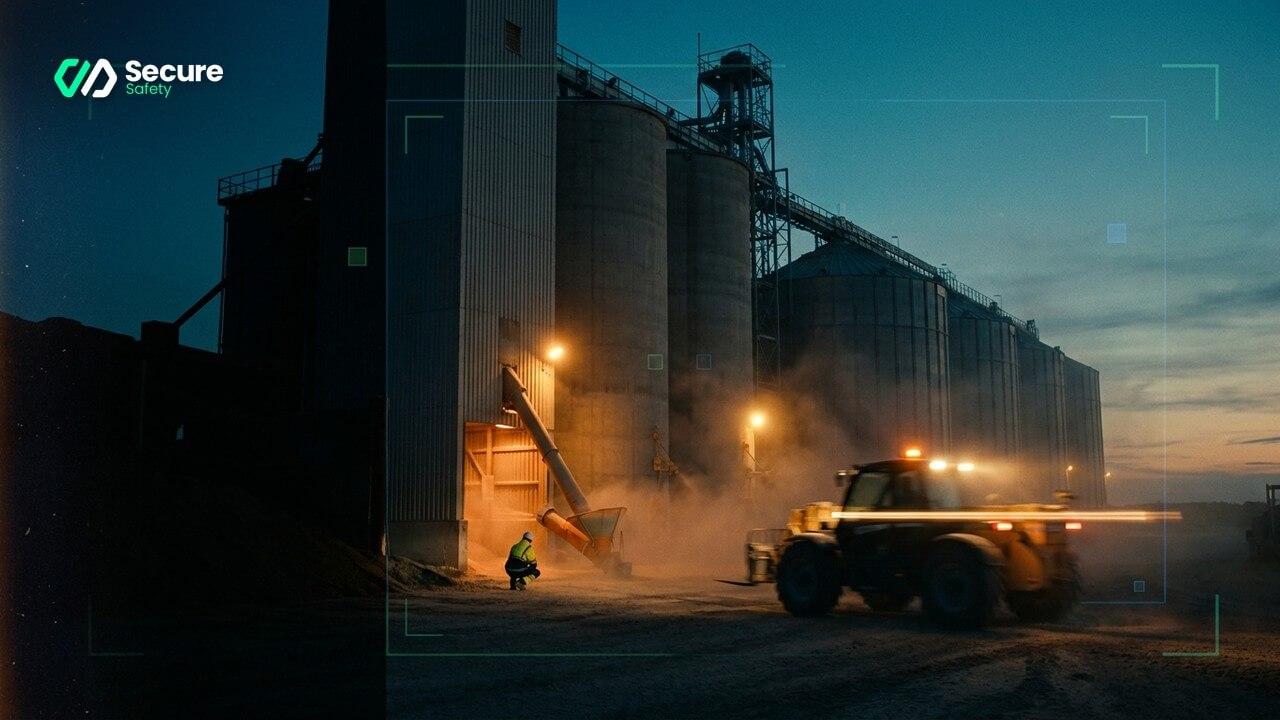
Every farm manager knows the particular unease of a busy harvest yard at dusk. A telehandler reverses across the concrete with its load raised, the driver half-blind to what is behind him. A worker crosses the same ground carrying a sack, trusting that the man in the cab has seen him. Grain thunders into an intake pit. A dog barks. For a few seconds, everyone and everything is moving at once, and safety rests entirely on the assumption that each person can see every other. Most days, that assumption holds. On the day it does not, agriculture becomes what the statistics have long said it is.
Agriculture is, per worker, the most dangerous industry in Britain. It employs a small fraction of the workforce yet accounts for a wildly disproportionate share of workplace deaths year after year. The reasons are not mysterious. Heavy machinery, working animals, confined spaces, grain, dust and height, all handled in scattered, weather-beaten locations by small teams under the relentless clock of the season.
Why the farm and the feed mill are so hard to keep safe
The hazards of agriculture and agri-processing do not queue up politely. They overlap.
Machinery and vehicles are the largest single killer. Telehandlers, tractors, trailers and loaders move constantly through yards where the same ground serves as workspace, walkway and thoroughfare. Reversing incidents, being struck by a moving vehicle, and being caught by unguarded power take-off shafts recur in fatality reports with grim regularity.
Grain and stored crop carry their own quiet menace. A person can be drawn into flowing grain and submerged in under a minute, unable to climb out against the pull. Silos and pits are confined spaces where oxygen depletes and dust builds. And that dust, in the right concentration, is explosive.
Livestock injure and kill more people than most outsiders would guess. Cattle handling, particularly around calving, turns a routine task into a contact hazard with an animal that outweighs the handler many times over.
Falls, entanglement and dust fill out the rest of the picture, across grain stores, feed mills, processing halls and the towering fixed plant of the modern agri-processing site.
What unites all of these is speed and isolation. The hazard arrives in seconds, and there is rarely a supervisor standing at the exact spot to intervene. Traditional safety controls, the toolbox talk, the painted walkway, the reversing beeper, all depend on human attention that seasonal fatigue steadily erodes.
A second pair of eyes that never blinks
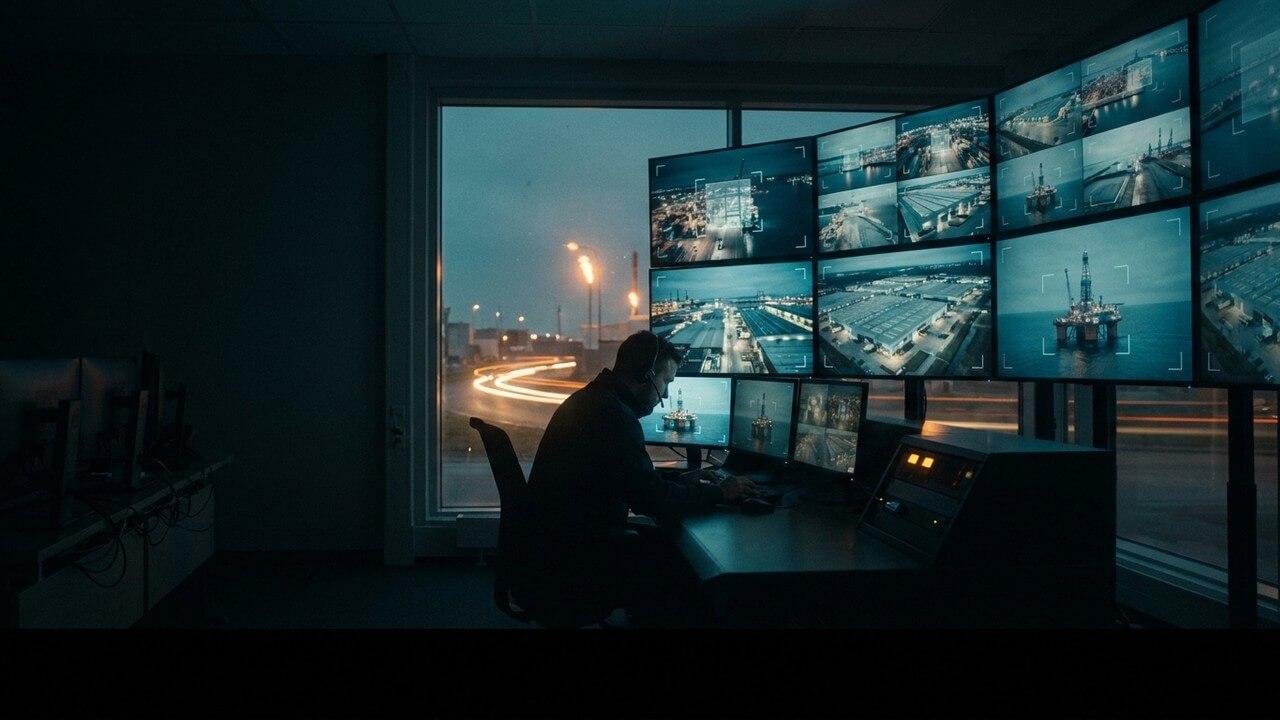
This is where AI safety monitoring earns its place. SecureSafety adds a computer-vision layer to the CCTV a site already runs, in the grain store, over the intake pit, across the yard, along the processing line. No new cameras, no new cabling, no footage leaving the premises. The system watches the same scenes your team watches, but it watches all of them, continuously, without tiring.
It is trained to recognise the specific geometry of agricultural risk:
- Vehicle–pedestrian conflict. When a person and a moving telehandler or tractor occupy the same space, the system flags it in real time, the single most valuable intervention on any farm yard.
- Red-zone and intake monitoring. A person stepping onto or near a grain intake, an auger, or an unguarded conveyor triggers an immediate alert.
- Confined-space and silo presence. The system knows when someone has entered an area they should not be in alone, or without the checks that precede it.
- Fall and person-on-the-ground detection. A worker down in a remote grain store is seen and escalated, even when no colleague is nearby.
- PPE and speed. Missing high-visibility clothing, or a vehicle moving too fast for a shared yard, both register as they happen, not in hindsight.
The point is not to replace judgement. It is to catch the moment a good operation, under pressure, drifts out of its own rules, and to raise the alarm while there is still time to act.
Forged where the margin for error is zero
It is fair to ask whether detection built in a laboratory can survive the mud, dust and glare of a real farm. Ours was not built in a laboratory. The core detection was developed offshore, on oil and gas drill floors, among the heaviest moving equipment and the least forgiving conditions in industry, where a missed hazard costs a life and there is no second chance. From there it was proven in the operations of a national oil major, a major international port and an international airport, running at a sub-0.05% error rate and delivering field-measured reductions of around 90% in unsafe behaviour. A grain yard at harvest is a demanding place. It is not more demanding than a drill floor in a storm, and the system has already learned its lessons there.
Practical, on-premise, and built for scattered sites
Agriculture rarely has a dedicated safety control room, and it certainly has no appetite for footage of its people or premises sitting on someone else's cloud. SecureSafety runs on-premise. The video is processed on site and stays on site. Alerts reach a phone, a screen in the office, or the operations lead directly, wherever they happen to be.
For multi-site operations, feed mills, grain stores, processing plants and the farms that supply them, the same layer gives head office something it has never reliably had, a consistent, objective record of where risk actually occurs. Not the incidents that got reported, but the near misses that did not. That data turns safety from a reaction into a plan.
The harvest will always be a race against weather and time. The machinery will always be heavy and the animals will always be strong. What has changed is that a site no longer has to depend solely on a tired operator glancing over his shoulder at the wrong moment.
Agricultural safety monitoring: implementation guide
Seasonal workforce and constant induction challenge
The seasonal workforce challenge in agriculture is structurally similar to the contractor management problem in construction: a large number of workers arrive in a short period with limited site-specific safety knowledge. Camera-based PPE monitoring and zone enforcement applies site rules to every new arrival automatically, without depending on every worker having fully internalised the induction before they begin work. This is particularly relevant at harvest when the pressure to deploy labour quickly conflicts with the time needed for thorough safety induction.
Integration with existing equipment telematics
Many modern agricultural machines are equipped with telematics systems that provide location and operational state data. Integration between telematics and the AI monitoring platform allows zone configurations to be automatically adjusted based on machine state — a drop zone beneath a telescopic handler that activates when the machine is in lifting mode, for example, can be linked to the machine's operational state signal rather than requiring manual zone activation for each lift.
Implementation checklist for agricultural and agri-processing sites
- Site layout seasonal review: review camera coverage and zone configurations at the start of each harvest season to reflect changes in facility layout, traffic routes and workforce composition
- Mobile plant GPS integration: for sites with GPS-enabled mobile plant, assess whether plant location data can be used to augment zone monitoring in areas with incomplete camera coverage
- Grain store and silo entry monitoring: confirm camera coverage at all confined space entry points, with specific attention to grain stores and silos where engulfment is a specific risk
- Night-time detection capability: harvest operations often run through the night; confirm that camera specifications and lighting provide adequate detection capability for the night-shift operation
See what your cameras have been missing. Book a demo.