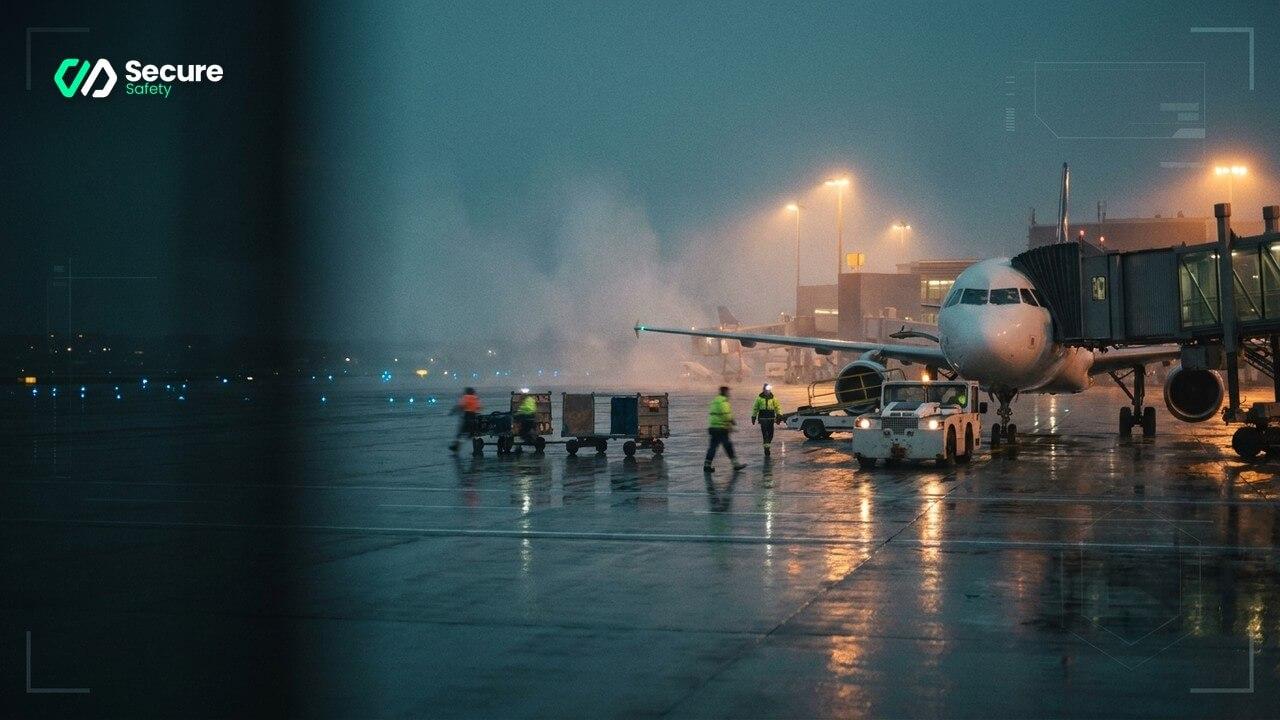
Every ground handling manager knows the forty-minute window. The aircraft rolls onto the stand, the engines spool down, and in the space of one turnaround a dozen vehicles and twenty people converge on a rectangle of concrete not much bigger than a tennis court. A pushback tug reverses into position. A belt loader noses up to the forward hold. A fuel bowser, a catering truck, a potable-water unit and a ground power cart all thread between wingtips, jet blast and a moving crowd of people in high-visibility vests. It is choreography performed under time pressure, in every kind of weather, often in the dark.
And it is where most airport injuries happen.
The concrete arithmetic of the apron
Passengers rarely see the ramp, so they rarely think about it. But ask anyone in airside operations and they will tell you the same thing: the terminal is not the hazard. The apron is.
The reasons are structural, not careless. Ground service equipment moves in tight radii around a fragile, expensive aircraft. Reversing vehicles have blind spots the size of a car. Jet blast can knock a person off their feet. Ground crew work close to running engines, spinning props and pressurised systems while shouting over noise that drowns out every warning. Add the relentless pressure to hit an on-time departure and you have the single most concentrated collection of vehicle-pedestrian conflicts anywhere in transport.
The consequences are not only human. A belt loader that kisses a fuselage, a tug that clips a wingtip, a service door left open a fraction too long — each of these is an aircraft ground damage event, and each one runs from tens of thousands to millions in repair and delay costs. The industry's own estimates put the annual bill for ramp damage in the billions. Behind every figure is a near miss that almost became something worse.
Why the old defences fall short
Airports are not short of safety effort. There are marshalling procedures, equipment approach zones, safety cones, banksmen, toolbox talks and mandatory reporting. All of it matters. None of it watches continuously.
Procedures depend on tired people remembering them at three in the morning. Banksmen cannot be everywhere. And the CCTV that already blankets every stand is, in practice, a forensic tool — footage reviewed after an incident, to understand what went wrong once the damage is done. The cameras see everything and warn no one.
That is the gap. The information needed to prevent a collision is almost always present on the apron in the seconds beforehand. What has been missing is something tireless enough to watch every stand at once and quick enough to speak up while there is still time to stop.
What a watching layer actually does
This is the part computer vision was made for. SecureSafety adds an AI detection layer to the cameras an airport already has. No new hardware on the stand, no rewiring, no cabling across live taxiways. The existing feeds are analysed in real time, and the moment the system sees a hazard developing it raises an alert — to the ramp supervisor, the control room, or an audible warning on the stand itself.
On the apron, that means watching for the specific ways a turnaround goes wrong:
Vehicle-pedestrian conflict
The system tracks every tug, loader and bowser against every person on foot, and flags the instant a worker strays into the path of moving equipment or a vehicle reverses toward someone in its blind spot.
Equipment approach and stand incursion
It knows the aircraft's protected envelope. When ground service equipment approaches too fast, from the wrong angle, or crosses a boundary it should not, the alert fires before contact — the difference between a warning and a damage report.
PPE and red-zone compliance
High-visibility clothing, restricted areas around engines and hazard zones during fuelling — all monitored continuously, not spot-checked.
Falls and person-on-ground
A worker who slips on a wet apron, falls from a loader or goes down out of a colleague's sightline is detected in seconds, so help is dispatched before anyone happens to notice.
The point is not to replace the crew's judgement. It is to give them a second set of eyes that never blinks, never looks away, and never gets complacent on the four-hundredth turnaround of the shift.
Proven where the stakes are highest
It is fair to ask whether a system like this holds up in the real world, or only in a demonstration. Ours was not built in a lab. The detection was forged offshore, on the drill floors of oil and gas platforms — an environment of heavy moving equipment, deafening noise and zero tolerance for error, where a lapse costs lives. From there it has gone on to run in national oil-major operations, a major international port and an international airport, holding a sub-0.05% error rate and, on measured sites, cutting unsafe behaviour by around ninety per cent. The apron is demanding. It is not more demanding than a drill floor in a swell.
On-premise, and airside by design
Airports are among the most security-conscious operators anywhere, and airside footage is sensitive by its nature. SecureSafety runs entirely on-premise. The video is analysed on site and never leaves it. There is no cloud upload, no third-party data trip, nothing to satisfy but your own security and privacy teams. What happens on the ramp stays on the ramp.
The quiet economics of prevention
The safety case for watching the apron is obvious. The financial one is almost as strong. One prevented tug-into-fuselage event can pay for the system many times over. Fewer ground damage claims, fewer delayed departures, cleaner audit trails and a demonstrable, evidenced reduction in unsafe behaviour — the kind of thing that changes a conversation with an insurer or a regulator.
Most of all, it turns the apron's cameras from a record of what went wrong into a means of stopping it. The footage was always there. Now something is watching it in time to matter.
Airport ramp safety monitoring: what works on the apron
Ground support vehicle and aircraft proximity
The interaction between ground support vehicles — tugs, belt loaders, catering trucks, fuel bowsers — and taxiing or powered aircraft is the highest-consequence vehicle-proximity scenario in any operational environment. An aircraft strike by a ground vehicle is a multi-fatality potential event and an aviation safety regulatory event in addition to a worker safety event. Camera monitoring of ground support vehicle movements on the apron, with speed enforcement and zone monitoring around powered aircraft, addresses the vehicle safety dimension of ramp operations while remaining within the scope of a workplace safety monitoring deployment.
Sterile zone enforcement at aircraft stands
Aircraft turnaround operations require a defined sterile zone around the aircraft during specific phases — engine runs, fuel loading, pushback — when personnel without specific authorisation must not be in the immediate aircraft vicinity. Camera-based zone monitoring at aircraft stands, activated for the duration of each controlled phase, provides the continuous enforcement that the SMS requirement for sterile zone management demands.
FOD and equipment management
Foreign object debris (FOD) on the ramp is a critical aviation safety risk: an object sucked into an engine intake can cause catastrophic damage. Camera monitoring of the ramp and stand areas can be configured to detect unattended objects — a cone not removed, a ground power unit left in the stand — that constitute potential FOD sources. This capability is complementary to the visual FOD walk routine but provides a continuous check rather than a periodic one.
Regulatory notes for airport AI safety deployment
Airport ramp safety monitoring deployments must align with the CAA SMS requirements applicable to the aerodrome licence. The Discovery phase includes a review of the aerodrome's SMS documentation to confirm that the monitoring deployment is consistent with the documented controls and that the compliance log outputs support the SMS evidence requirements. For international airports with ICAO compliance obligations, alignment with PANS-Aerodromes (Doc 9981) SMS requirements is confirmed during the same review.
See what your cameras have been missing — book a demo.