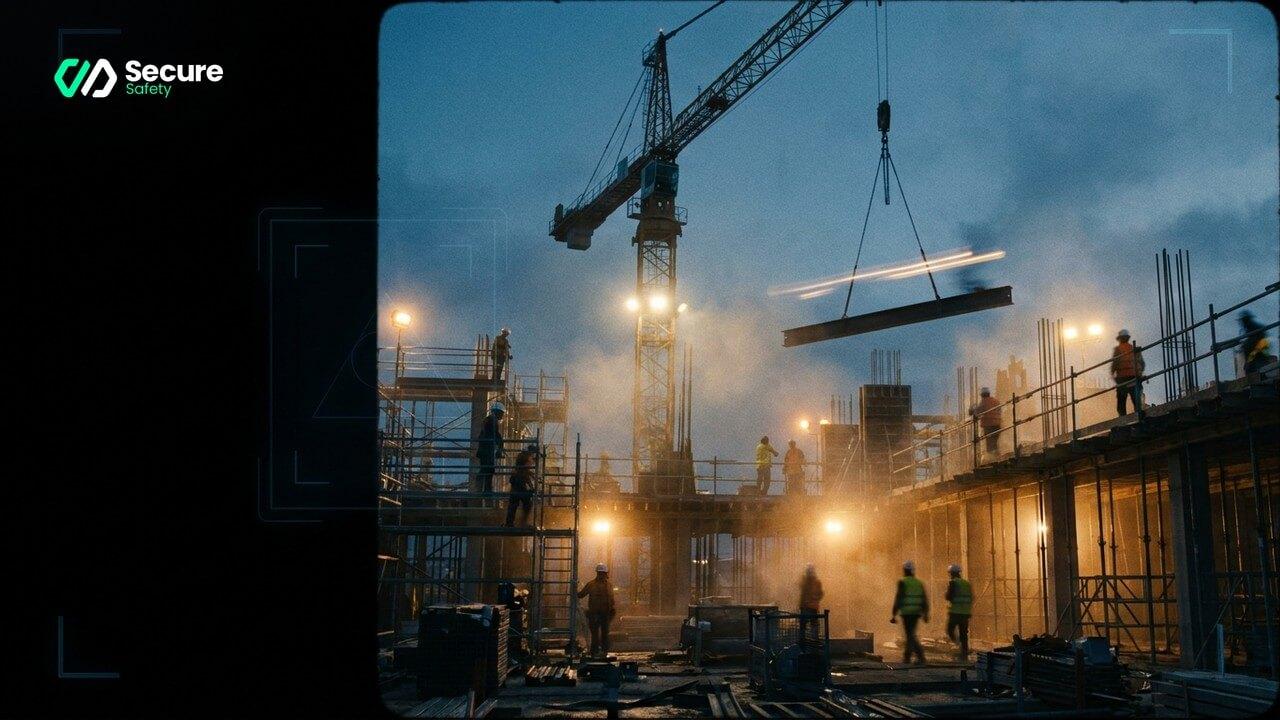
Every site manager knows the feeling. It is half past three on a Friday, the concrete pour ran late, two subcontractors you have never met are working near the edge of the third floor, a telehandler is reversing toward the gate, and you are on the phone in the cabin with your back to all of it. For those ninety seconds, nobody is watching the things that hurt people. And on a construction site, ninety seconds is plenty.
Construction remains one of the most dangerous industries in the developed world. In Great Britain it accounts for the largest share of worker fatalities of any sector year after year, and falls from height are the single biggest cause. The hazards are not exotic. They are the ordinary, repeating events of a working day: a missing harness, a hard hat left in the van, a worker drifting into the swing radius of a load, a vehicle and a person arriving at the same point at the same moment.
The difficulty has never been knowing what is dangerous. It is that a building site is a machine for generating blind spots.
The site that never holds still
A warehouse floor looks the same on Monday as it did on Friday. A construction site does not. The edge that was fenced yesterday is an open riser today. The safe walking route becomes a crane exclusion zone by lunchtime. Trades rotate through, agency workers arrive for a single shift, and the geometry of the hazard changes with every phase of the build.
This is why the traditional tools struggle. Toolbox talks are given once and forgotten by the afternoon. Inductions cover a site that no longer exists by week three. A safety officer, however diligent, can stand in exactly one place at a time, and the moment they turn a corner the scaffold they just inspected is out of sight. Supervision on a construction site is not a failure of effort. It is a failure of coverage. There are simply more things happening than there are eyes to watch them.
Watching the whole site, continuously
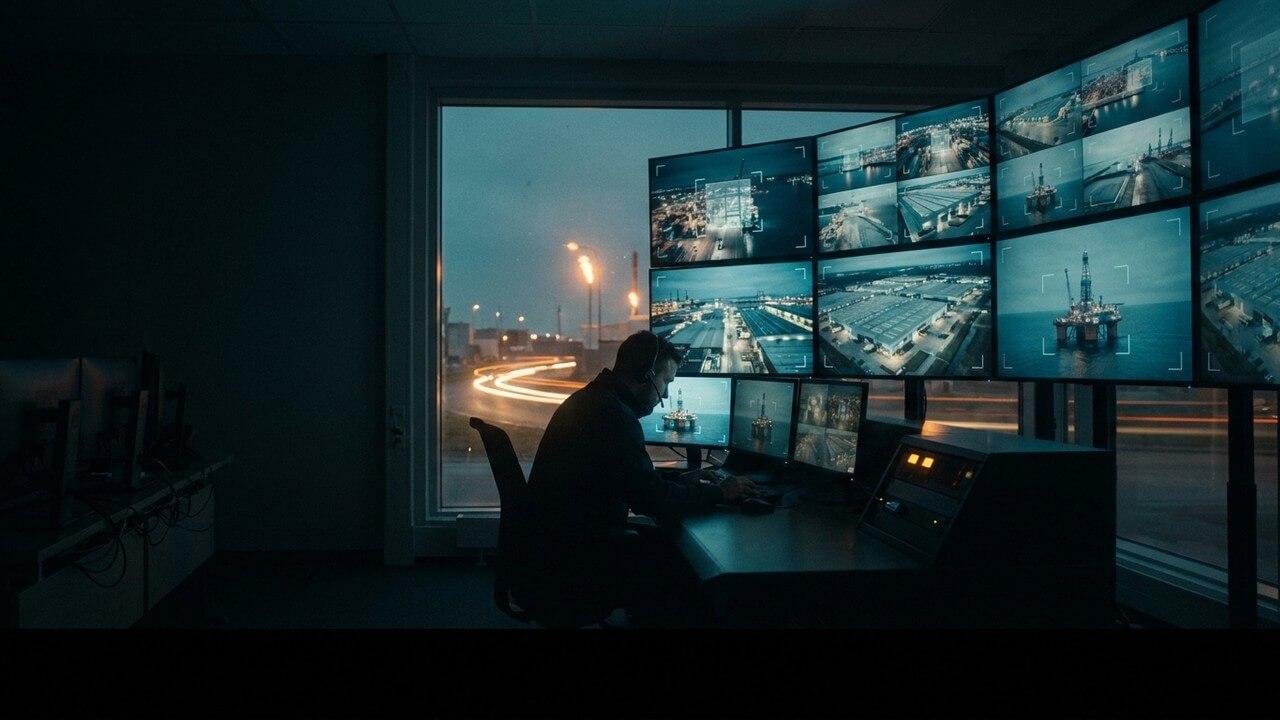
This is the gap computer vision was built to close. Most active sites already carry CCTV for security and welfare monitoring. AI safety monitoring adds an intelligent layer on top of those existing cameras, so the footage that was only ever reviewed after an incident starts working in real time to prevent one.
The system watches every camera at once, on every shift, and recognises the situations that precede an accident:
- PPE compliance. Hard hats, hi-vis, harnesses and eye protection, checked continuously against the rules for each zone — a harness required on the leading edge but not in the site compound.
- Working at height. People near unprotected edges, open risers, fragile roofs or scaffold gaps, flagged the moment they enter the danger area rather than after a fall.
- Plant and pedestrian conflict. Excavators, telehandlers, dumpers and delivery vehicles moving in the same ground as people on foot — the collision risk that causes so many of the industry's serious injuries.
- Falls and person-on-ground. A worker down and not moving, detected in seconds so the alarm is raised while the response still counts.
- Exclusion zones. Crane swing paths, demolition areas and freshly poured slabs, monitored so that an accidental incursion is caught as it happens.
When the system sees something wrong, it alerts — a signal to the site office, the supervisor's phone, or a local warning on site. Not a report filed for next month's safety meeting. A prompt while there is still time to act.
Forged where the stakes are highest
It is fair to ask whether detection trained in a lab can survive the mud, dust and chaos of a real building site. Ours was not trained in a lab. This technology was developed in offshore oil and gas, on the drill floor — heavy moving equipment, deck crews working within feet of it, weather, glare, and no tolerance for error whatsoever. It has since been proven in the operations of a national oil major, at a major international port and at an international airport, running at a sub-0.05% error rate and delivering field-measured reductions of around 90% in unsafe behaviour. A construction site is demanding. It is not more demanding than a drill floor in heavy seas.
That pedigree matters for one practical reason. A safety system that cries wolf is worse than no system at all, because people stop listening to it. Detection that holds up in the harshest industrial environment on earth is detection your site team will still trust in month six.
What the evidence changes
There is a second dividend, and principal contractors feel it keenly. Every alert the system raises is timestamped and recorded. Over a few weeks, patterns emerge that no clipboard would ever capture: the gate where near-misses cluster at shift change, the subcontractor whose crews consistently skip harnesses, the times of day when fatigue shows in the numbers.
That turns safety from a matter of opinion into a matter of record. It sharpens your conversations with subcontractors, strengthens your position under the Construction (Design and Management) Regulations, and gives you something solid to show a client or an inspector: not a promise that the site is run well, but the evidence of it.
On your cameras, on your terms
Two questions always follow. What does it cost to install, and where does the footage go.
Because the system runs on the CCTV you already have, there is no new hardware to bolt to a scaffold, no cabling across an active site, no capital project. And because it runs on-premise, the video never leaves the site. Nothing is streamed to a third-party cloud. Faces need not be stored. For a workforce that is understandably wary of being filmed, and for a data-protection officer who will ask, the honest answer is that the analysis happens on site and stays there.
The worker on the third floor at half past three does not need you to be watching at that exact second. They need the site to be watching. That is what this technology does — quietly, on every camera, on every shift, so that the ninety seconds when your back is turned is no longer the moment nobody is looking.
Applying AI safety monitoring on a live construction project
Managing monitoring through a project lifecycle
A construction site is not a static environment: the layout changes as the project progresses, new hazards are created and old ones are resolved, and the workforce composition changes as different trades are mobilised and demobilised. The AI monitoring system must keep pace with these changes, which requires a zone management process that is as agile as the project planning process.
The most effective approach is to integrate zone configuration updates into the site management workflow: when a new section of site is opened, a new crane is brought in, or a new contractor is mobilised, the zone configuration update is part of the management process, not an afterthought. This requires both a responsive zone configuration tool (which the platform provides) and an operational process for requesting and completing updates (which is established during the Discovery phase).
CDM coordination and monitoring evidence
The principal contractor under CDM 2015 has a duty to plan, manage, monitor and coordinate all construction work. The monitoring dimension of this duty is often addressed by supervisor walk-rounds, near-miss reporting and periodic site safety inspections — all of which are episodic and therefore provide incomplete coverage. AI monitoring provides the continuous component of the monitoring duty, generating a timestamped record of safety events across the site that supplements the episodic monitoring activities and provides the documentary evidence that CDM compliance requires.
Contractor workforce management through AI
Large construction sites typically have dozens of different contractors working simultaneously, each with their own PPE scheme, training standards and safety culture. The principal contractor cannot rely on contractor self-monitoring to maintain standards consistently. Camera-based PPE monitoring at site entry points and in the work zones enforces site-wide rules on every worker regardless of their employer, and provides the principal contractor with the evidence that contractor compliance is being systematically monitored — which is both a CDM requirement and a defence in the event of an incident involving a contractor.
Implementation notes for construction site deployments
- Temporary camera infrastructure: construction sites typically use temporary camera masts; confirm these are included in the deployment scope and that the mast positions are reviewed as the site layout changes
- Phase-based deployment: for long-duration projects, consider a phased deployment approach where the monitoring scope is reviewed and updated at each project phase milestone
- Sub-contractor briefing requirement: all contractors on site should receive a briefing on the monitoring scope and purpose before their mobilisation; this should be included in the contractor induction process managed by the principal contractor
See what your cameras have been missing — book a demo.