Every plant manager in food and beverage knows the particular sound of a near miss. The squeak of a boot skidding on a washed-down floor. The clatter of a pallet jack pulled up short a foot from someone's heel. The half-second of silence after a knife slips. Nothing happened this time. But the sound stays with you, because you know that on the next shift, on a different line, under a little more pressure, it will not stay a near miss.
Food and beverage processing is one of the most deceptively dangerous environments in industry. It looks clean. It looks orderly. Yet it combines almost every hazard category into one wet, cold, fast-moving space — and the pace of the line rarely leaves room to slow down and think.
Why food plants are harder than they look
The numbers tell the story plainly. Across the UK and Europe, food and drink manufacturing consistently records injury rates well above the average for all industry. Slips and trips are the single largest cause. And it is not hard to see why.
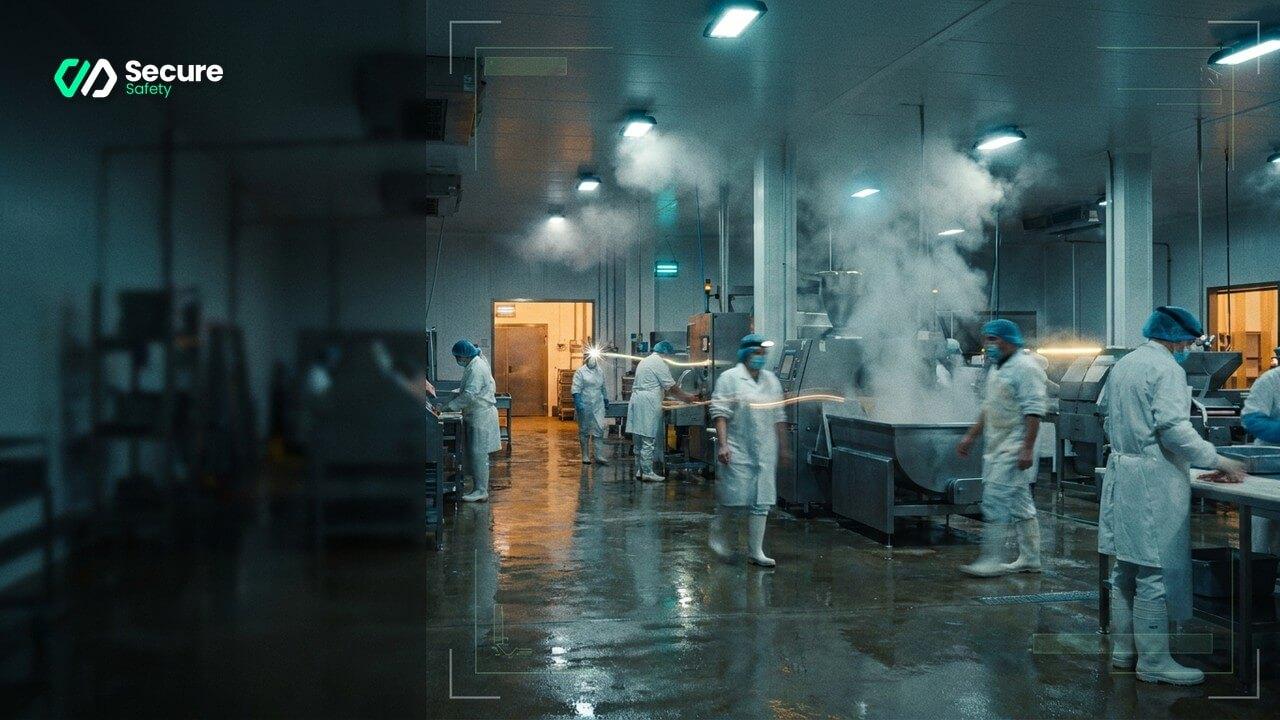
The floors are wet by design. Hygiene protocols demand constant washing, and water, product residue, oil and cleaning chemicals turn stainless steel and sealed concrete into a skating rink. Add refrigerated rooms where condensation forms, freezer thresholds where ice builds, and the picture sharpens.
Then layer on everything else moving through that space:
- Forklifts and pallet trucks weaving between people in tight, congested aisles.
- Fast conveyor lines where hands work close to moving parts and blades.
- Cold and confined areas where a fall may go unseen for critical minutes.
- Cleaning-in-place chemicals and steam that create their own exposure risks.
- Round-the-clock shifts where fatigue quietly erodes attention.
Each of these has its own control measures. Each is inspected, signed off, toolbox-talked. And yet incidents still happen, because the one thing no clipboard can do is watch every square metre of the floor, on every shift, without blinking.
The gap between the audit and the shift
Most safety systems in food processing are built around moments: the audit, the inspection, the investigation after something goes wrong. These are necessary. They are also, by their nature, occasional. The auditor walks the line on a Tuesday morning. The hazard appears at 2am on a Sunday.
The real risk lives in the hours between — in the spill that sits unnoticed for twenty minutes because everyone is heads-down on throughput, in the person who takes a shortcut through a vehicle lane because the long way round costs them ninety seconds they do not have.
This is the gap that continuous monitoring is meant to close. And most sites already have the raw material to close it, sitting quietly in the ceiling: their cameras.
What the cameras could already be telling you
Your CCTV was installed for security and, perhaps, for HACCP and quality assurance. It records faithfully. But recording is not the same as seeing. A recording tells you what happened after you already know to go looking. It does nothing in the moment the hazard appears.
AI safety monitoring changes what those cameras are for. It adds a computer-vision layer to the feeds you already have — no new hardware bolted to the walls, no ripping out the network — and turns passive footage into a system that watches and acts in real time.
In a food or beverage plant, that means the software can be trained to see the things that actually cause harm:
Slip and spill detection
A pool of water or product on the floor is flagged the moment it forms, and the alert goes to the nearest supervisor's phone — not to a hard drive nobody reviews until Monday. The spill gets mopped while it is still a spill, not after it becomes an incident report.
Vehicle and pedestrian conflict
The system recognises when a forklift and a person are on a collision path in a shared aisle and raises the alarm before the two meet. In congested cold stores and dispatch bays, this is often the difference between a warning and a crush injury.
PPE and hygiene compliance
Missing hairnets, absent cut-resistant gloves, unworn hi-vis in the yard — checked continuously and objectively, without a supervisor having to stand and stare.
Falls and person-on-the-ground
If someone goes down in a chilled room or a quiet corner of the warehouse, the system sees it and calls for help immediately, rather than relying on chance discovery.
Fire, smoke and restricted zones
Early smoke around ovens, fryers and packaging lines, and unauthorised entry into red zones near moving machinery — caught at the first sign, not the first casualty.
None of this replaces your safety team. It gives them a set of eyes that never tires, never looks away, and never waits for the review meeting.
Proven where the margin for error is zero
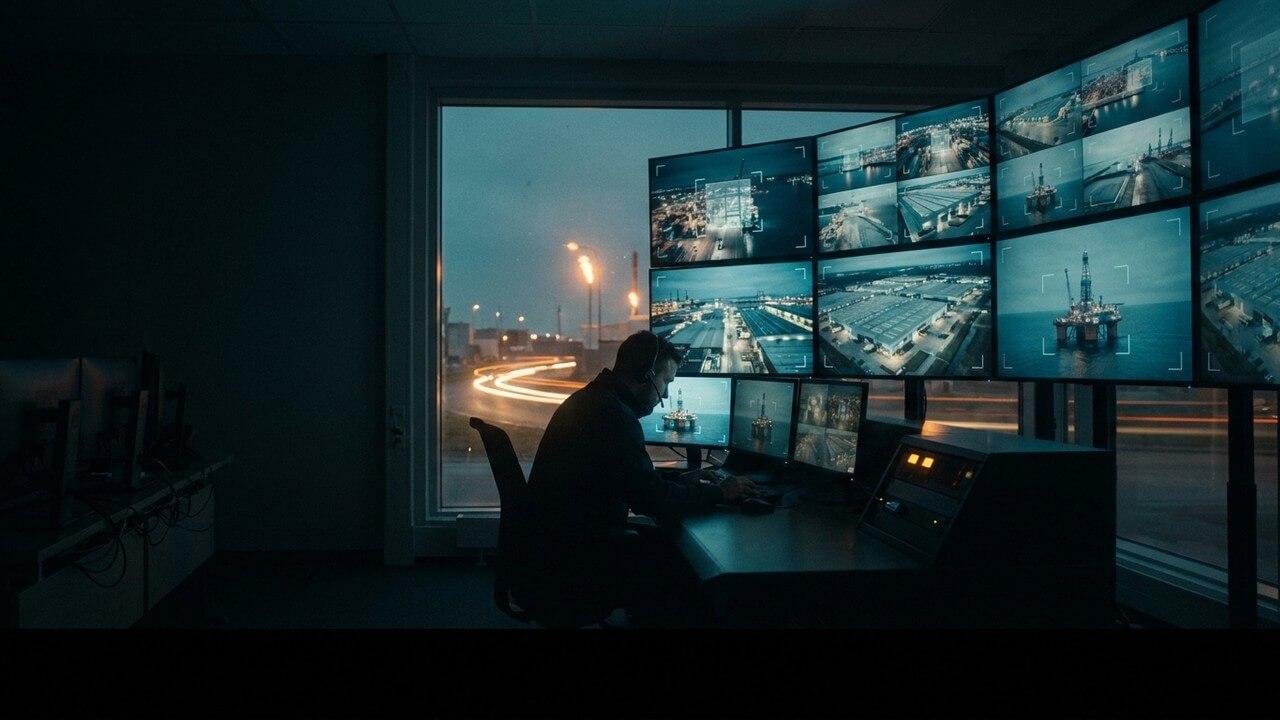
It is fair to ask whether detection like this holds up in the mess of a real production environment — the steam, the glare off wet steel, the constant movement. The honest answer is that this technology was not born in a food plant. It was forged offshore, on the drill floors of oil and gas, which is about as unforgiving as an industrial workspace gets: heavy equipment in constant motion, deafening noise, weather, and absolutely no tolerance for a missed hazard because lives depend on every call. From there it went into a national oil major's operations, a major international port and an international airport, running at a sub-0.05% error rate and, on measured sites, cutting unsafe behaviours by around 90%. A wet floor and a fast line are demanding. They are not more demanding than a drill floor in a heavy sea.
Because the processing itself runs on-premise, footage never leaves your site. For an industry that guards its facilities, its recipes and its people's privacy closely, that matters as much as the detection does.
The quiet economics of prevention
The case for this is not only moral, though it is that. A single serious slip can mean weeks of lost time, an enforcement notice, higher premiums and a line running short-staffed. Multiply the small, unrecorded near misses across a year and you have a steady tax on output that never appears as a line item.
Continuous AI monitoring shifts the whole model from reacting to preventing. It does not ask your people to be more careful. It removes the hazard before carelessness ever gets its chance.
The wet floor and the fast line are not going away. They are the nature of the work. The question is only whether anything is watching them closely enough, all the time, to catch the moment before it turns.
AI safety monitoring in food and beverage production: the practical applications
Zone entry PPE verification for hygiene and safety
Food production facilities have a dual PPE compliance challenge: the safety PPE requirement (hard hat, hi-vis, safety boots) and the hygiene PPE requirement (hair net, beard snood, colour-coded clothing, specific footwear). Both must be enforced at zone entries, and both can be monitored by the same camera deployment with appropriate detection configuration. The Discovery phase documents both sets of requirements per zone and configures the detection to enforce them simultaneously.
For BRC Global Standards audits, the compliance log from an AI PPE monitoring deployment provides the continuous verification evidence that manual sign-in sheets cannot. The auditor who asks "how do you verify that all personnel entering the processing area are wearing full hygiene PPE?" has a more convincing answer when the response includes a timestamped log of every zone entry and every PPE compliance check rather than a policy document and spot-check records.
Forklift and pallet truck operations in production areas
The vehicle hazard in food production facilities is often underestimated because the vehicles involved are smaller than in an outdoor logistics environment — counterbalanced forklifts and electric pallet trucks rather than reach stackers and HGVs. But the consequence of contact in a food production environment is no less severe, and the pedestrian density in production areas during shift changeover is comparable to any warehouse. Camera monitoring of the crossing points between vehicle routes and pedestrian routes in production areas addresses the same hazard as in logistics environments, with configuration adapted to the specific vehicle classes and sightline constraints of the production floor.
Hygiene zone boundary management
Many food production facilities have strict hygiene zone boundaries — the clean zone, the high-care zone, the high-risk zone — where the movement of personnel and equipment between zones must be controlled to prevent microbiological cross-contamination. While this is primarily a food safety requirement rather than a worker safety requirement, the zone monitoring capability used for safety applications can extend to hygiene zone boundary management, providing a single monitoring platform for both purposes.
See what your cameras have been missing — book a demo.