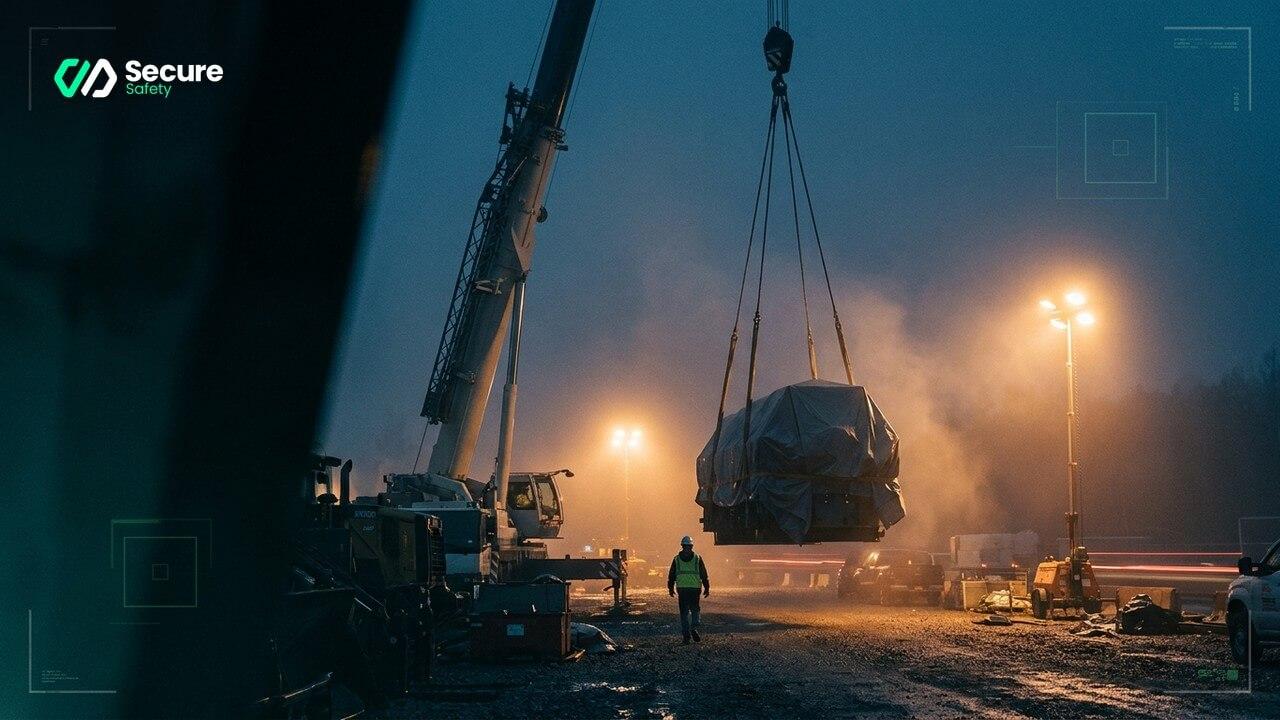
Every rigger knows the moment. The load leaves the ground, the slings snap taut, and for a few seconds a mass of steel hangs in the air above a working deck. The exclusion zone is marked. The banksman is watching. The plan was signed off that morning. And then someone — a fitter fetching a tool, a visitor who took a shortcut, a colleague who simply forgot — walks under the load. Nothing happens, ninety-nine times out of a hundred. It is the hundredth time that fills the accident reports.
Lifting operations concentrate risk in a way few other activities do. A suspended load is potential energy waiting for a reason. When something fails — a sling, a shackle, a moment of miscommunication between crane operator and signaller — the consequences arrive faster than any human can react. The Health and Safety Executive's own data has long placed struck-by and line-of-fire incidents among the leading causes of serious injury and death across construction, ports, and heavy industry. These are not freak events. They are the predictable outcome of people and heavy loads sharing the same space.
Why lifting is so unforgiving
The hazards around cranes are well understood, which is precisely what makes the continued toll so frustrating. There is the load itself, and the line of fire beneath it. There are the pinch and crush points where a slewing load meets a fixed structure. There is tag-line management, ground conditions under outriggers, and the blind spots every operator learns to live with. And running through all of it is the exclusion zone — the single most important control in any lift plan, and the one most casually breached.
The problem is not a lack of rules. LOLER — the Lifting Operations and Lifting Equipment Regulations 1998 — already requires that lifts be properly planned, supervised by a competent person, and carried out safely. Most sites have a lift plan, a permit system, and a barrier of some kind. The gap is not in the paperwork. It is in the seconds between the plan and reality, when a well-drilled procedure meets a distracted human being. A cone and a length of tape cannot see. A banksman cannot watch the load, the operator, the tag lines, and the far edge of the exclusion zone all at once.
The exclusion zone that watches itself
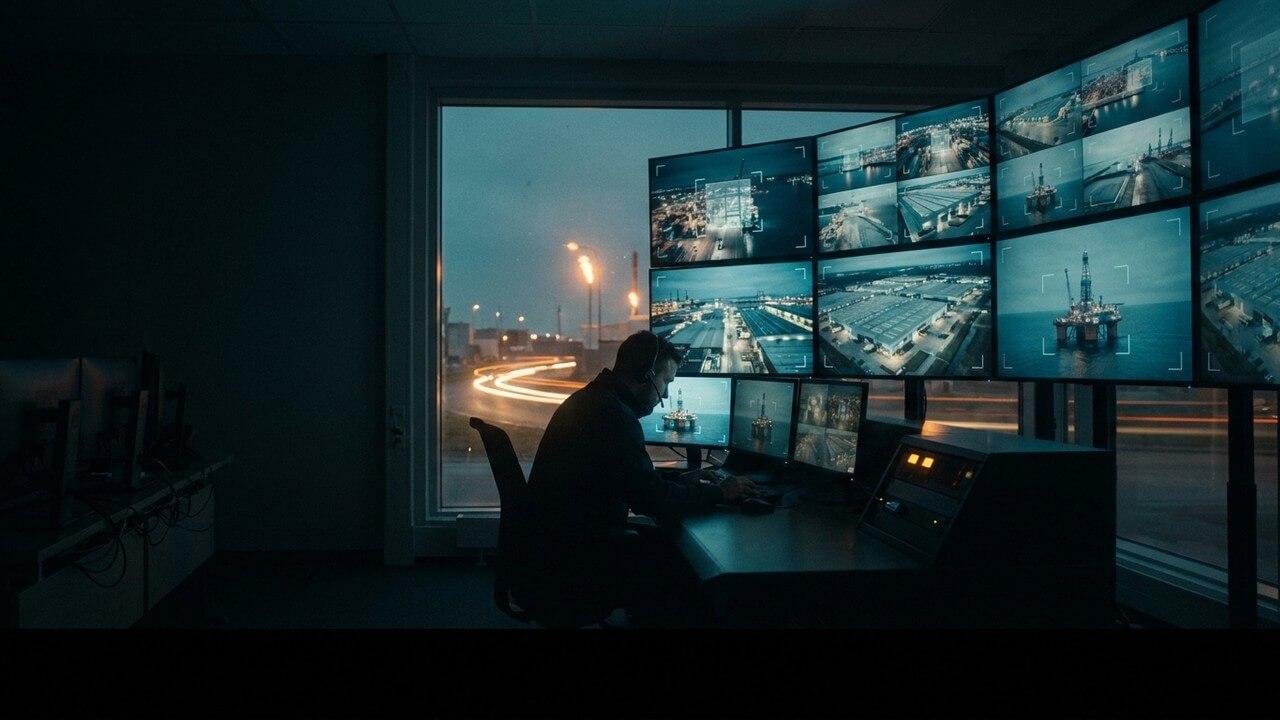
This is where computer vision changes the arithmetic. SecureSafety adds an AI layer to the CCTV a site already has — no new cameras, no new masts, no footage leaving the premises. The system watches the lift the way an ideal safety officer would, if you could station one at every camera and guarantee they never blinked.
It understands the geometry of a lift. Define the exclusion zone once, and the system holds it. The moment a person crosses into the footprint beneath or around a suspended load, it flags the breach in real time — to a control room, a supervisor's screen, or an audible alarm on the deck. It distinguishes a person from a parked vehicle, a shadow, or the load itself, so the alerts mean something and are not dismissed as noise.
From line-of-fire to genuine prevention
The point is not to catalogue near-misses after the fact, though the record it builds is valuable. The point is the intervention that happens while the load is still in the air. A supervisor who is told, in the moment, that someone has stepped into the line of fire can stop the lift. That is the difference between a corrected mistake and a fatality investigation.
The system layers naturally onto the other controls a lifting operation depends on. It can confirm the right PPE — hard hats, high-visibility vests — before work begins. It can watch for a person on the ground, the signature of a fall or a strike. It monitors people counting and restricted-area entry across the wider site, so the exclusion zone is not an island but part of a continuously watched environment.
Proven where the margins are thinnest
This detection was not built in a laboratory. It was forged offshore, on drill floors — where cranes swing loads across a pitching deck, where the moonpool opens directly onto the sea, and where there is no tolerance for a system that cries wolf or misses the one breach that matters. It has since run in the operations of a national oil major, at a major international port, and at an international airport, holding a sub-0.05% error rate and, in the field, contributing to reductions of around 90% in unsafe behaviour. A drill floor is the most demanding lifting environment there is. A system proven there tends to find a warehouse yard or a construction site comparatively forgiving.
What it means for LOLER and for evidence
Regulators do not only ask whether you had a plan. They ask whether it was followed, and how you knew. An AI monitoring layer turns "we told people to stay clear" into a demonstrable, time-stamped record of exclusion-zone integrity across every lift. When a breach occurs, you have the footage, the flag, and the intervention. When an inspector or an insurer asks how you supervise your lifting operations, you have a concrete answer rather than a policy document.
None of this replaces the competent person, the lift plan, or the discipline of a well-run team. It is not meant to. It is a tireless second set of eyes, positioned exactly where human attention is most likely to lapse and the cost of lapsing is highest — beneath a load, in the line of fire, in the seconds that decide everything.
The load is going up whether or not anyone is watching the ground beneath it. The only question is whether something is watching when it matters.
Crane and lifting safety monitoring: the specific capabilities that matter
Dynamic drop zone management
The fundamental challenge of AI monitoring for lifting operations is that the hazard zone changes as the lift progresses. A load being lifted from the ground to an elevated position has a different drop zone at each stage of the lift, and both the area directly beneath the load and the potential swing arc must be monitored. The platform tracks the position of the load throughout the lift using camera views from multiple angles, updating the enforced exclusion zone continuously as the load moves. This is categorically different from a static zone drawn around a crane base — it is a live spatial model of the current hazard.
Suspended load and personnel detection
The interaction between a suspended load and personnel in the area below is the specific event that the monitoring must prevent: someone walking beneath a suspended load without knowing it is there. Camera coverage from an overhead or angled position looking down on the drop zone provides the detection geometry needed to identify personnel in the area beneath a suspended load, with the load itself also visible in the same frame. When the zone is active and a person is detected beneath the load, the alert fires immediately to the crane operator, the banksman and the control room.
Banksman and signaller monitoring
AI monitoring of lifting operations extends to the banksman and signaller role. A banksman who has moved out of the crane operator's sightline but is still in the drop zone, or who has left the operation unattended, is a condition the camera can detect. Combined with permit-to-work integration that records the registered banksman for each lift, the platform can flag discrepancies between the registered personnel and those present at the lift.
Regulatory context for lifting operations monitoring
The Lifting Operations and Lifting Equipment Regulations 1998 (LOLER) require lifting operations to be properly planned, appropriately supervised, and carried out in a safe manner. The planning requirement includes the identification of load paths and the exclusion of personnel from the area beneath suspended loads. AI monitoring provides both the real-time enforcement of this exclusion and the documentary evidence that the exclusion was enforced throughout each lift — which is precisely the evidence an HSE inspector requires to verify LOLER compliance.
See what your cameras have been missing — book a demo.