Every plant manager knows the moment. A machine has been guarded, interlocked and risk-assessed to the last bolt. Then a fixed guard is lifted "just for a second" to clear a jam, a light curtain is taped over because it keeps tripping the line, or a gloved hand reaches past a barrier that was never quite tall enough. The engineering did its job. The human being, under pressure to keep the line running, quietly worked around it.
This is the uncomfortable truth about machine guarding. It is one of the great achievements of industrial safety — and it is static. A guard protects against the hazard you anticipated, in the position you fixed it, for as long as it stays where you put it. It cannot see the worker who bypasses it. It cannot notice that it has been removed. It has no idea what is happening two metres to its left.
Machine vision closes that gap. Not by replacing the guard, but by watching over it.
Where physical guarding runs out
Guarding standards such as BS EN ISO 13857 and the Provision and Use of Work Equipment Regulations exist because moving machinery is unforgiving. Presses, stamping lines, robotic cells, conveyors, mixers and CNC equipment account for a grim share of the amputations and fatalities the HSE records each year in manufacturing. The regulations work. But they rest on an assumption that guards remain in place and are used as intended.
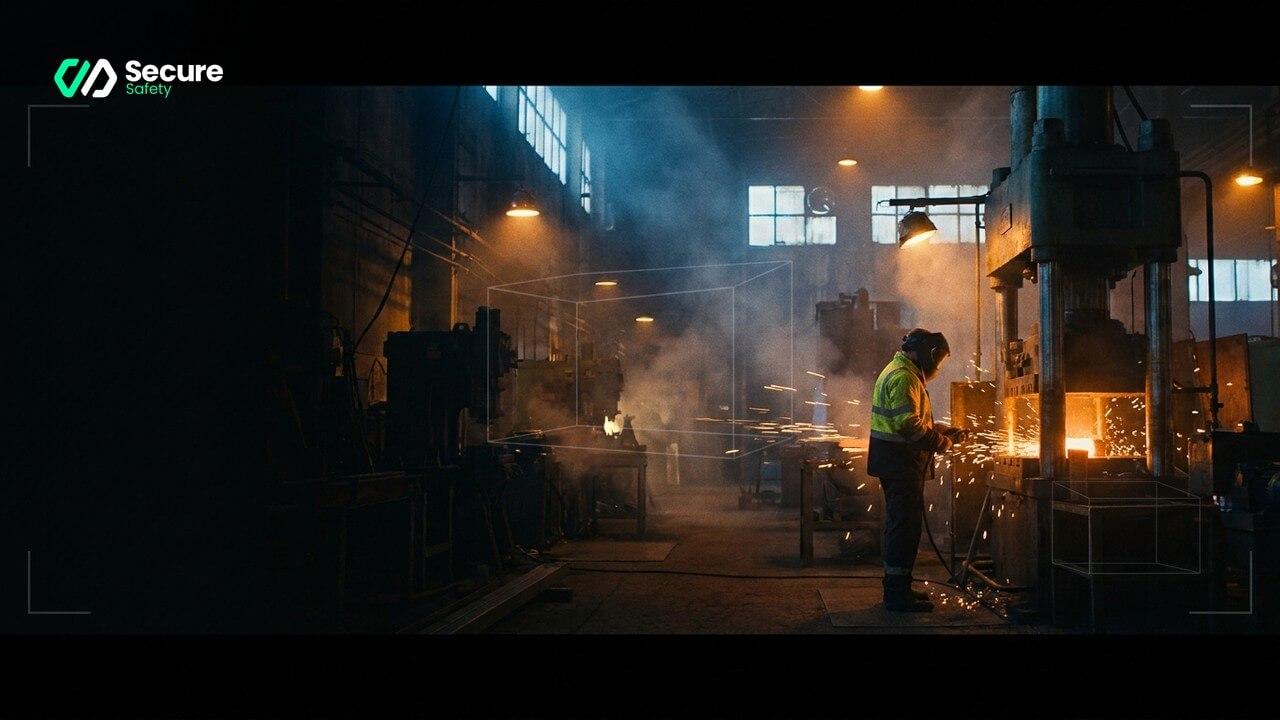
On a real shop floor, that assumption erodes shift by shift. Interlocks get defeated. Maintenance work happens with panels open. A pallet is stacked where it blocks an emergency stop. An operator leans into a robot's working envelope to inspect a part because the alternative is stopping the cell and explaining the downtime. None of these are acts of recklessness. They are ordinary people making ordinary trade-offs, and physical guarding has nothing to say about any of them.
The result is a blind spot precisely where the energy is highest — around the machinery that can take a hand in a fraction of a second.
What a camera can see that a guard cannot
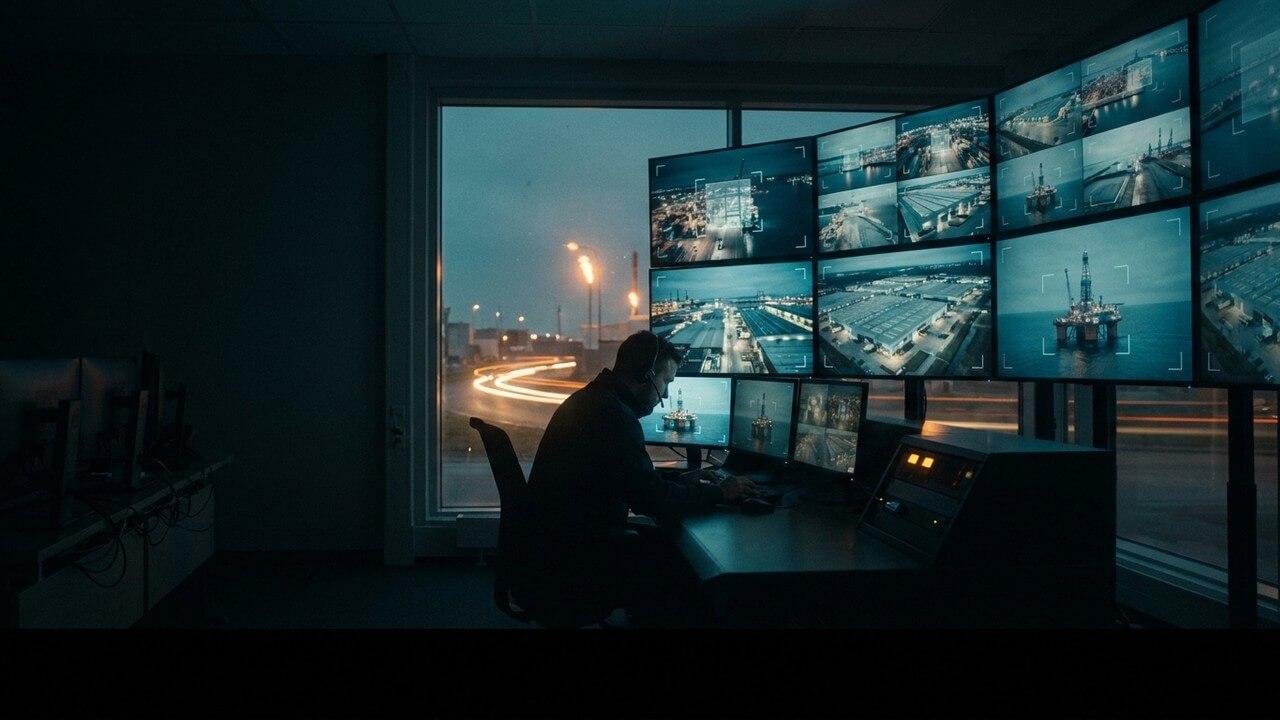
Computer vision turns your existing CCTV into a second layer of protection that is aware of behaviour, not just position. It watches the interaction between people and machines, continuously, and understands what it is looking at.
On the factory floor that means detecting, in real time:
Intrusion into danger zones
Define a virtual boundary around a press, a robot cell or a moving conveyor. If a person — or just a limb — crosses into it while the machine is live, the system flags it instantly, and can be wired to slow or stop the equipment before contact.
Defeated or missing guards
A fixed guard that has been removed, a panel left open during a run, a light curtain obstructed. The system knows what "normal" looks like and notices when the configuration is wrong, not merely when someone is already hurt.
PPE and readiness at the machine
Cut-resistant gloves near a blade, eye protection at a grinding station, the right footwear in a forklift aisle. Compliance checked at the point of risk rather than at the factory gate.
The near-miss you would otherwise never hear about
The reach-over that did not quite reach. The moment someone stood in the load path and stepped back in time. These are the leading indicators of the accident that has not happened yet — and traditionally they vanish, unrecorded, the instant they pass.
Because the analysis happens on-premise, none of this footage leaves the site. The cameras you already own become the sensors; the intelligence sits behind your firewall, watched by no one outside your walls.
Proven where the stakes are highest
This is not a laboratory idea. The detection was forged in offshore oil and gas, on drill floors — heavy moving equipment, zero tolerance for error, lives measured against every second. It has since run in the operations of a national oil major, a major international port and an international airport, at a sub-0.05% error rate, and has delivered field-measured reductions of around 90% in unsafe behaviour. A stamping line is a demanding environment. It is not more demanding than a drill floor in heavy weather. The system learned to watch in the hardest room there is.
From incident report to prevention
The deepest change machine vision brings to manufacturing is not the alert. It is the shift in when you find out.
Traditional machinery safety is retrospective. You learn the guard was defeated when the RIDDOR report is written. You learn the danger zone was too easy to enter when a claim lands. Machine vision moves that knowledge forward in time. Instead of a monthly incident log, you get a live picture of how people and machines actually interact — which cell attracts the most reach-overs, which shift shows the most bypassed interlocks, which layout quietly pushes operators into the load path.
That is the difference between counting accidents and preventing them. It gives the safety leader something they have rarely had: evidence of the near-miss, in time to act on it, and a documented trail that a guard was defeated before anyone was harmed.
Machine guarding will always be the first line of defence. It should be. But a static barrier and an intelligent observer are not competitors — they are a pair. The guard holds the line. The vision system makes sure the line is still there, still used, and still enough.
Factory floor AI monitoring: the operational picture
Predictive maintenance and safety AI convergence
Factory safety monitoring and predictive maintenance monitoring increasingly share a common technical infrastructure: both use camera data processed on-premise by AI models to generate operational insights. The convergence of these capabilities on a single platform reduces the total infrastructure cost and creates the possibility of safety-relevant insights from machine behaviour data — for example, an unusual vibration signature from a machine being operated outside its designed parameters that correlates with an increased risk of mechanical failure.
Production zone and maintenance zone boundary management
Manufacturing facilities have a dynamic tension between production zone rules (no access except by authorised production personnel) and maintenance zone rules (no access except by authorised maintenance personnel during isolations). The transition between these states — shutting down a machine for maintenance and then restarting it for production — requires that the zone rules change at the right moment. Camera-based zone monitoring with permit-to-work integration provides the continuous enforcement layer for both states, with the zone configuration switching automatically when the permit state changes.
High-speed line and conveyor safety
High-speed production lines and conveyors create a specific entanglement and entrapment risk that is distinct from the general machine guarding hazard. Camera monitoring of the zones adjacent to running conveyors — particularly the access points that are used for cleaning, feeding material, and clearing jams — detects approach to the hazard zone in conditions where the incentive to bypass the guard is highest (production pressure, the jam that needs clearing quickly).
Implementation notes for manufacturing deployments
- PUWER compliance evidence: the continuous zone monitoring compliance log provides evidence of systematic machine guarding control monitoring that supports PUWER compliance documentation
- Shift and maintenance window configuration: ensure the zone configuration accurately reflects the different rules that apply during production vs. maintenance windows — incorrect configuration during maintenance periods is a significant source of unnecessary alerts and alert fatigue
- Integration with SCADA for machine state zones: for facilities with SCADA systems, assess whether machine state data (running/stopped/isolated) can be used to automate zone configuration changes rather than relying on manual control room updates
See what your cameras have been missing — book a demo.