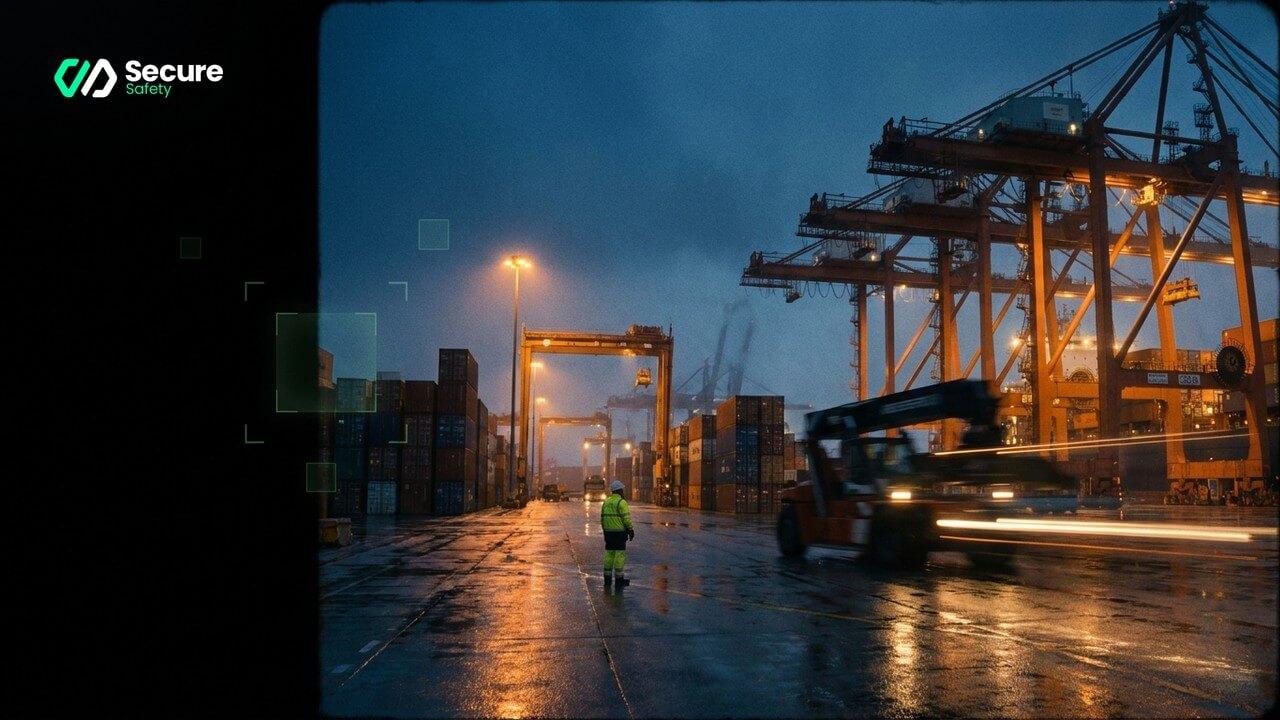
Stand at the edge of a container yard at three in the morning and you will understand the problem in about ninety seconds. A straddle carrier — a four-storey steel frame on eight tyres, carrying thirty tonnes of cargo — glides through a lane at fifteen miles an hour. Its driver sits high up in a cab with a blind spot that swallows a grown adult whole. Somewhere below, a lasher in high-vis crosses between the stacks to reach the next row. Neither can see the other for the two seconds that matter most.
Most of the time, nothing happens. The terminal has procedures. The worker knows the rules. The driver is experienced. And then one night, on one crossing, all three of those safeguards fail at once — and a family gets a phone call.
Container terminals are among the most dangerous industrial environments on the planet, precisely because they combine the two things safety professionals fear most: enormous moving machines and people on foot, sharing the same ground, around the clock.
Why the yard is uniquely hostile
A warehouse is a controlled box. A container terminal is a small, floodlit city that never sleeps, and it stacks hazards on top of one another.
The machines are blind by design. Straddle carriers, reach stackers and rubber-tyred gantry cranes are built to lift boxes, not to see the ground. Their operators sit metres above the deck, looking through a forest of steel corner-castings. A pedestrian standing in the wrong place is simply not in the picture.
The layout changes hour by hour. Stacks rise and fall as vessels are worked. A sightline that was clear on the morning shift is a canyon of forty-foot boxes by nightfall. Fixed guarding and painted walkways can't keep pace with a yard that rearranges itself every few hours.
It runs day and night, in every weather. Rain, sea fog, low winter sun off the water, sodium floodlights throwing long shadows — the conditions that most degrade human vigilance are the terminal's normal operating state.
The traffic is relentless. Quay cranes, internal tractor units, service vehicles and pedestrians all interleave under the clock of the berthing window. Every incentive on the yard pushes toward speed. Safety is the thing that quietly gets compressed.
What the cameras already see, and ignore
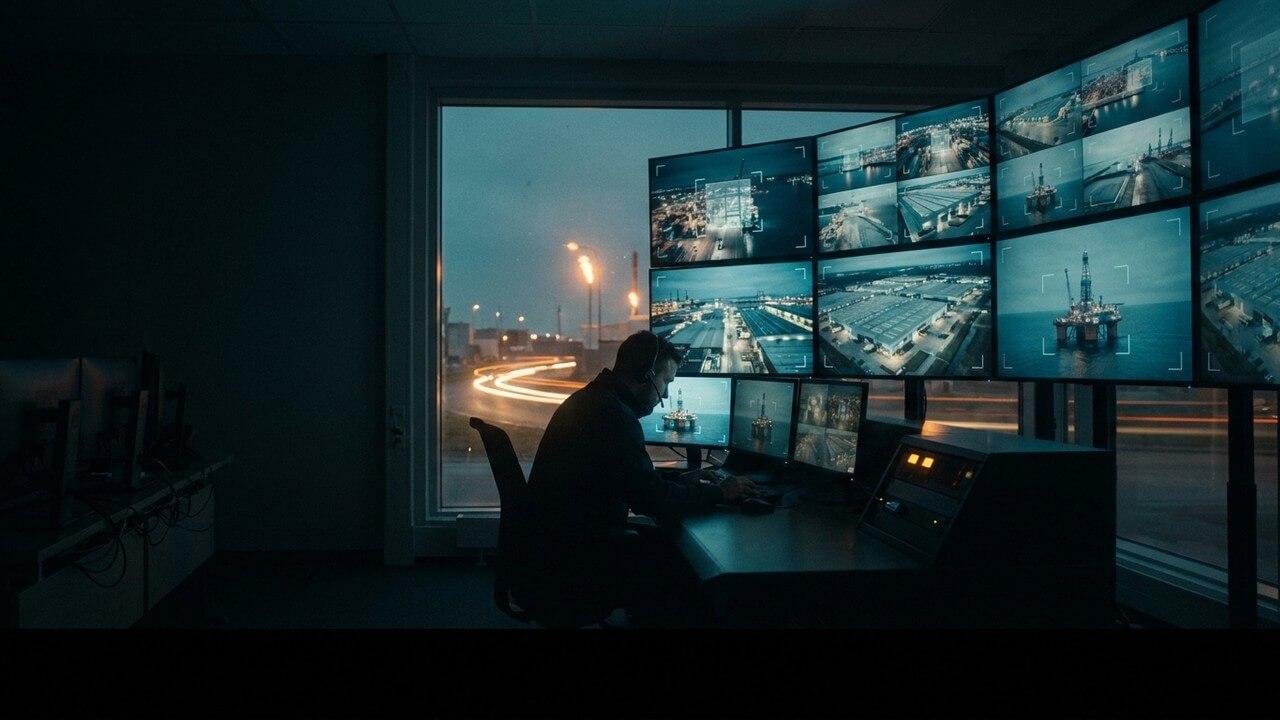
Here is the uncomfortable truth. Nearly every one of these near-misses is already being filmed. A modern terminal is saturated with CCTV — on the quay, over the interchange zone, down the traffic lanes, on the light masts. Those cameras record everything and prevent nothing. When a straddle carrier clips a walkway, the footage becomes evidence for the investigation, not a warning that could have stopped it.
The gap has never been the cameras. It has been the impossibility of a human watching forty screens at once, through the night, without blinking. That is the gap computer vision closes.
How AI safety monitoring works on a terminal
SecureSafety adds a perception layer to the CCTV you already own. No new masts, no trenching, no rip-and-replace. The software watches the existing feeds in real time and understands what it is looking at.
Straddle carrier and pedestrian conflict detection
The system tracks every machine and every person in frame and models the space between them. When a worker on foot enters the swept path of a moving straddle carrier — or strays into an interchange lane that should be clear — it fires an alert in the moment it matters, not in the post-incident report. Supervisors get a live warning; the event is logged with the clip attached.
Red-zone and restricted-area monitoring
Under-crane exclusion zones, the quay edge, live stacking rows — these are places a person on foot should never be while machines are working. Draw the zone once and the system holds the line, flagging any intrusion regardless of how the stacks shift around it.
PPE, speed and behaviour
The same layer verifies high-vis and helmet compliance, monitors vehicle speed through the lanes, and surfaces the patterns of unsafe behaviour that precede incidents — the shortcuts across live lanes, the habitual near-misses — so you can correct them before they mature into a RIDDOR entry.
Because it runs on-premise, none of this footage leaves the terminal. For an operator handling secure cargo and customs-controlled areas, the video stays behind your own fence, on your own hardware. That distinction matters to a port far more than it does to a warehouse.
Proven where the stakes are highest
This detection was not born in a lab. It was forged offshore, on drill floors — the most demanding safety environment there is, where heavy equipment swings over working crews and there is zero tolerance for error. It has since run in the operations of a national oil major, a major international port and an international airport, holding a sub-0.05% error rate and delivering field-measured reductions of around 90% in unsafe behaviour. A container yard is a hard problem. It is not a harder one than a moving drill floor in a heavy sea.
From evidence to prevention
The shift a port makes with this technology is not really about cameras or algorithms. It is about when you learn things. Today, a terminal learns about its worst moments after they happen — in the incident log, the insurance claim, the HSE file. AI moves that knowledge forward in time, to the two seconds before, when a warning can still change the outcome.
That is the whole proposition. Not more surveillance. Earlier knowledge. The same feeds you are already paying to record, finally doing something useful with what they see.
The busiest ports in the world move a box every few seconds. The margin for the person on foot in that yard is measured in seconds too. Closing that margin is exactly the kind of problem a machine that never blinks was built to solve.
Container terminal safety monitoring: the operational specifics
Gantry crane operations and drop zone management
Container cranes are the highest-energy lifting devices in any industrial environment: a 40-tonne container suspended from a ship-to-shore crane represents an enormous potential energy. The drop zone beneath a crane lift cannot be enforced by a banksman standing at the edge — the zone moves with the crane traverse and extends below the crane rail height on both the sea side and the land side simultaneously. Camera-based drop zone monitoring, integrated with the crane's traverse position data where available, enforces the exclusion beneath the load path continuously throughout the lift cycle.
The gate entry challenge
Container terminal gate entries are among the highest-risk pedestrian environments in logistics: a controlled flow of HGVs entering and exiting the terminal at speed, with port workers crossing the traffic flow for access to offices and facilities. AI speed monitoring and pedestrian zone monitoring at gate entries is the highest-priority monitoring deployment for most terminal operators, providing both real-time conflict detection and the speed violation data that supports gate entry traffic management decisions.
Night operations and variable lighting
Container terminals operate on a 24-hour cycle with vessel calls often requiring cargo operations through the night. Night operations with artificial lighting, the movement of high-sided containers that create deep shadow zones, and the concentration of activity on a narrow quayside create a monitoring challenge that requires cameras and detection models calibrated for the specific lighting conditions of each terminal. The Discovery phase camera survey includes night-time conditions as part of the standard assessment.
Implementation checklist for port and terminal deployments
- Crane operations integration: assess whether crane traverse and lift state data is available from the crane control system and whether integration to automate drop zone activation is technically feasible and operationally worthwhile
- Port Marine Safety Code documentation alignment: the deployment scope and compliance log outputs should be designed to support PMSC audit requirements from the outset — define the audit evidence requirements before the deployment is configured
- Multi-shift coverage verification: confirm that the alert routing and escalation chain is appropriate for all three shifts, including the night shift when control room staffing may be reduced
See what your cameras have been missing — book a demo.