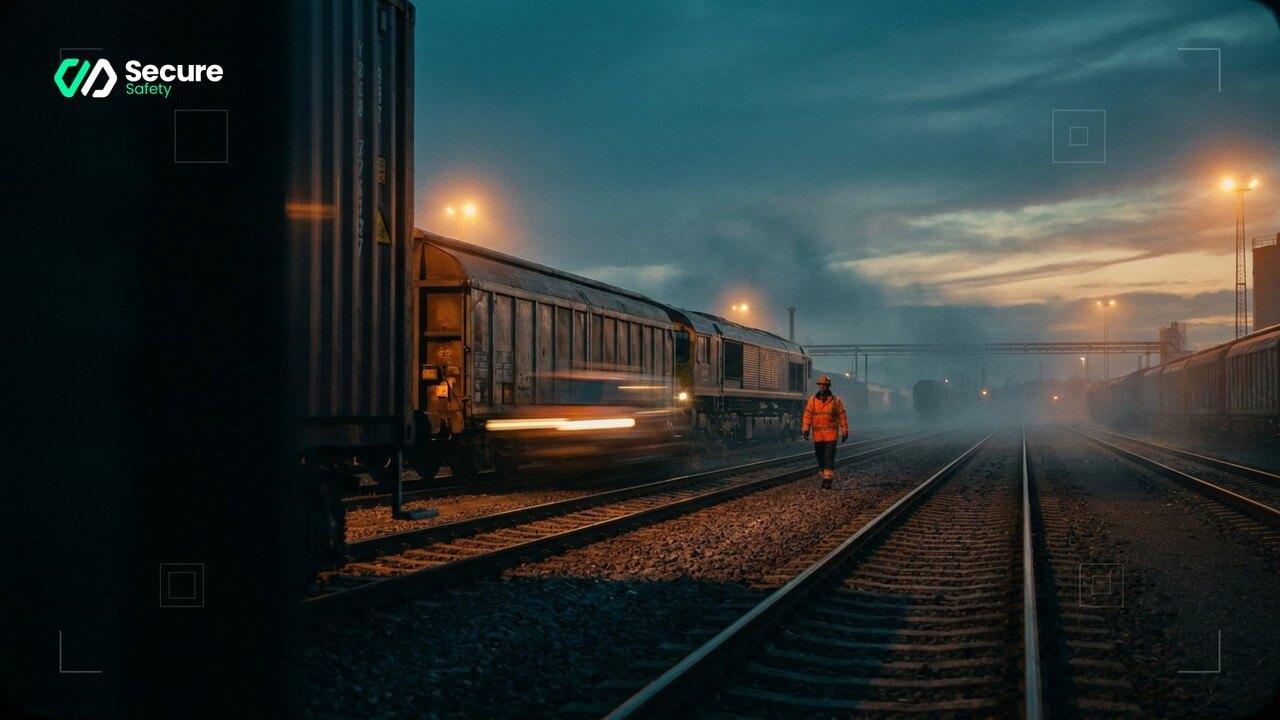
Every yard supervisor knows the sound. The dull steel clash of a wagon coupling in the half-light before the shift has properly begun, followed by the long, patient roll of a rake being drawn down the track. It is an ordinary sound, repeated a hundred times a day. And it is the sound of the single most dangerous machine on your site moving toward a person who cannot always hear it coming.
A rail or intermodal yard is a peculiar kind of hazard. Unlike a warehouse or a factory floor, the danger here is quiet, enormous and slow. A shunting locomotive weighs more than any forklift on Earth, stops in tens of metres rather than centimetres, and gives almost no warning. The worker on the ballast, radio to one ear and eyes on a coupling, is operating in the one environment where a moment of ordinary inattention can be irreversible.
The problem with a yard is that it is everywhere at once
The trouble is not that yards are careless places. Most are governed by rigorous rule books, safe systems of work, lookout protocols and possession procedures. The trouble is scale and sightline. A single intermodal terminal can run to several kilometres of track, dozens of reach stackers and side-loaders, road haulage crossing rail at grade, and a workforce spread so thinly across the site that no supervisor can see more than a fraction of it at any moment.
The classic yard incidents follow from exactly this geometry:
- Track worker struck or trapped during shunting, where a person on or near the running line is not seen by the movement team.
- Red-zone incursion, where someone crosses into a live shunting area, a fouling point, or the space between buffer and wagon.
- Vehicle–pedestrian conflict at the busy seam where road haulage, reach stackers and rail all converge.
- Coupling and uncoupling injuries, the close-quarters work between vehicles where a person is briefly invisible to everyone but themselves.
- PPE and exclusion-zone lapses on the apron, on gantry approaches, and around energised overhead lines.
Every one of these has been written into a rule. And rules, on their own, are silent. They cannot watch. They tell a worker what should happen; they do not notice when it doesn't.
What a watching layer changes
This is the gap that computer vision closes. Not by replacing the rule book, the lookout or the possession plan, but by giving them a tireless second pair of eyes across the whole yard at once.
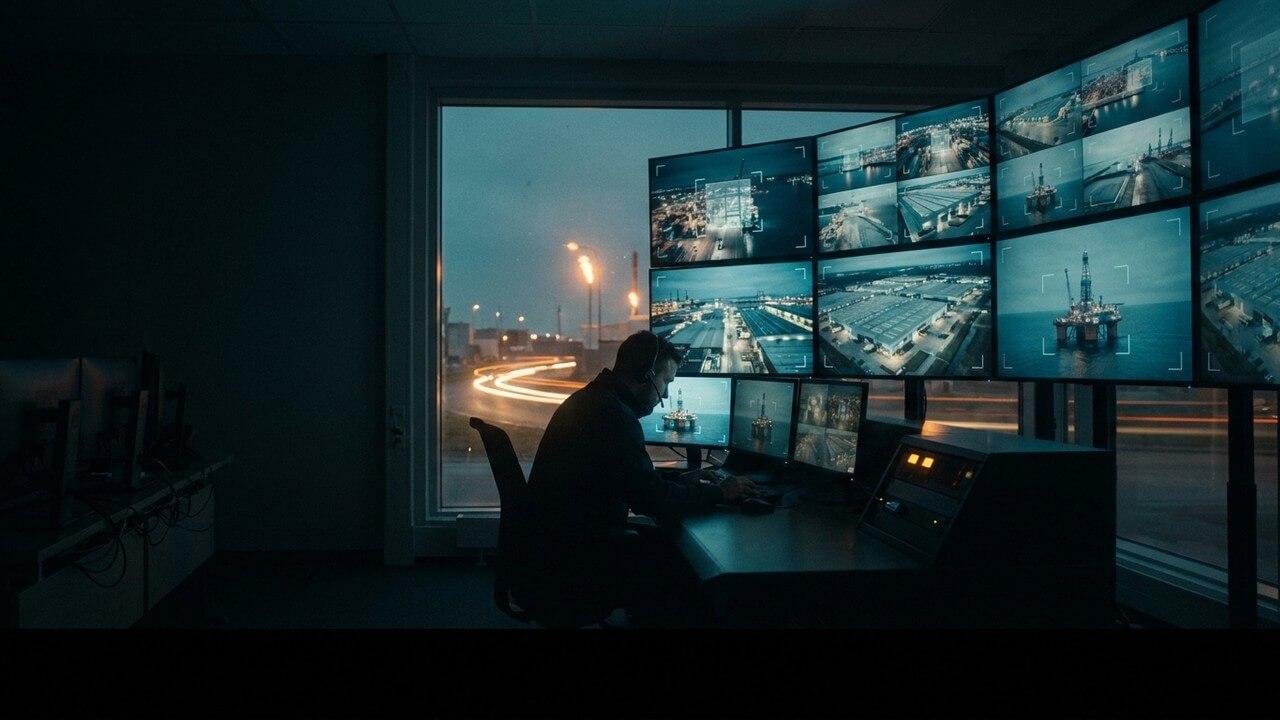
SecureSafety adds an AI detection layer to the CCTV you already have. There is no new hardware to trench in along the ballast, no cameras to hang on gantries, no cabling across live track. The software reads your existing feeds and understands what it is seeing: this is a person, this is a shunting movement, this is the space between them and it is closing.
When a track worker steps inside a defined red zone as a movement approaches, the system raises an alert in real time — to the yard control room, to a supervisor's screen, to whatever channel already carries your operational alarms. When a reach stacker and a pedestrian converge at the road-rail interface, it sees the conflict developing rather than reporting it afterward. It counts people into and out of a possession. It flags the missing hi-vis on the apron. It watches the coupling point that no human can watch continuously.
Because it runs on-premise, the footage never leaves your site. For a yard that sits inside critical national infrastructure, or under the eye of a rail regulator, that is not a convenience — it is a condition of even having the conversation.
Proven where the stakes are highest
It is fair to ask where a claim like this has been tested. Ours was forged offshore, on the drill floors of oil and gas — an environment with the same essential problem as a rail yard, only compressed into a smaller and less forgiving space. Heavy equipment in constant motion. People working within a metre of it. Zero tolerance for error, because the sea does not offer second chances. The detection has since run in a national oil major's operations, at a major international port and at an international airport, at a measured error rate below 0.05 percent, and in the field it has been associated with reductions in unsafe behaviour of around ninety percent. A yard full of slow, heavy, quiet machines is precisely the kind of place that pedigree was built for.
From incident report to leading indicator
The quieter benefit is the one that pays back longest. A yard that only measures safety by its incidents is steering by the wreckage in the mirror. Because the system logs every red-zone incursion, every near-conflict, every close approach that did not become a collision, it turns the invisible into data.
Over a month, patterns surface. One siding that generates incursions at shift change. One road-rail crossing where conflicts cluster after dark. One reach-stacker route that keeps bringing metal and people too close. These are the leading indicators a supervisor has always sensed but never been able to prove. With them, you can move a walkway, re-time a movement, or re-brief a crew before the incident that would otherwise have written the lesson for you.
Where to begin
You do not need to instrument the whole yard on day one. The sensible start is a single high-consequence zone — the shunting neck, the busiest road-rail interface, the coupling area with the worst near-miss record — running on the cameras already trained on it. Prove the detection where it matters most, measure what it catches, and extend from there.
The wagons will keep coupling in the half-light. The question is only whether anything is watching the space between the steel and the person standing in it.
Rail and intermodal yard safety monitoring: the specific challenges
The level crossing and vehicle-rail interface
Intermodal yards that include rail-served facilities face a specific vehicle-rail interface hazard that has no direct equivalent in road-only logistics environments. A road vehicle crossing an active rail line — even at a controlled level crossing — represents a collision risk that is qualitatively different from a vehicle-pedestrian conflict: the consequences of a collision between a reach stacker and a moving rail wagon are catastrophic. Camera monitoring at level crossings in intermodal yards, with real-time alert generation when a vehicle is detected on the crossing as a rail movement is active, provides the safety layer that the combination of signage and signalling cannot always guarantee.
Multi-modal handover zones
The handover zone between rail and road operations — where rail-served equipment transfers containers to road vehicles or vice versa — concentrates multiple vehicle classes, crane operations and pedestrian movements into a constrained area. AI monitoring of this zone combines vehicle-pedestrian conflict detection, crane drop zone management and speed monitoring into a single continuous layer that watches all three simultaneously.
Implementation considerations
- Rail movement status integration: for intermodal yards with SCADA-connected rail signalling, integration of rail movement status with zone activation provides automatic enforcement of level crossing exclusions based on current train position rather than relying on manual zone activation
- Multi-vehicle class detection: confirm that the detection models are validated for the specific vehicle mix on the site — reach stackers, terminal tractors, shunting locomotives and road vehicles in the same frame require a detection system that reliably distinguishes all four classes
See what your cameras have been missing — book a demo.