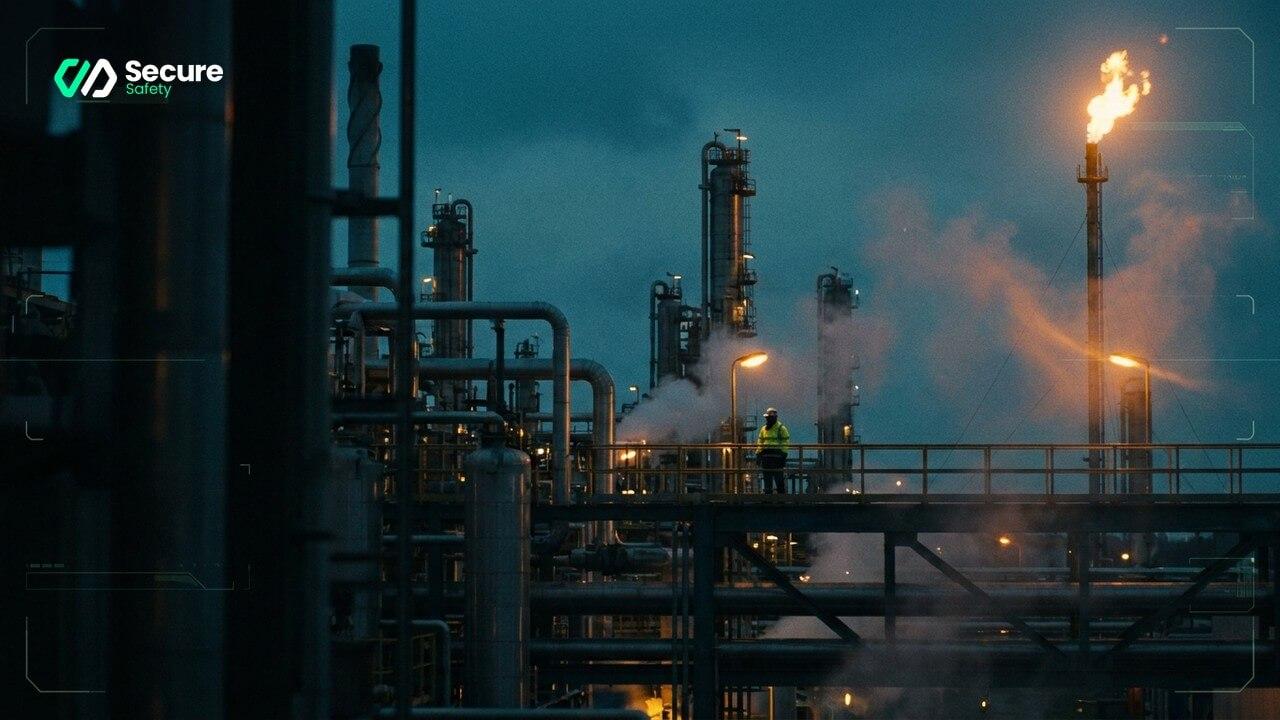
Every refinery process safety engineer knows the particular unease of a hot work permit. On paper it is a controlled operation: a grinder, a welding set, a cutting torch, signed off for a defined task in a defined place for a defined window of time. The gas test is clean. The fire watch is briefed. The extinguisher is racked. And then the shift wears on, the job runs long, someone drifts twenty metres to reach an awkward joint, and a shower of sparks arcs toward a drain, a vent, or a flange that was never part of the assessment. The permit still says everything is fine. Reality has quietly moved on.
This is the enduring problem of petrochemical safety. The most dangerous conditions are not the ones you plan for. They are the ones that develop, minute by minute, after the plan is signed.
The refinery is a landscape of invisible boundaries
Under DSEAR — the Dangerous Substances and Explosive Atmospheres Regulations — a refinery is carved into hazardous-area zones according to how likely an explosive atmosphere is to be present. Zone 0, 1 and 2 are not painted on the ground in any way a tired worker can reliably read at the end of a twelve-hour shift. They are lines on a drawing, translated imperfectly into the real world of pipe racks, bund walls and process units.
The whole discipline of ignition control depends on people respecting boundaries they cannot see, and on equipment being where the paperwork says it is. A non-rated phone in a pocket, a diesel bowser parked too close to a loading gantry, a hot work operation that creeps out of its cordon — each is a small breach of an invisible line. Any one of them, on the wrong day, is the ignition source in an incident report.
Traditional controls are procedural. They rely on the permit, the toolbox talk, the fire watch and the honesty of the moment. They are necessary. They are also, by their nature, blind between inspections.
What a camera can watch that a permit cannot
An AI safety layer does not replace the permit system. It watches the gap the permit cannot cover: the live reality of the work as it actually unfolds.
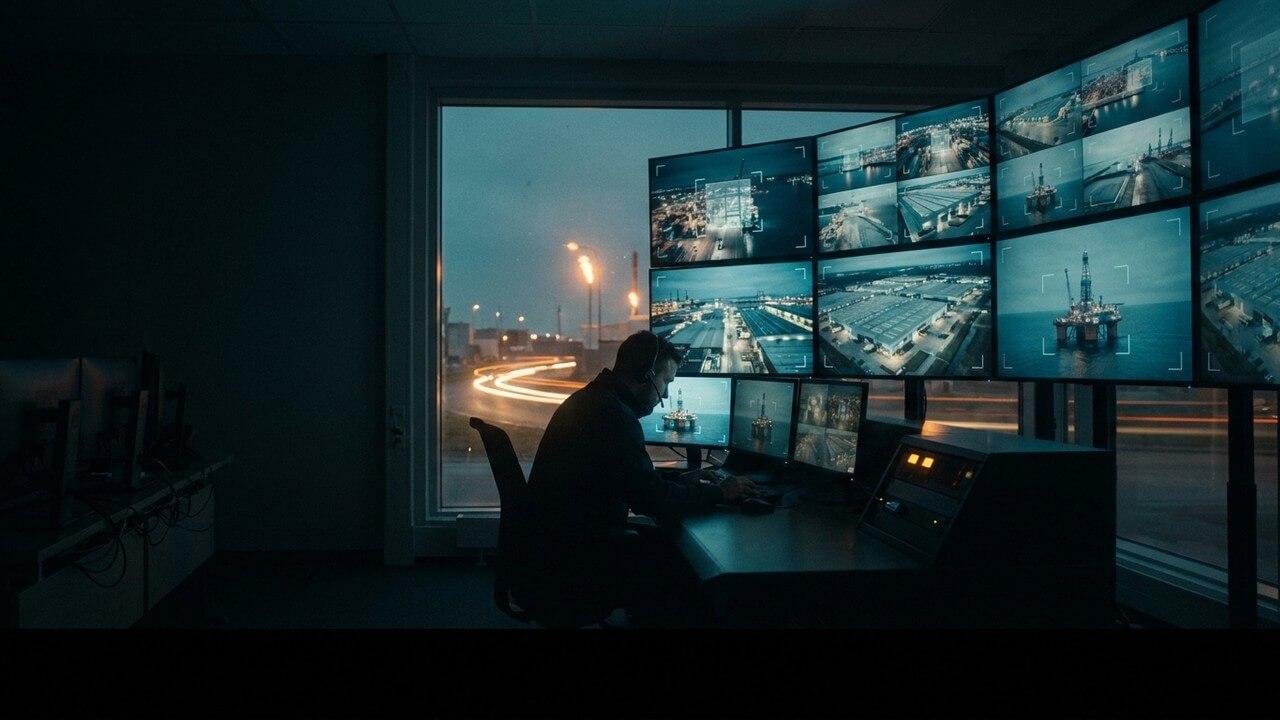
Applied to the CCTV a refinery already has, computer vision continuously monitors the things that turn a controlled task into an uncontrolled one.
Hot work that leaves its cordon
Define the permitted work area as a geofenced region. If the operation — the person, the spark signature, the equipment — moves outside that boundary, the system flags it in real time, not at the next fire-watch round. The digital cordon does not get tired, and it does not assume the job is going to plan.
Ignition sources in a hazardous zone
A vehicle idling inside a Zone 1 boundary. A worker entering a restricted process area without the right authorisation. Movement in a bunded area during a transfer. The system knows the zones because you draw them once, onto the camera view, and it holds those lines for every hour of every shift thereafter.
PPE and people, where it matters most
Flame-resistant clothing, helmets and high-visibility compliance, checked continuously rather than at the gate. People counting for a live muster during an alarm, so a supervisor knows in seconds who is still inside a unit rather than reconstructing it afterwards.
The first wisp of fire or smoke
In an environment where fire doubles in size in seconds, visual detection of flame or smoke — at the point it starts, not when it reaches a ceiling sensor high above an open process structure — buys the one commodity a refinery emergency never has enough of: time.
Proven where the tolerance for error is zero
It is worth saying plainly where this capability was forged. The detection models were developed not in a lab but on offshore drill floors — heavy moving equipment, hydrocarbons underfoot, and no acceptable margin for a missed hazard. They have since run in the operations of a national oil major, a major international port and an international airport, at a measured error rate below 0.05 per cent, with field-recorded reductions of around 90 per cent in unsafe behaviour. A refinery is a demanding environment. It is not more demanding than the one this technology grew up in.
On-premise, because your footage should not travel
There is an understandable reluctance, on any high-hazard COMAH site, to send operational camera feeds to someone else's cloud. So it does not happen. The AI runs on-premise, on hardware inside your own perimeter. Footage never leaves the site. What leaves — if you choose — is an alert: a notification to a control room or a supervisor's radio that something on the ground no longer matches the plan.
That distinction matters to your security team, your IT risk register and your regulator alike. Continuous monitoring should not mean continuous exposure.
From reactive paperwork to a live safety picture
The value is not that the machine watches the cameras. It is that it watches all of them, at once, without fatigue, and measures what it sees against the boundaries you have set. A DSEAR zone becomes a line the system actively holds rather than a line on a drawing. A hot work permit gains a witness that stays alert for the full duration of the job. A near miss that would once have been noticed only if someone happened to be looking becomes a logged, timestamped event you can act on and learn from.
None of this removes the engineer's judgement, the permit-to-work discipline or the fire watch. It makes each of them stronger by closing the interval between control and reality — the interval where refinery incidents are born.
Your cameras are already pointed at the hazard. They are simply not being asked to think.
DSEAR and AI: the compliance workflow
Zone-by-zone documentation approach
DSEAR compliance documentation for a refinery or chemical plant requires a zone-by-zone record of the classified areas, the controls in place for each zone, and the monitoring evidence that confirms the controls are effective. For zones where camera monitoring is the primary behavioural control layer, the AI system's compliance log provides the continuous monitoring evidence that the zone record requires. Each zone in the DSAR documentation can reference the camera coverage and the detection log as evidence that the PPE and access controls are being continuously monitored.
The permit-to-work connection
Almost all work in classified zones on a refinery is controlled by permit-to-work. The AI monitoring layer at zone entry points complements the permit system by providing a continuous visual check that only permitted personnel with the correct PPE are in the zone, and that the zone is immediately vacated when an unplanned event (instrument alarm, spillage) triggers an emergency response. The combination of PTW documentation and AI monitoring compliance log creates a two-layer audit trail for regulators and insurance surveyors.
Implementation checklist for DSEAR-site deployments
- ATEX zone map: obtain the site's current ATEX zone classification documentation before specifying camera hardware — all cameras in Zone 1 or Zone 2 areas must be ATEX-rated and connected via appropriate cable glands
- PTW system integration scope: define the integration between the AI monitoring system and the permit-to-work platform during Discovery — the integration scope determines whether zone activation can be triggered automatically by permit issue or requires manual control room action
- COMAH safety report alignment: confirm with the site's process safety team that the AI monitoring deployment is consistent with the monitoring controls described in the COMAH safety report before go-live
See what your existing CCTV has been missing across your DSEAR zones — book a demo.