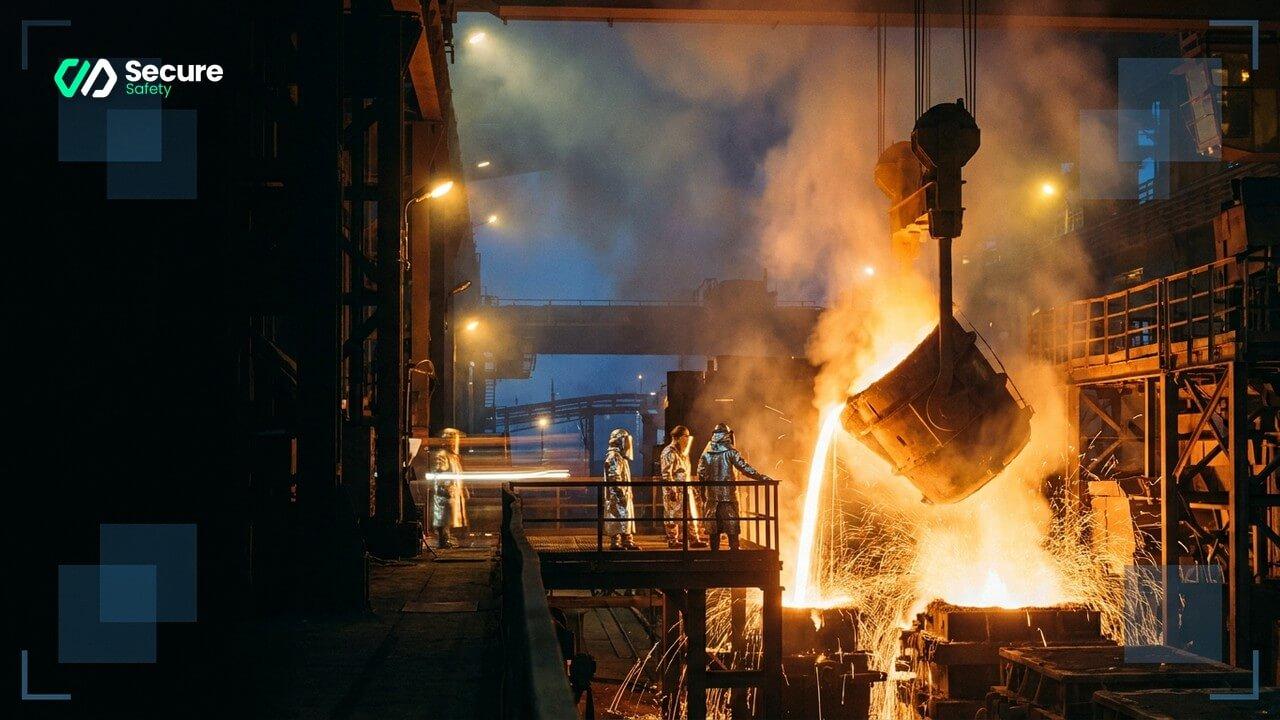
Every melt-shop supervisor knows the sound. The low roar of the furnace, the hiss as the ladle tilts, and then the pour — a ribbon of metal at 1,600 degrees Celsius arcing into the mould, throwing sparks that die on the concrete like fireflies. It is a controlled event, rehearsed a thousand times. And it is one wet floor, one stray pedestrian, one distracted crane operator away from catastrophe.
Steel and heavy-metals production is one of the few industries where a single lapse does not injure — it maims, or kills, in seconds. There is no time to react to molten metal. The margin of error is not thin. In many cases, it is zero.
The hazards that don't forgive
Most industrial safety systems are built for a world where you get a warning. A gas alarm sounds; you evacuate. A machine jams; you lock it out. The metals industry is less forgiving. Its signature dangers are fast, silent until the instant they aren't, and often invisible to a control room watching a wall of static CCTV feeds.
Molten metal contact and steam explosions. The gravest risk in any foundry or steelworks is liquid metal meeting moisture. A damp ladle, water pooled in a mould pit, a leaking cooling line — any of these can trigger a steam explosion that hurls molten material across the bay. The precursors are visible long before the event: standing water, a person crossing a pour path, a vessel moved without clearance.
Hot-work zones and pedestrian conflict. Charging cars, transfer ladles, and overhead cranes move enormous mass through tight corridors shared with people on foot. A worker stepping into a transfer aisle during a lift is a familiar line in far too many incident reports.
PPE at the edge of tolerance. In the heat of a melt shop, the temptation to lift a visor, loosen an aluminised jacket, or skip the spats is constant. The very discomfort of proper protection is what makes non-compliance so common — and so quietly dangerous around radiant heat and spatter.
Fire, slag, and dropped loads. Sparks find combustibles. Slag pots overflow. Loads shift on the crane. Each is a known failure mode, and each announces itself with a visual cue in the seconds before it goes wrong.
Why cameras see what rosters miss
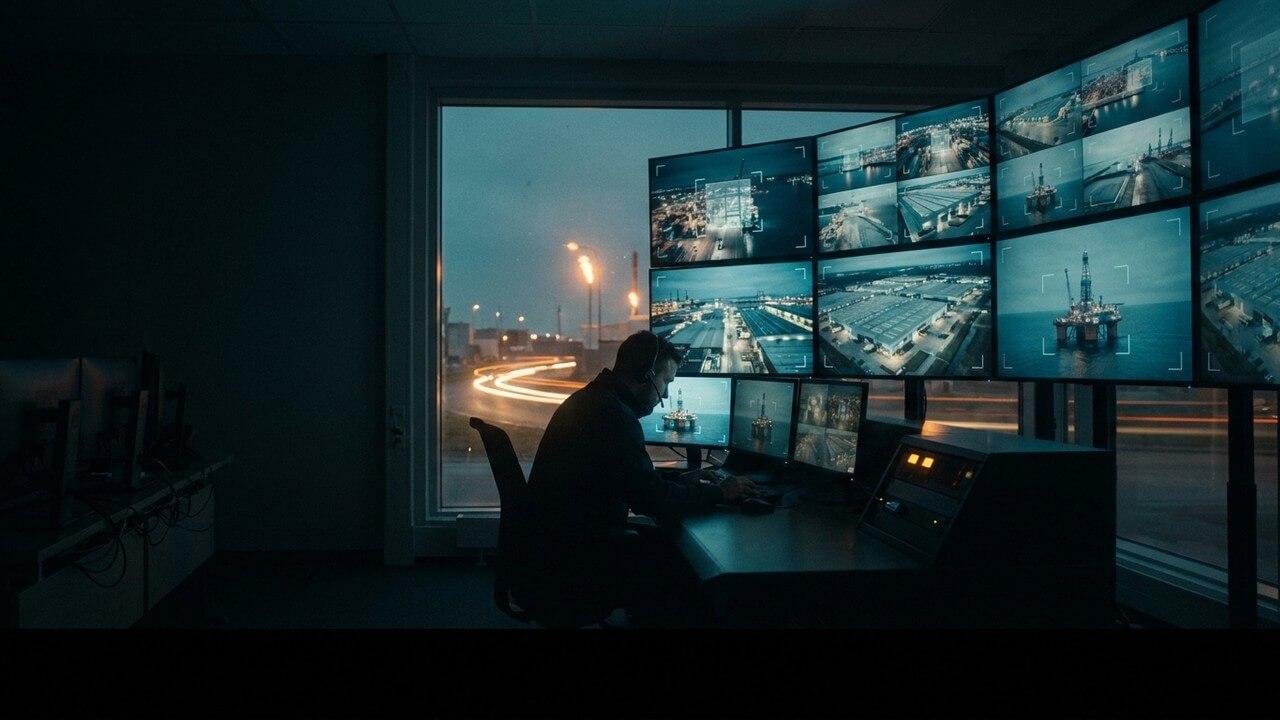
The uncomfortable truth is that most metals plants already have eyes on these hazards. They have dozens, sometimes hundreds, of cameras. What they lack is anyone able to watch all of them, all the time, without blinking.
A human monitor can hold perhaps four or five feeds in useful attention. Fatigue sets in within the hour. The one camera showing a worker drifting toward a pour line is, statistically, the one nobody is looking at when it matters.
This is precisely the gap computer vision was built to close. An AI safety layer watches every feed at once, without fatigue, and flags only the moments that need a human decision — a person in a restricted zone during a pour, a missing aluminised jacket at the furnace door, standing water where a ladle is about to travel, the first flicker of an unplanned fire. It does not replace your safety team. It gives them a hundred tireless pairs of eyes and tells them where to look.
No new hardware, no footage leaving site
Two objections usually arrive together in heavy industry. The first: we are not rewiring a live plant for a software experiment. The second: our footage does not leave this site, ever.
Both are answered the same way. A modern AI safety platform is a software layer that runs on the CCTV you already own. No new cameras, no cabling through a hot mill, no capital project. And it runs on-premise — the video is analysed inside your own perimeter and never travels to a cloud. For a sector where process footage is commercially sensitive and sites are often security-controlled, that distinction is not a nicety. It is a condition of entry.
Forged where the stakes were highest
It is fair to ask where a system like this earns the right to stand in a melt shop. Ours was not built in a lab. The detection was developed on offshore oil and gas drill floors — heavy moving equipment, zero tolerance for error, lives at stake with every operation — and hardened in national oil-major operations, a major international port and an international airport. In the field it has run at a sub-0.05% error rate and is credited with reductions of around 90% in unsafe behaviour where it has been deployed. The environments differ. The discipline of watching dangerous, fast-moving industrial work without missing the one frame that matters does not.
From alert to habit
The value of catching a single near-miss is obvious. The deeper value is quieter, and it compounds.
When a system flags every instance of a worker entering a hot-work zone without clearance, or crossing a transfer aisle during a lift, those flags become data. Patterns emerge. You learn which shift, which bay, which handover produces the most breaches — and you fix the cause, not the symptom. Unsafe behaviour that once went unrecorded because nobody saw it becomes a measurable, falling number on a chart your safety committee reviews.
That is how a real safety culture is built in heavy industry: not by posters, but by making the invisible visible, consistently, until the safe way becomes the only way anyone remembers working.
The economics of a molten margin
A single molten-metal incident carries costs that dwarf any monitoring budget — the human toll first, then the investigation, the enforcement action, the lost production while a bay sits idle. Against that, a software layer on existing cameras is among the least expensive safety interventions a metals plant can make, and one of the few that works every shift without being asked.
Steel has been made by people willing to work close to fire for as long as we have made it at all. That will not change. What can change is how many of them go home whole.
AI monitoring in steel and heavy metals: the specific applications
Molten metal and high-temperature zone management
Steel production environments include areas where the presence of personnel during specific operations creates a risk of severe injury from molten metal, radiant heat, or steam explosion from moisture contact. These areas require strict zone enforcement during tapping, casting, and pouring operations. Camera-based zone monitoring that activates based on the operational state of the furnace or casting machine provides continuous exclusion enforcement without requiring a banksman to be stationed at the zone boundary throughout a long casting run.
Overhead crane and ladle operations
The transfer of molten metal in ladles by overhead crane is a high-consequence operation where a ladle failure or crane incident would have catastrophic consequences. Camera-based monitoring of the ladle travel path, enforcing a clear exclusion beneath the ladle for the full duration of the transfer, is the monitoring layer that provides continuous enforcement of the exclusion that manual banksman-based enforcement cannot maintain at scale.
Dust and fume environments
Steel and metals production environments involve significant airborne particulate and fume, which affect camera image quality and create specific challenges for PPE monitoring. The detection models must distinguish between smoke from an incipient fire and normal production fume; between a respiratory protection issue and a worker in fume shadow. Characterisation of the specific visual noise conditions in each monitored area is a critical part of the Discovery phase for steel and metals deployments.
Implementation checklist for steel and metals deployments
- High-temperature camera housings: cameras monitoring furnace taphole areas, casting machines and ladle handling areas require thermally protected housings rated for radiant heat levels at the installation distance
- Fume and dust camera characterisation: during Discovery, identify the specific fume and dust levels at each monitoring point and confirm that camera sensitivity and housings are appropriate for sustained operation in those conditions
- Operational state integration: assess whether furnace and casting machine operational state data is available via the plant control system and whether integration to automate zone activation is technically feasible
Steel and heavy metals safety: the critical monitoring points
This post already covers the key monitoring applications. See the additional context below for implementation guidance.
Tapping and casting exclusion management
Electric arc furnace tapping operations and continuous casting operations create temporary high-hazard zones that are active for a defined period during each heat. The exclusion zone around an EAF tapping bay during a tap is an absolute exclusion — no personnel who are not directly involved in the tap operation should be within the defined radius. Camera-based zone monitoring that activates automatically based on the furnace operational state (integrated with the melt shop control system) provides continuous exclusion enforcement without requiring a dedicated banksman for each tap.
Implementation checklist for steel deployments
- Furnace state integration: assess whether the furnace PLC or melt shop SCADA can provide operational state signals to trigger zone activation — this is the most reliable zone management approach for tapping and casting operations
- Crane path monitoring configuration: define the load path for each overhead crane in the melt shop and configure the drop zone for the full traverse distance, not just the ladle destination
- Radiant heat camera specifications: cameras monitoring areas adjacent to active furnaces and casting machines must be specified for the radiant heat levels at the installation distance — the Discovery phase thermal survey confirms the appropriate specification for each monitoring point
See what your cameras have been missing — book a demo.