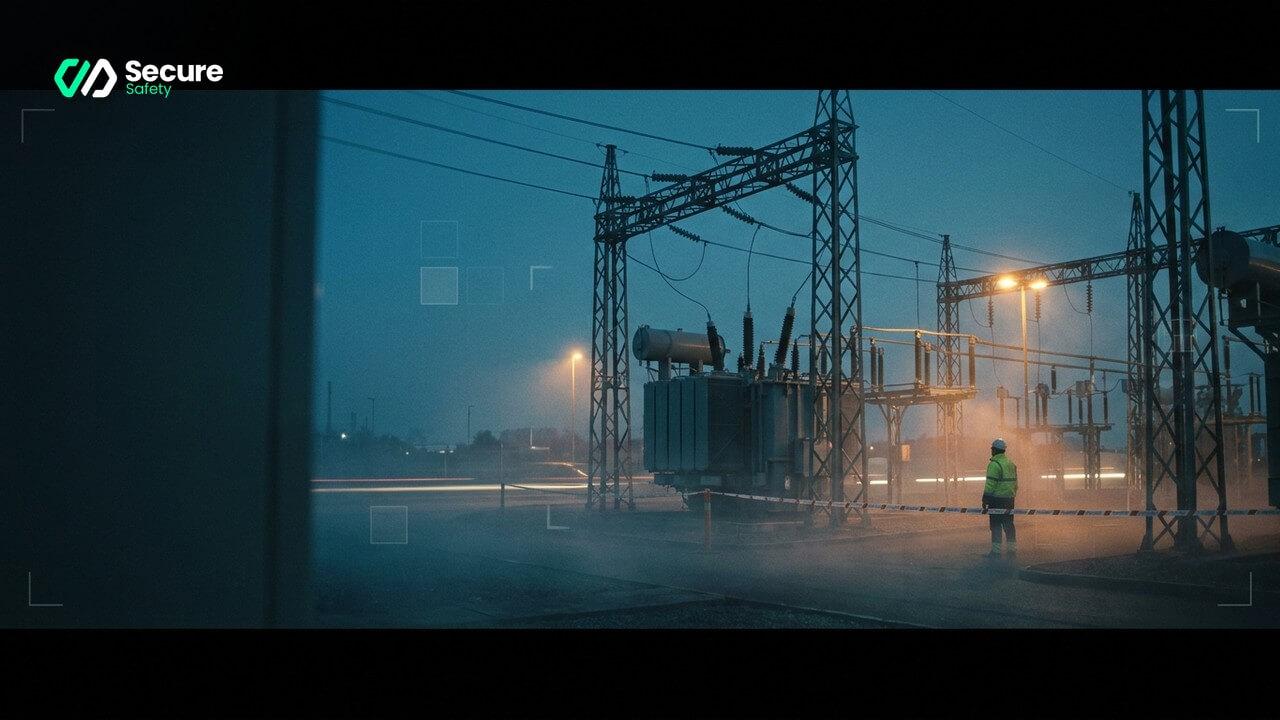
Every substation engineer knows the deceptive calm of a switchyard on a clear morning. The gantries hum. The transformers tick as they warm. Nothing moves, and that stillness is the trap, because the most dangerous thing on the site is invisible, silent, and utterly indifferent to how careful you usually are. A live busbar gives no warning. There is no heat you can feel from a safe distance, no sound to flinch from. The boundary between an ordinary shift and a fatality is a painted line on concrete and the memory of a permit briefing that happened three hours ago.
This is the particular cruelty of electrical work. In most industries, a hazard announces itself. A reversing vehicle beeps. A hot surface glows. In a switchyard, the energy that will kill you looks exactly like the energy that will not. Safety depends entirely on people respecting distances they cannot see, in an environment engineered to look serene.
The hazards that paperwork cannot watch
The utilities sector runs on procedure, and rightly so. Permits to work, isolation and earthing procedures, approach-distance tables, competent-person sign-offs — these are the accumulated wisdom of an industry that has buried its lessons. They are indispensable. They are also, by their nature, snapshots. A permit describes what should happen. It cannot see what does.
Consider where things actually go wrong in substations, switchyards and generation plant:
- Approach-distance breaches. A worker steps closer to energised equipment than the safe clearance allows — reaching for a tool, taking a shortcut across a bay, or simply losing spatial awareness in a lattice of steel that all looks the same.
- Wrong-bay entry. The isolation is on bay three. The work is on bay three. But the site has six identical bays, and the one thing standing between a technician and a live apparatus is that they walk through the correct gate.
- Contractor unfamiliarity. Outage seasons bring crews who do not know the site, working long hours against a schedule, in a yard where every local shortcut carries a lethal assumption.
- PPE lapses. Arc-flash-rated clothing, insulating gloves, face shields — the protection is only protection if it is worn at the moment it is needed, not slung over a shoulder because the task "will only take a second".
- Lone working. Remote grid assets are often unmanned. A collapse, a fall, a shock — and there is no one within earshot to raise the alarm.
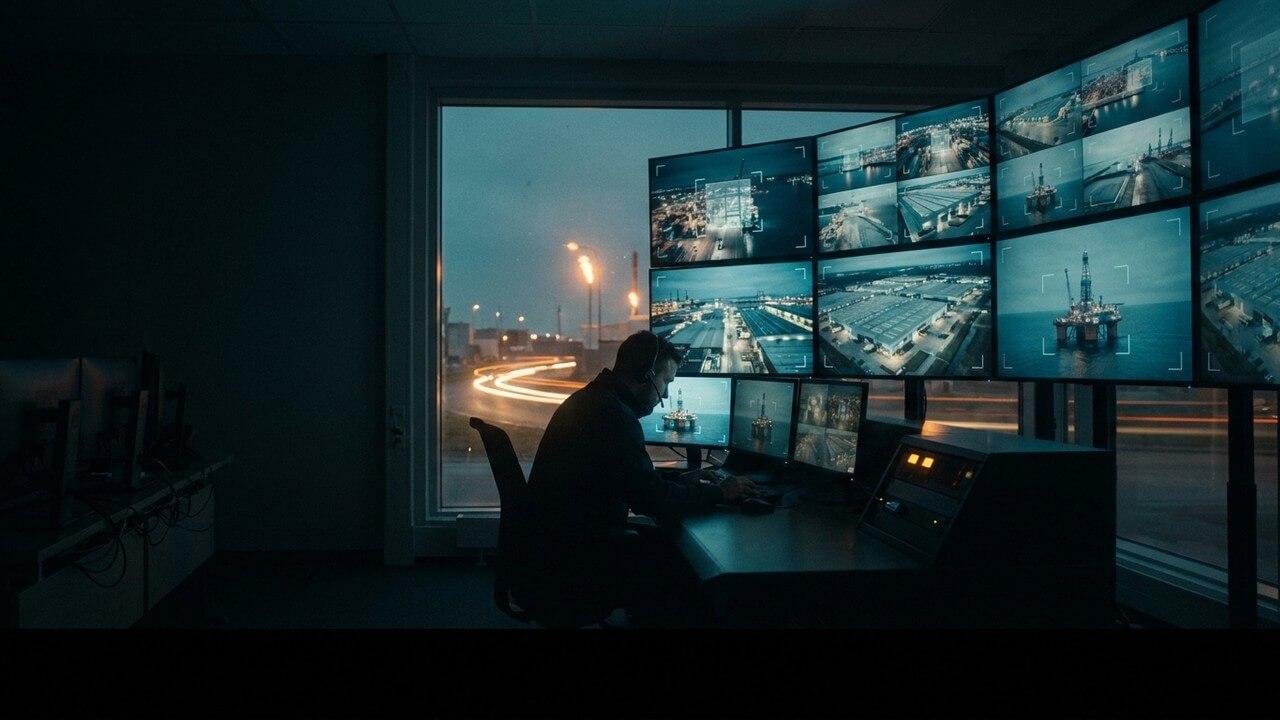
Each of these is a breach of a boundary that exists only on a drawing or in a briefing. None of them is reliably caught by a control room watching a wall of camera feeds that no human being can meaningfully monitor for eight hours at a stretch.
What a camera can see that a checklist cannot
An AI safety layer does not replace your permit system, your isolation procedures or your competent persons. It watches the gap between the plan and the shift — the live reality of the yard as the work actually happens.
Using the cameras you already have, computer vision can hold an exclusion zone as a persistent, geometric fact rather than a painted suggestion. Draw a virtual boundary around an energised bay, a transformer compound or a switch house, and the system watches it continuously. The instant a person crosses it — or lingers at a marginal approach distance — an alert reaches the control room or the supervisor's phone in seconds, while there is still time to act.
The same layer recognises whether arc-rated PPE is being worn in the areas that demand it, flags a person who has gone to ground and not got up, counts and categorises who is present in a compound, and distinguishes an authorised route from a wrong turn into a live bay. It does not tire. It does not glance away at hour seven. It watches every camera, every bay, every second, with the same attention it had at the start of the shift.
Forged where the margin for error is zero
This detection was not born in a laboratory. It was built in offshore oil and gas, on drill floors — heavy moving steel, high energy, and no tolerance for a missed hazard, where a lapse is measured in lives. It has since been proven in the operations of a national oil major, a major international port and an international airport, running at a sub-0.05% error rate and delivering field-measured reductions of around 90% in unsafe behaviour. A switchyard presents a different hazard, but the same discipline: an unforgiving environment where the difference between a normal day and a coroner's inquest is a boundary respected or a boundary crossed. That is precisely the problem this technology was engineered to solve.
On-premise, because the grid is critical infrastructure
Utilities do not have the luxury of casual data governance. Substation and control-room footage is sensitive, and much of it sits under critical-national-infrastructure obligations. The SecureSafety layer runs entirely on-premise. Video is analysed on site and never leaves it — nothing is streamed to an external cloud, nothing is stored beyond your own network. You gain the vigilance without surrendering the footage, which is usually the difference between a system your security team will approve and one they will veto.
From lagging reports to a leading indicator
The deeper prize is not any single caught breach. It is the data. Every exclusion-zone approach, every PPE lapse, every wrong-bay near miss becomes a logged, timestamped, reviewable event. Instead of learning about unsafe behaviour only when it finally produces an injury, you can see the pattern building — which bay, which crew, which hour of which shift keeps generating breaches — and intervene before the pattern completes itself. Safety stops being a stack of incident reports written after the fact and becomes a live picture of how your sites actually behave.
A switchyard will never look dangerous. That is the whole problem, and it is exactly why it repays a system that watches the invisible boundaries so your people do not have to trust their memory of where the lines are.
Utilities and power infrastructure safety monitoring
Electrical exclusion zones and live equipment management
Work near live electrical equipment is subject to the specific requirements of the Electricity at Work Regulations 1989 and the associated HSE guidance on work in the vicinity of overhead lines and underground cables. Camera-based exclusion zone enforcement around live high-voltage equipment provides the continuous monitoring layer that complements the physical barriers and permit-to-work controls required by the regulations. A zone that is enforced only when a supervisor is present is not compliant with the regulations' requirement for adequate precautions at all times.
Substation and transformer compound monitoring
Network substations and transformer compounds are typically unmanned for extended periods, accessed by lone engineers for planned maintenance and emergency response. The combination of camera-based zone monitoring at the compound entry with wearable man-down monitoring for engineers working inside provides the monitoring coverage that the lone worker guidance requires for high-voltage environments. The on-premise architecture is particularly relevant here: many substation sites have limited or expensive telecommunications infrastructure that makes cloud-dependent systems impractical.
Water treatment and pumping station monitoring
Water infrastructure sites — treatment works, pumping stations, booster installations — are often remote, operate with minimal staff, and involve confined space entry, chemical handling (particularly chlorine and other disinfection chemicals) and working near water. AI monitoring at these sites addresses the lone-worker dimension primarily, with camera coverage of the main working areas supplemented by wearable monitoring for workers in areas without camera coverage.
Regulatory context for utilities monitoring
- Electricity at Work Regulations 1989 — requirements for work near live electrical equipment, applicable to monitoring of high-voltage zone exclusions
- Water Industry Act 1991 — safe system of work requirements for water infrastructure workers
- The Confined Spaces Regulations 1997 — applicable to maintenance activities in network chambers, plant rooms and tanks
- Network and Information Systems (NIS) Regulations 2018 — security and resilience obligations that complement the safety monitoring requirements
See what your cameras have been missing — book a demo.