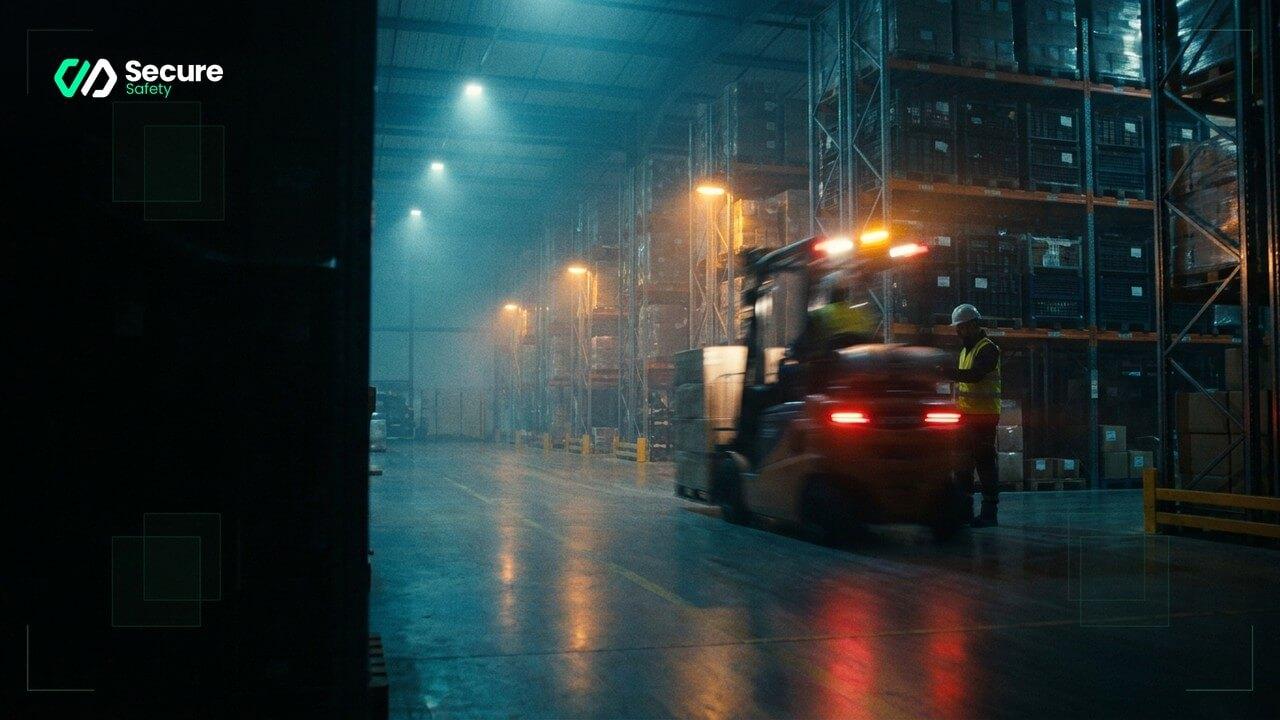
Walk the floor of a modern distribution centre at the start of a peak shift and you are watching a machine made of people. Pickers move against a clock. Forklifts thread between racking and pallet stacks. A reversing HGV noses onto a loading bay while a colleague crosses behind it, arms full, eyes on the label in his hand. The choreography is astonishing, and for the most part it works. Then a single misjudged metre — a blind corner, a phone glance, a pallet left where it shouldn't be — turns routine into a near miss. Or worse.
The logistics industry has spent a decade making the warehouse faster. Slotting optimisation, conveyor automation, wearable scanners, robots that bring the shelf to the picker. Throughput is measured to the second. Yet the same building that knows exactly how many units left the dock each hour often has no idea how many times a worker stepped into the path of a truck.
That is the gap the smart warehouse still leaves open. And it is the one worth closing next.
Speed and safety are not a trade-off
There is an old assumption in logistics that safety and productivity pull against each other — that every barrier, one-way system and speed limit is a tax on output. It is a false economy. The incidents that actually stop a warehouse are not the safe behaviours. They are the collisions, the falls, the racking strikes, the fire in a battery-charging bay. A single serious injury shuts an aisle, triggers an investigation, and pulls your best people off the floor for days.
A genuinely smart warehouse treats safety as part of the same operating picture as throughput — measured, visible, and acted on in real time. Not a clipboard audit once a quarter. A live signal, every shift.
The camera that already sees everything
Here is the quiet irony of most distribution centres: nearly every dangerous moment is already on film. You have cameras over the loading bays, along the main thoroughfares, above the mezzanine, watching the yard. They record faithfully. They prevent nothing. When something goes wrong, the footage becomes evidence for the insurer and the regulator — a recording of the accident you wanted to avoid.
AI video analytics changes what those cameras are for. Instead of passively recording, a computer-vision layer watches the feed the way an ideal safety officer would — everywhere at once, without blinking, without a break — and raises the alarm in the moment a hazard forms rather than after it has cost someone.
Crucially, this is a software layer on the CCTV you already own. No new sensors bolted to every forklift. No wearables to charge and issue. No rip-and-replace. The infrastructure is on the ceiling already; it has simply been under-employed.
What it watches for on a logistics floor
The hazards in a warehouse are specific, and a system worth having is tuned to them rather than sold as a vague promise of "insight":
- Vehicle–pedestrian conflict. The defining risk of any logistics site. The system flags a person entering a forklift or HGV path, a worker on a vehicle-only route, or the blind-corner moment where two paths are about to cross.
- Segregation and red-zone breaches. Pedestrian walkways, exclusion zones around reversing bays, the area behind a tail-lift — any incursion is caught the instant it happens.
- Falls and person-on-the-ground. From a mezzanine, a ladder, a loading dock, or a straightforward slip. The system distinguishes a person who has fallen from one who is crouching, and escalates.
- Speed monitoring. Forklifts and MHE moving too fast for a zone, detected without a single onboard telematics box.
- PPE compliance. Hi-vis and hard hats where the rules require them, checked continuously rather than at the gate.
- Fire and smoke. Early optical detection — particularly valuable around lithium-battery charging areas, where minutes matter more than a smoke detector's threshold allows.
- Dropped objects and blocked routes. A pallet in a fire escape, a spill in an aisle, an obstruction on a walkway.
Each detection is a chance to intervene before the incident, not a line in a report after it.
Proof from a harder place than your warehouse
It is fair to ask whether detection like this holds up in the mess of a real working floor — the clutter, the poor light, the constant movement — or whether it only works in a demo.
The honest answer is that this technology was not born in a warehouse. It was forged offshore, on the drill floors of oil and gas platforms, which is about the most demanding safety environment there is: heavy equipment in constant motion, salt spray and shifting light, zero tolerance for error, and lives genuinely at stake. It has since run in the operations of a national oil major, at a major international port, and inside an international airport, at a sub-0.05% error rate, with field-measured reductions of around 90% in unsafe behaviour once teams could see and correct what the cameras caught. A distribution centre, for all its complexity, is not a harsher test than a drill floor in heavy weather.
What managers actually get
The point of all this is not more data. It is fewer incidents and a floor that runs without interruption.
An alert reaches a supervisor's screen or radio the moment a hazard forms, so the reversing truck stops, the pedestrian is called back, the spill is cleared. Over weeks, the pattern in the alerts tells you something an audit never could: which corner, which shift, which crossing point keeps generating near misses — so you can re-route traffic or move a rack before anyone is hurt. And because it runs on-premise, none of your footage leaves the building. There is no cloud upload of your people or your operation; the analysis happens on site, and the video stays there.
The smart warehouse has already proven it can move goods faster. The next measure of intelligence is whether it can send everyone home in the same condition they arrived.
What changes when AI safety monitoring goes live in a logistics facility
The first 30 days: establishing the baseline
The most valuable output of the first 30 days is not the alerts themselves — it is the baseline data. Before the monitoring starts changing behaviour, it shows you what your site looks like without enforcement. How many vehicle-pedestrian near-misses are there per shift? Which crossing points generate the most events? Which forklifts exceed the speed limit most frequently, and at what time of day? This data is typically uncomfortable the first time it is presented to operations leadership, because the honest answer is "more than you thought." It is also the foundation of every subsequent improvement.
The behaviour change window: 30–90 days
The deterrence effect of consistent, visible monitoring typically takes three to six weeks to become measurable. Drivers slow down not because they are being watched in a given moment but because they now know that speed is measured on every run. PPE compliance improves not because supervisors are walking the floor more but because every gate entry is checked and the result is logged. The mechanism is not surveillance — it is the replacement of inconsistent, selective enforcement with consistent, impersonal enforcement. The same behaviour standard applies at 3am on a quiet shift as at 9am during the peak.
The data-driven improvement cycle: 90 days onwards
By the end of the first quarter, the detection data is rich enough to support engineering decisions. The crossing point with the highest near-miss frequency is the crossing that needs physical redesign. The aisle with the most speed violations is the aisle where the layout rewards shortcut behaviour. The battery charging area that keeps generating smoke alerts is the area that needs a ventilation review. These interventions are not speculative — they are targeted at the exact locations the data keeps naming. This is the shift from reactive safety management (responding to incidents) to proactive safety management (removing the conditions that cause them).
Regulatory context: what UK logistics operators are required to demonstrate
The Workplace (Health, Safety and Welfare) Regulations 1992 require employers to organise traffic routes to ensure pedestrians and vehicles can circulate safely. The Management of Health and Safety at Work Regulations 1999 require employers to make and give effect to arrangements for the effective planning, organisation, control, monitoring and review of the preventive and protective measures. RIDDOR (Reporting of Injuries, Diseases and Dangerous Occurrences Regulations 2013) requires reporting of workplace injuries meeting specific thresholds, including over-three-day injuries and fatalities.
What these regulations require, in practice, is not just that controls exist but that they work and that evidence of their working can be demonstrated. An AI monitoring system provides exactly this: a continuous, timestamped record of the controls in operation (zone enforcement, PPE checking, speed monitoring) and their effectiveness (alert rates, response times, incident frequency). This record is the response to the HSE inspector who asks "how do you know your traffic management controls are being followed?" A verbal answer is not sufficient. A data-backed answer from a continuous monitoring system is.
Implementation checklist for a logistics AI safety deployment
- Site hazard map: before specifying any detection, walk the site and list the specific hazards in priority order — not all hazards are equal, and the monitoring should address the highest-risk scenarios first
- Camera coverage assessment: identify which areas are well-covered by existing cameras and which have gaps; determine whether gap-filling cameras or wearable monitoring is more appropriate for the uncovered areas
- Traffic route review: use the pre-deployment walkthrough as an opportunity to review the current traffic management plan and identify any routes, crossings or layouts that are hazardous regardless of monitoring
- Shift-based configuration: determine whether different detection rules apply to different shifts — a night shift with lower pedestrian foot traffic may have different appropriate thresholds than a peak day shift
- Integration with HR and performance management: agree in advance how speed and PPE data will be used in line management conversations — the data should support coaching and engineering improvements, not be used as the primary basis for disciplinary action in isolation
- Emergency response protocol update: update the site emergency response procedure to reflect the new detection capabilities — in particular, confirm that the control room knows how to access the camera clip for a person-on-ground alert and the response time expectation from alert to first responder on scene
See what your cameras have been missing — book a demo.