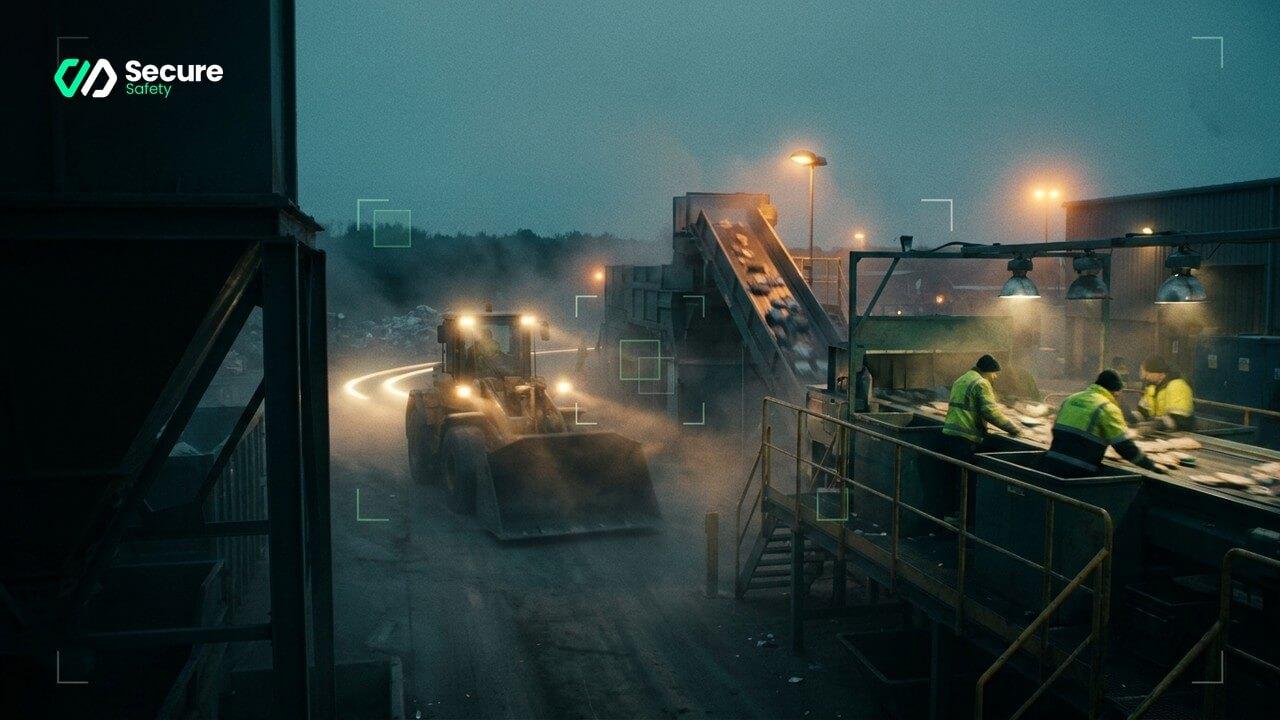
Every site manager at a recycling plant knows the tipping hall at its worst. A collection lorry reverses through a fog of dust while a loader pivots across the same floor. A picker steps down from the sorting cabin to clear a jam. The belt keeps moving. The engines drown out shouting. For a few seconds, three moving things and one person on foot share a space the size of a tennis court, and everyone is trusting everyone else to have seen them.
Most of the time, that trust holds. The trouble is that "most of the time" is not a safety system.
The industry the statistics keep flagging
Waste and recycling rarely features in glossy technology brochures, yet it sits stubbornly near the top of Britain's fatal-injury tables. The Health and Safety Executive puts its rate of fatal injury at many times the all-industry average — a small workforce carrying a wildly disproportionate share of the deaths. Year after year, the pattern barely changes.
The reasons are not mysterious. A materials-recovery facility, or MRF, is one of the most hostile environments an operator can design. Heavy plant and people share the same floor by necessity. Loads are unpredictable — a bin can hold a gas canister, a lithium battery, a length of steel or a wasp's nest. Dust and noise blunt the senses that would normally keep a worker safe. And the commercial pressure to keep tonnage moving never lets up.
Three hazards do most of the killing and maiming. Vehicles striking people on foot. Workers caught in or against moving machinery. And fire, increasingly from batteries hidden in the waste stream. Any safety technology that claims to help this sector has to speak directly to those three, or it is not really speaking to the sector at all.
Why the cameras are already there — and already ignored
Here is the quiet irony. Almost every waste site is already covered in cameras. Tipping halls, weighbridges, sorting lines, yard gates and picking cabins are watched around the clock, often on dozens of feeds. But those cameras were installed to settle disputes and deter fly-tipping, not to prevent harm. They record the aftermath. Nobody can watch forty screens at once, and by the time footage is reviewed, the incident it captured is already someone's injury.
This is the gap that AI safety monitoring closes, and it is why waste and recycling is such an unforced opportunity. You do not need a new hardware programme, a capital fight or a site shutdown. A computer-vision layer runs on the CCTV you already own, watching every feed at once, every second, and raising an alert the moment a hazard forms rather than the day after it lands.
Refuse vehicle and pedestrian detection
The single most valuable thing such a system does on a waste site is watch the interface between machines and people. It learns the geometry of your tipping hall and your yard. It knows where the loader operates, where the pedestrian walkway runs, and where the two should never overlap. When a picker steps into the path of a reversing lorry, or a visitor drifts off the marked route toward the loading shovel, the alert fires in real time — to the supervisor, to a beacon, to whatever your site already uses to get attention.
It does this without fatigue, without a blind spot behind the cab, and without needing the driver to have looked in the right mirror at the right instant.
Machinery, red zones and dropped objects
The same layer holds an unblinking line around the dangerous machinery. A picker reaching over a running conveyor, someone crossing into the baler's exclusion zone, a person on the ground near the plant — these are the moments that turn into life-changing injuries, and they are exactly the moments a person watching a wall of monitors will miss. The system treats a defined red zone as inviolable and flags the breach before contact, not after.
Fire and smoke, before it takes the building
Battery fires have quietly become the sector's nightmare. A single crushed lithium cell can smoulder unseen in a picking line or a bunker of baled material for minutes before anyone smells it, and a MRF is essentially a warehouse packed with fuel. Continuous visual detection of smoke and early flame across every feed buys the minutes that decide whether you lose a bin's worth of material or the whole shed.
Proof from a harder floor
It is fair to ask where a system like this earns the right to be trusted around heavy plant and people. Ours was forged offshore, on drill floors in oil and gas — arguably the most demanding safety environment there is, with heavy equipment in constant motion, zero tolerance for error and lives on the line every shift. It has since run in national oil-major operations, at a major international port and at an international airport, holding a sub-0.05% error rate and, on monitored sites, contributing to field-measured reductions of around 90% in unsafe behaviour. A tipping hall is a serious place. It is not more serious than a moving drill floor in a swell.
What changes when the watching never stops
The immediate benefit is prevention: the near miss that gets interrupted before it becomes a RIDDOR entry. But the deeper value is in what the system quietly accumulates. Every alert is a leading indicator — evidence of where and when your site's defences are thinnest. Over a few weeks you learn that the walkway breach always happens on the early shift, that the loader-and-pedestrian conflict clusters around the same skip, that a particular gate is a recurring flashpoint. That is the raw material of a genuinely proactive safety case, and the kind of continuous-monitoring evidence auditors increasingly expect to see.
And because it runs on-premise, the footage never leaves your site. For an operator already wary of who watches the yard, that matters. Your cameras stay yours; only the alerts travel.
An overdue conversation
Waste and recycling has spent years being told its risks are simply the cost of doing the job. They are not. The hazards are visible, repetitive and, for the most part, catchable in the instant before they cause harm — by cameras that are, in nearly every case, already bolted to the walls and pointing in the right direction.
The technology that finally treats this sector as seriously as it treats a refinery has arrived. The only real question is how long a site can justify recording its incidents when it could be preventing them.
Waste and recycling safety monitoring: closing the sector's safety gap
The three vehicle hazards that define the sector
Waste and recycling facilities generate vehicle-pedestrian conflict risk from three distinct vehicle interaction patterns, each requiring different monitoring approaches:
Site vehicle and pedestrian interaction: the routine movement of grab lorries, hook-lift vehicles and wheeled loading shovels in shared yard space with operatives on foot. This is the classic forklift-pedestrian scenario translated to heavier, less manoeuvrable vehicles with more severe consequences of contact. Camera monitoring at conflict points is the primary mitigation.
Reversing vehicle and bystander interaction: vehicles reversing to tipping points are among the highest-risk manoeuvres in a waste facility because the driver's visibility is severely limited, the speed of the reversal concentrates the risk into a short time window, and the tipping area is also where site operatives are directing loads. Camera monitoring of reversing approaches, with conflict detection when a person enters the vehicle's reversing path, provides the supplementary monitoring that a banksman cannot maintain continuously.
Mobile plant and pedestrian separation: wheeled loading shovels and grab machines operating in the processing area of a material recovery facility operate in confined spaces with limited visibility and high pedestrian density. Zone monitoring around operating plant enforces the exclusion that physical barriers cannot provide in a dynamic processing environment.
The agency workforce challenge
Waste and recycling facilities use a high proportion of agency and temporary workers, with turnover that makes consistent safety induction challenging. Camera-based PPE monitoring at site entry points enforces site-wide rules on every worker regardless of how recently they joined or who their employer is.
Implementation notes for waste and recycling sites
- Dust and contamination camera housings: waste facilities generate significant airborne contamination; camera housings must be specified for the dust and moisture levels at each installation point
- Emergency vehicle routing monitoring: confirm that the camera coverage includes the emergency vehicle access routes — a blocked emergency route is a fire safety hazard that camera monitoring can detect and alert on immediately
See what your cameras have been missing — book a demo.