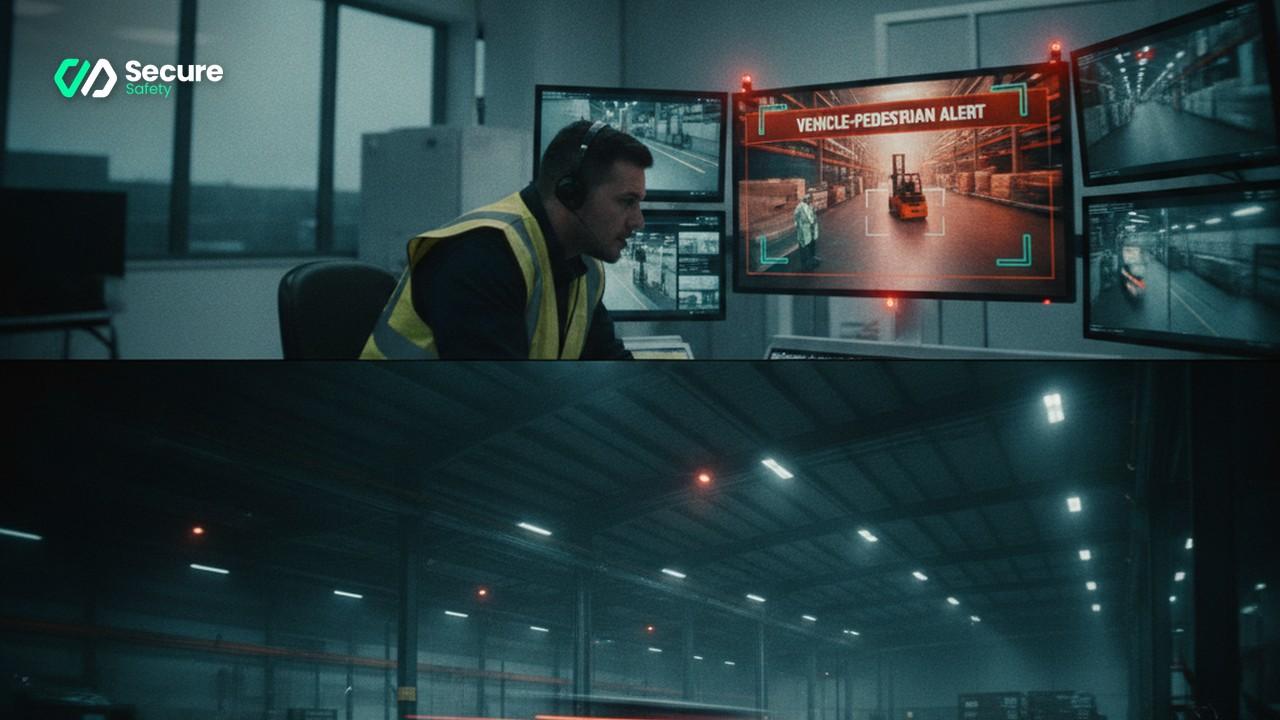
SecureSafety real-time vehicle-pedestrian detection — alert visible within 200ms of conflict.
The forklift passed behind a steel column. In the fraction of a second that the pedestrian — a contract fitter crossing the aisle from the stores cage — was visible on camera, the computer vision system had already detected the conflict, scored the proximity, and fired the alert. The timestamp read 14:42:06.158. The alert hit the control room screen at 14:42:06.320.
The operator on duty was looking at the wrong screen.
By the time he turned to the main alert monitor, the fitter had made it safely to the other side. No harm done. But when the site's EHS manager reviewed the event log the following morning, she noticed something that troubled her more than the near-miss itself: the acknowledgement timestamp read 14:42:47. Forty-one seconds from alert to acknowledgement, for an event that resolved itself in under two.
"If they had collided," she told the operations director that week, "we would have known about it in real time. But we could not have stopped it."
The sub-200ms detection window is the part of a safety AI system that vendors demonstrate most proudly, and rightly so. What matters equally — and is far less often discussed — is what happens to the alert in the 59 seconds that follow.
Why alert chain latency is a safety-critical design choice
In process safety, the latency from hazard to intervention is modelled explicitly. Relief valve set points are calculated. Emergency shutdown logic is engineered to precise tolerances. Alarm rationalisation under IEC 62682 is a formal discipline with its own practitioner qualification. The same rigour is rarely applied to the alert chain downstream of a detection event, despite the fact that human response latency can easily dominate total system response time.
Consider a typical vehicle-pedestrian proximity event. The detection system fires at T+0. The network delivers the alert to the control room at T+0.2 seconds. The operator notices it at T+4 seconds. The operator assesses the situation at T+9 seconds. The operator makes radio contact with the ground at T+22 seconds. The ground responder locates the hazard area at T+45 seconds. Any physical intervention — stopping the vehicle, clearing the pedestrian — happens at T+60 seconds or later.
In a pedestrian-speed scenario, a worker can travel roughly two metres in the six-to-nine seconds from detection to operator assessment. In a forklift scenario at three metres per second, the vehicle travels thirty metres in that same window. Detection is only the beginning. Every second of latency in the chain that follows is distance — and in a vehicle–pedestrian situation, distance is the margin between a near-miss and a fatality.
The design of the alert chain — who receives it, on what device, in what format, and what the escalation path is if no one responds in time — is therefore a safety-critical engineering decision. It deserves the same documentation, review, and testing as the detection system itself. HSE's guidance on emergency procedures (HSG191) requires that emergency arrangements are "practicable, tested and communicated to all who may need to act on them." An alert chain is an emergency arrangement. Treat it as one.
The four failure modes of an industrial alert chain
Across deployments in oil and gas, ports, and manufacturing environments, four failure modes account for most alert chain breakdowns. Understanding them in order of frequency helps prioritise which to address first.
Failure mode 1: Alert not seen. The most common failure, and the most fixable. Alerts that appear only on a central control room screen rely entirely on the operator being oriented towards that screen, in that room, at the moment the alert fires. In the scenario that opened this article, 41 seconds elapsed because the operator's attention was elsewhere — a routine occurrence in any multi-screen control environment where 17 feeds compete for attention. Solutions include ambient notification (a dedicated flashing light strip or an audible tone distinct from routine system sounds), push notifications to a smartwatch or supervisor's handheld device, and — for the highest-severity events — an automated local PA alert that does not wait for human acknowledgement.
Failure mode 2: Alert seen but dismissed. Alert fatigue manifests acutely in the control room. When an operator has seen 200 vehicle proximity alerts in a week, each resolving without incident, the 201st registers as noise rather than signal. The solution is not fewer alerts but more meaningful classification: tier-1 events must look and sound categorically different from tier-2 and tier-3 events. Tier-1 events should require active acknowledgement within a defined window before escalation fires automatically — the act of acknowledgement itself keeps the operator cognitively engaged with the event rather than allowing passive dismissal.
Failure mode 3: Alert seen, response too slow. The operator acknowledges the alert but the physical response chain — reaching the location, evacuating the area, stopping the vehicle — takes longer than the hazard timeline allows. This is usually a workflow design failure rather than a personnel failure. If the escalation path requires the control room operator to telephone a supervisor, who radios a team leader, who finds the nearest worker — the chain has too many links for a real-time hazard. High-severity events should trigger near-simultaneous notifications to the control room, the nearest field supervisor, and (where site layout permits) the PA system, so that the physical response chain starts at multiple points at once.
Failure mode 4: No escalation path. The most dangerous failure: an alert fires, no one acknowledges it within the response window, and nothing happens automatically. This occurs when escalation rules have not been configured, when the responsible role is unstaffed at that hour, or when the on-duty operator has stepped away. A properly designed alert chain always has a secondary and tertiary recipient, and the system always escalates if the primary acknowledgement does not arrive within the defined window — no matter what time it is, no matter what is happening in the control room.
Designing an acknowledgement-and-escalation workflow
The following escalation architecture reflects the design used in SecureSafety deployments across major industrial sites. It is not a prescription — site layouts, staffing structures, and radio protocols vary — but it represents the minimum viable chain for a site operating continuous shift patterns.
For a tier-1 (critical) event:
- Screen alert fires in control room simultaneously with audible alert and ambient light indicator (T+0.2s)
- Push notification to shift supervisor's device (T+1s)
- If no acknowledgement from control room within 15 seconds: automated PA alert for the affected zone, naming the camera zone and event type in plain language (T+15s)
- If no acknowledgement from either source within 30 seconds: push notification escalates to site emergency coordinator (T+30s)
- Event logged as "unacknowledged critical" if no acknowledgement within 60 seconds — triggers mandatory post-shift review with named accountable manager
For a tier-2 (significant) event: Screen alert plus push notification to supervisor. Escalation to site manager if no acknowledgement within four hours. Automatic close-out prompt at end of shift with mandatory outcome code.
For tier-3 (minor/log) events: Screen notification only. Auto-closed into the daily log at end of shift. Reviewed in aggregate at the weekly safety meeting.
This structure ensures that a single point of failure — an operator stepping away, a supervisor whose phone is on silent during a meeting — does not allow a critical event to dissolve into the log unactioned. The design must be documented and configured in the system, not assumed. Every deployment should specify: which roles hold each escalation position by shift, what devices they carry, what the acknowledgement timeout windows are, and what the escalation order is if the primary recipient is unreachable. This documentation belongs in the site's safety management system and must be reviewed whenever roles, shift patterns, or staffing levels change.
The PA, smartwatch, and radio triad
Three notification channels complement each other in ways that no single channel achieves alone. Understanding the strengths and limitations of each is the basis for designing a channel mix that matches your site's physical layout and operational rhythm.
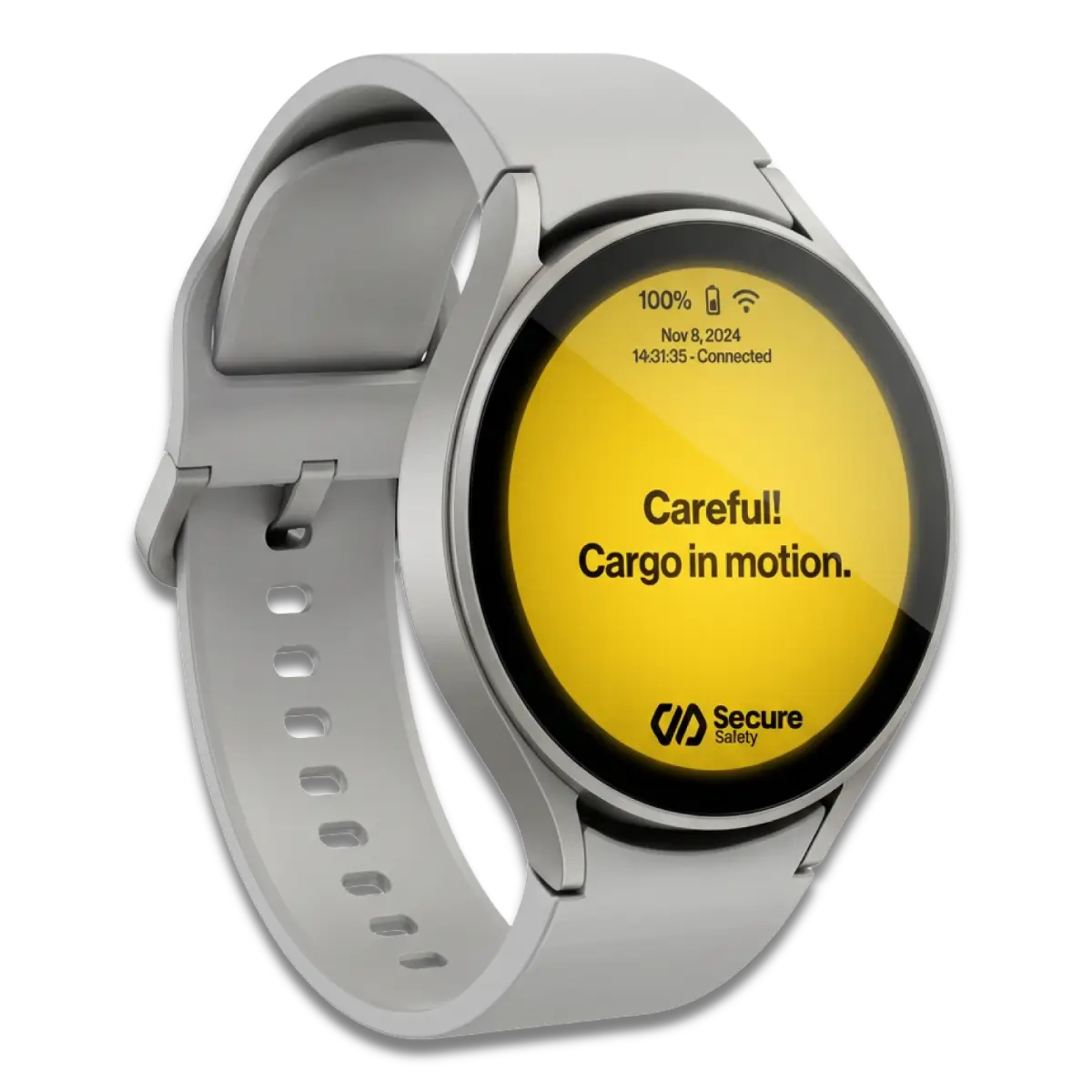 The SecureSafety safety smartwatch delivers an alert to the wrist within seconds of a detection — no control room in the chain of response.
Overhead PA provides immediate ambient notification to everyone in a defined zone, including workers who carry no personal device. Its principal limitation is breadth: a zone-wide PA alert will interrupt all workers in the zone, not only those near the hazard. Used for tier-1 events where immediate area attention or movement halt is the intended response, this is appropriate — and sometimes the only way to reach people in loud industrial environments where personal devices cannot be heard. Used for lower-tier events, it creates ambient noise that workers learn to ignore, which erodes the PA's credibility when a genuine emergency occurs. Reserve the PA for critical events only.
The SecureSafety safety smartwatch delivers an alert to the wrist within seconds of a detection — no control room in the chain of response.
Overhead PA provides immediate ambient notification to everyone in a defined zone, including workers who carry no personal device. Its principal limitation is breadth: a zone-wide PA alert will interrupt all workers in the zone, not only those near the hazard. Used for tier-1 events where immediate area attention or movement halt is the intended response, this is appropriate — and sometimes the only way to reach people in loud industrial environments where personal devices cannot be heard. Used for lower-tier events, it creates ambient noise that workers learn to ignore, which erodes the PA's credibility when a genuine emergency occurs. Reserve the PA for critical events only.
Smartwatch or wearable push notification reaches a named individual — the shift supervisor, the emergency coordinator — silently and personally. A wrist vibration with a distinctive pattern (distinguishable from a calendar reminder or a phone call) cuts through the distraction of a busy control room or a supervisors' meeting. Wrist-worn device notifications are consistently faster to acknowledge than desktop-only alerts in noisy or high-activity environments; the physical vibration on the wrist is not subject to the same attention-competition as a screen in the operator's peripheral vision.
Radio communication remains the most versatile channel for the physical response. Once an operator has acknowledged and assessed the event, radioing field personnel is typically the fastest mechanism for getting a physical presence to a location. The critical link to manage is between the alert system and the radio user: many sites still rely on the control room operator making a manual radio call, which introduces a human latency step and depends on the operator having the right channel preselected. Where the site operates a structured radio call protocol for emergency events, the alert system should integrate with that protocol — either by triggering a dedicated emergency channel announcement automatically or by populating the operator's screen with the target radio identifier and a standard call script for that event type.
What to log and time-stamp
Every element of the alert chain should generate a time-stamped log entry that forms part of the safety management system's auditable record. At minimum, the log for each alert should contain:
- T+0: Detection event created — event type, camera zone, confidence score, frame reference
- T+0.2s: Alert delivered to control room — delivery confirmation timestamp from the system, not just the creation timestamp
- T+X: First acknowledgement — named user, device type, elapsed time from delivery
- T+Y: Escalation triggered, if applicable — which tier escalation, which recipient, elapsed time from initial alert
- T+Z: Event resolved or further escalated — outcome code (false positive, confirmed near-miss, investigated, RIDDOR potential)
- T+end: Closure note from supervisor — what was found at the location, what action was taken, any follow-on corrective actions raised
This log serves multiple functions simultaneously. In the event of a RIDDOR-reportable incident, it demonstrates the precise timeline of the detection and response, enabling investigators to assess whether the alert chain performed as designed. For ISO 45001 audits, it provides objective evidence of the near-miss investigation process. For internal performance management, it generates the data needed to calculate mean acknowledgement time by shift, by event type, and by escalation tier — the data you need to identify where the chain is weakest and to set a measurable improvement target.
The logging discipline also makes it possible to detect degradation before it causes harm. If the mean acknowledgement time for tier-1 events on the night shift is consistently three times longer than on the day shift, that is a staffing, training, or device configuration problem that requires attention — and the log data surfaces it automatically.
Checklist for auditing your alert chain
Apply the following checklist quarterly, and following any significant site change — new shift structure, revised staffing levels, new camera coverage, or updated emergency contact arrangements:
- All tier-1 event types drive at least two simultaneous notification channels (screen plus device, or screen plus PA)
- Acknowledgement timeout windows are defined for all tiers and configured in the system, not assumed
- A named escalation recipient exists for every shift pattern — no coverage gaps at handover
- Secondary and tertiary escalation recipients are configured for all tier-1 event types
- All escalation recipients have been individually briefed on the alert protocol and have physically tested receiving a notification on their device
- The PA alert system has been tested for zone coverage — every worker in the target zone can clearly hear the alert over ambient noise
- Alert delivery confirmation is logged by the system (not only alert creation)
- Acknowledgement logs are reviewed weekly for patterns: which events consistently go unacknowledged, which shifts show the longest response latency
- False positive rate is tracked by event type and camera — a high false positive rate on a specific camera is a known alert-fatigue risk and should trigger a system configuration review
- Post-event review process for unacknowledged tier-1 events is documented and consistently applied after every occurrence
- Alert chain configuration is included in the site's safety management system as a controlled document under change control
- The full chain — from detection to physical intervention — has been timed against a staged real scenario at least once per quarter, with results recorded
The offshore installations where SecureSafety first operated set an uncompromising standard for alert chain design. A platform operating 24 hours a day, 50 miles offshore, with a helicopter as the emergency service, has no tolerance for a workflow assumption or a configuration gap. Every link in the chain from camera to crew was engineered, documented, tested under full operational load, and reviewed after every significant event. The lessons from that environment are now built into every SecureSafety deployment — onshore and offshore alike. The sub-200ms detection latency is matched, by design, to an alert chain capable of acting on it. Book a demo to see the full chain in operation and assess how it would map to your site's shift structure and control room setup.