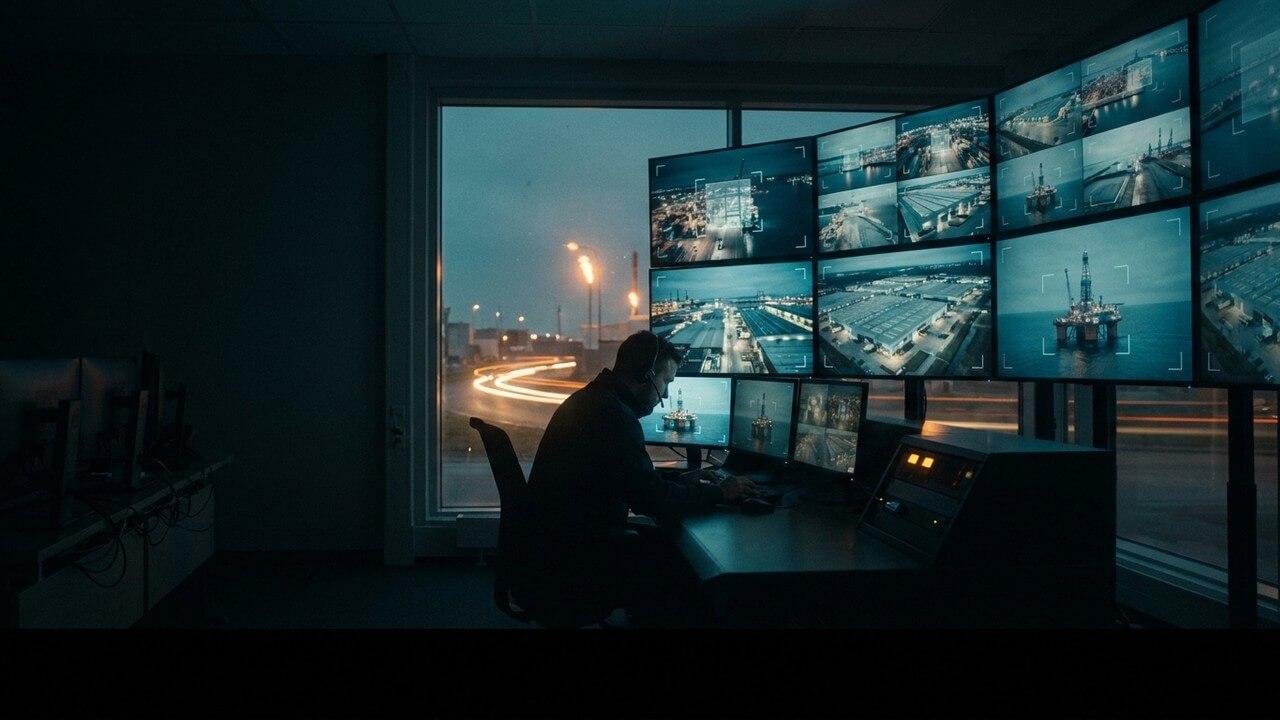
There is a particular silence that settles over a site after a fatality. The machines are switched off. The car park empties slowly, in ones and twos, because nobody quite knows what to say. Somewhere a phone is ringing that will not stop for weeks. Every operations director dreads that silence, and most will do almost anything to avoid it — yet when the finance conversation turns to safety technology, the same directors are asked to justify the spend against a fine they hope will never come.
That framing is wrong. The fine is the smallest number on the page.
The visible cost — and why it is the least of it
When a worker dies, the headline figure is the penalty. Under the sentencing guidelines that now govern health and safety cases, a large organisation found grossly negligent can face a fine running into the millions, calibrated to turnover so that it genuinely hurts. That is the number that makes the board sit up.
But the penalty is a single, bounded, one-off event. It is also the part of the cost you can insure against, argue down, and eventually pay off. The damage that follows a fatality is neither bounded nor one-off. It compounds.
The ledger nobody wants to read
Sit down and total the true cost, and the fine becomes a rounding error.
The investigation and its shadow. A serious incident triggers an enforcement investigation that can run for two or three years. During that time, senior people — the ones you can least spare — spend weeks giving statements, assembling records and sitting with lawyers instead of running the business.
Legal and defence. Corporate manslaughter and gross-negligence proceedings are not cheap to defend, whatever the outcome. Add the cost of individual directors who now need their own representation.
Downtime and disruption. The area is sealed. A prohibition notice can halt not one machine but a whole line, or a whole site, until an inspector is satisfied. Every hour of that is production you will never recover.
Insurance. Employers' liability premiums do not forgive a death. They reset, upward, and stay there for years.
The people who stay. This is the cost that never appears in a spreadsheet and matters most. The colleagues who witnessed it, or simply worked alongside the person, do not return to full productivity for a long time. Some never return at all. Recruiting and training their replacements, in a labour market that reads the news, is its own line item.
The name above the door. A fatality follows a company into every future tender. Ask any bid team what a fatality in the last five years does to a pre-qualification questionnaire. Contracts you would have won on merit are now closed to you before you write a word.
The Health and Safety Executive's own long-standing estimate is that the hidden costs of an incident outweigh the insured, visible costs by a ratio of roughly ten to one. For a fatality, the multiplier is unkind in the extreme. You are not looking at a fine. You are looking at a number with a great many zeros, spread across years, most of it invisible until it arrives.
Where the money actually leaks
Fatalities are, thankfully, rare. But they are almost never the first sign of trouble. They sit at the top of a pyramid whose base is thousands of small, unremarked unsafe acts — the pedestrian who cuts across the vehicle lane, the harness left unclipped, the guard propped open "just for a minute."
The tragedy of the traditional safety model is that it can only see the top of that pyramid, after the fact. A supervisor cannot watch every camera, every aisle, every shift. The near-misses that would have warned you go unrecorded because nobody was looking at the right frame at the right second. You learn the lesson only when the lesson is a person on the ground.
The business case for seeing everything
This is the precise gap that a computer-vision safety layer closes, and it is where the numbers begin to work in your favour.
The technology adds an AI layer to the CCTV you already own — no new cameras, no rewiring, no footage leaving the site, since it runs entirely on-premise. It watches every frame of every feed, all the time, and flags the unsafe behaviours before they mature into incidents: the vehicle–pedestrian conflict, the missing helmet or vest, the fall, the fire or smoke, the entry into a restricted zone. Not a report next month. An alert this minute.
Run that against the ledger above and the case makes itself. If continuous monitoring prevents a single fatality, it has paid for itself many hundreds of times over. But you do not need to invoke the worst case to justify it. Fewer minor injuries, lower premiums, cleaner audits, uninterrupted production and a safety record that wins tenders — each of these, on its own, services the investment. The prevented catastrophe is upside.
Our own detection was not built in a laboratory. It was forged offshore, on the drill floors of a national oil major, where heavy equipment moves in tight spaces and there is no tolerance for error whatsoever. It has since run in a major international port and an international airport, at a measured error rate below 0.05%, and has cut unsafe behaviours by around 90% where it operates. A system proven in that environment does not struggle with a warehouse aisle.
Reframing the question
The board question was never really "can we afford this technology?" It was always the harder one, asked too late: what is it worth to us to never sit in that silence?
Priced against the true, compounding cost of a workplace fatality — the years of investigation, the lost contracts, the people who never came back to themselves — continuous safety monitoring is not an expense to be defended. It is one of the better-returning investments on the plant.
Building the business case: a practical framework
Step one: quantify your current exposure
Before presenting a number for the technology, calculate the number it compares against. Start with your incident frequency data — not just fatalities and LTI events, but near-misses and first-aid events — and estimate the annualised cost using the HSE's own multipliers: the direct cost of a reportable incident typically runs to tens of thousands of pounds; a fatality to well over a million when the full legal, insurance and productivity impact is included. For most industrial sites, the total annualised cost of workplace incidents is many times the cost of the monitoring system that would reduce them.
Step two: document the specific hazard gaps
The board is more convinced by specifics than by generalities. Identify the three or four specific hazard scenarios on your site that represent the highest probability of a serious incident in the next twelve months — the forklift crossing without a crossing guard, the roof access with incomplete fall protection, the zone that workers cut through routinely. For each, document the current control and its known weakness. This makes the risk concrete and makes the technology's response to it concrete.
Step three: use the field data, not projections
The strongest argument for safety AI is not a model of what might be prevented. It is the measured outcome from a site where it has already been running. The ~80% reduction in tracked unsafe events from a controlled field trial, the elimination of human-machine segregation breaches, the 90% reduction in unsafe behaviour on monitored sites — these are the numbers to put in front of the board, with the source clearly attributed to a live operational deployment rather than a manufacturer's claim.
Step four: frame the insurance conversation separately
The insurance argument is often more compelling to a CFO than the HSE argument, because it operates on a shorter time horizon. Premium reductions from a demonstrable, documented safety monitoring programme are not hypothetical: insurers who can see a continuous compliance record, an alert response log and a trend in falling near-miss frequency price risk differently than those who receive an annual incident report and a verbal assurance. Include the insurer in the conversation before the board presentation if you can — a written indication of premium impact is more persuasive than a projection.
What the ROI looks like in practice
The return on a safety AI investment has three components that should be calculated separately and then presented together:
Hard savings: reductions in direct incident costs (first aid, temporary cover, RIDDOR reporting burden, HSE investigation management), insurance premium reductions and productivity improvements from reduced site disruption.
Risk reduction value: the statistical expected value of prevented incidents, calculated from your site's incident frequency, the probability change that continuous monitoring creates and the known cost per incident category.
Strategic value: contract qualification improvements, tender pre-qualification scores, insurance underwriting improvements and the retention of experienced workers who stay longer on sites with demonstrably better safety records.
On most industrial sites, the hard savings and risk reduction value alone justify the deployment within the first year. The strategic value makes the ROI compelling over a three to five year horizon. The prevented fatality sits beyond any of these calculations — it is the outcome that makes everything else secondary.
Common objections and how to answer them
"The spend isn't budgeted this year"
The Discovery phase — the scoped assessment that precedes full deployment — is a modest fixed cost that fits into most sites' operational discretionary budgets. It delivers a fully costed implementation proposal, a camera survey, a DPIA framework and a hazard-mapping exercise that has value independently of whether the full deployment proceeds. Beginning with Discovery is the standard response to a budget objection, because it defers the capital commitment while producing the evidence base that justifies it in the next budget cycle.
"We already have a good safety record"
A good safety record is built on lagging indicators: the incidents that have occurred and been managed well. It does not tell you whether the precursors — the near-misses, the unsafe acts that go unrecorded — are increasing or decreasing. The value of safety AI is precisely that it makes those precursors visible. A good lagging record combined with a monitoring system that shows a declining near-miss frequency is a sustainable safety programme. A good lagging record without that visibility is a run of luck that cannot be distinguished from a genuinely improving trend.
"Our workforce will resist being monitored"
The experience from deployment is that resistance is lowest when the communication is clear: the system is watching for incidents and hazards, not for productivity or disciplinary evidence; footage is not routinely reviewed by management; alerts are generated by automated rules that apply equally to everyone. Workers on sites where fall detection, PPE monitoring and zone enforcement are in place consistently report that they feel better protected, not more surveilled. The framing of the communication is the critical variable, not the technology itself.
See what your cameras have been missing — book a demo.