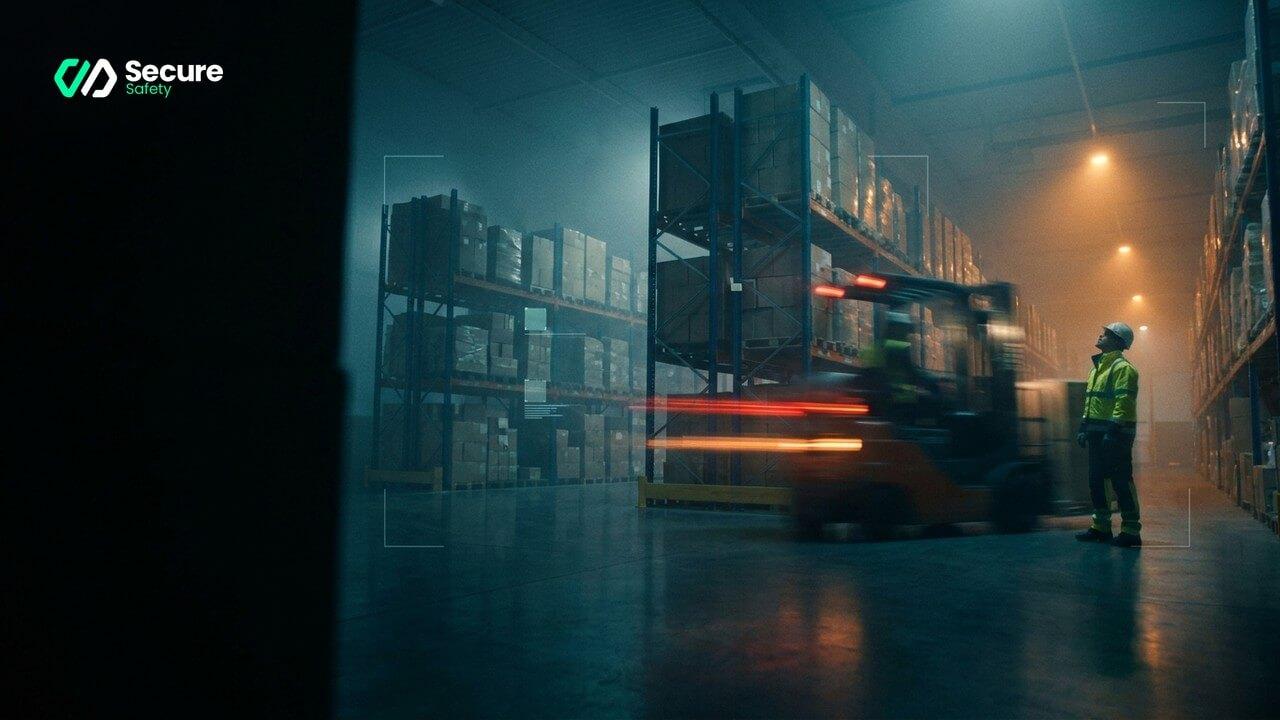
Every warehouse manager knows the moment. A forklift reverses out of an aisle. A worker steps round the end of the racking, head down, focused on a task. For a fraction of a second, neither can see the other. Most of the time, nothing happens. Occasionally, it does. Someone doesn't go home.
Being struck by a moving vehicle is the single largest cause of fatal injury in UK workplaces. It accounts for a disproportionate share of deaths despite making up only a small fraction of reported non-fatal incidents. In other words: when a vehicle hits a person, it tends to be serious. Forklifts, HGVs reversing onto loading bays, and yard traffic are the usual culprits.
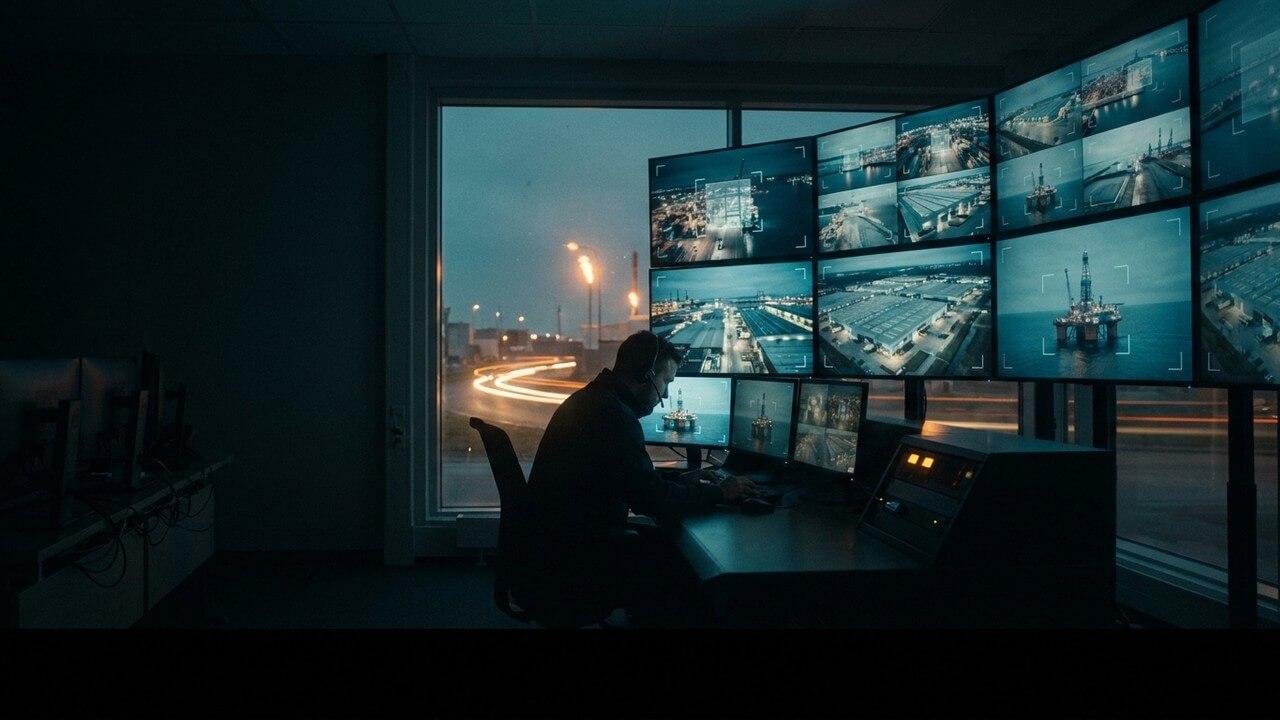
The uncomfortable truth is that almost all of these incidents are already being filmed. The CCTV camera over the loading bay captures the whole thing, and does absolutely nothing to prevent it. The footage becomes evidence for the Health and Safety Executive, not a warning that could have saved a life.
This post explains how AI changes that.
Why traditional controls aren't enough
The standard playbook for separating people and vehicles is well understood: pedestrian walkways, barriers, one-way systems, high-visibility clothing, banksmen, and forklift speed limits. These are essential and every site should have them.
But they all share one weakness: they depend on people following them, every time, under pressure. Walkways get short-cut when someone's in a hurry. Barriers get removed for a delivery and not replaced. A driver's view gets blocked by a load. A pedestrian takes three steps into a vehicle zone because it's quicker. Controls degrade in the real world, and no supervisor can watch every interaction across a busy site.
That's the gap. It isn't the absence of rules. It's the absence of anything watching whether the rules hold, second by second, across every camera.
How AI vehicle-pedestrian detection works
SecureSafety adds a layer of artificial intelligence to the CCTV you already have. There's no new hardware to install and no cameras to replace. The AI watches every feed continuously and understands what it's looking at: which objects are vehicles, which are people, how fast they're moving, and how close they are to each other.
When a pedestrian enters a forklift's path, strays into a designated red zone, or a vehicle exceeds a safe speed near people, the system raises an alert in real time, to a control room, a supervisor's screen, or an on-site alarm. The hazard is flagged while it's still a near-miss, not after it's become an incident.
Three capabilities do the heavy lifting:
- Proximity detection: recognising when a person and a vehicle are dangerously close, and escalating before contact.
- Red-zone monitoring: defining exclusion areas around operating machinery or vehicle routes, and detecting any unauthorised entry.
- Speed monitoring: flagging vehicles moving too fast for the area they're in.
Near-misses become data you can act on
The quiet revolution isn't just the live alert. It's the record. Every detected conflict becomes a data point. Over a few weeks, a pattern emerges that no clipboard audit could ever capture: this corner, on this shift, sees twelve close calls a week; that walkway is routinely ignored at shift change.
For the first time, a safety manager can see where risk actually concentrates, not where they assume it does, and fix the specific layout, route, or behaviour that's generating it. You stop managing safety on hunches and start managing it on evidence.
This is also exactly the kind of proactive, leading-indicator data the HSE wants to see. A company that can show it is actively detecting and reducing near-misses is in a far stronger position than one that can only count incidents after the fact.
Built where the stakes were highest
SecureSafety didn't begin in a warehouse. Our detection was forged offshore, on oil & gas drill floors. These are environments with heavy moving equipment, zero tolerance for error, and consequences measured in lives. Keeping people clear of moving machinery in a red zone on a pitching rig is about as hard as vehicle-pedestrian safety gets. Everything we learned there now protects sites on land.
That pedigree matters, because it means the technology was hardened in the most demanding conditions before it ever reached an ordinary loading bay.
See it on your own cameras, free
The fastest way to understand what AI detection would catch on your site is to run it. SecureSafety will deploy on one of your camera clusters for six weeks, at no cost, and show you exactly how many vehicle-pedestrian conflicts it picks up. That's a number you can take straight to your board.
No new hardware. No cloud: footage stays on your site. Just the close calls you can't currently see, made visible.
Where vehicle-pedestrian detection delivers the most value
Loading docks and reversing bays
Reversing HGVs on loading docks account for a significant proportion of forklift-and-vehicle pedestrian incidents because they combine limited driver visibility with the highest pedestrian density on any site. The moment a driver reverses a vehicle onto a dock, everyone working at that dock end needs to know — and a camera monitoring the dock approach detects both the vehicle's entry and any pedestrians in the reversing path simultaneously.
Blind aisle ends in warehousing
High-racking warehouses create natural blind corners at every aisle end. A forklift exiting an aisle cannot see pedestrians approaching from the perpendicular direction; the pedestrian cannot see the forklift. This is the scenario that generates the most near-misses in warehousing environments. Camera coverage of aisle end crossings, with zone configuration that alerts when a vehicle and a pedestrian simultaneously approach the same junction, converts the blind corner from an unmonitored risk to a continuously enforced crossing.
Gate entries and site perimeters
External vehicles — delivery HGVs, contractor vehicles, skip lorries — are among the highest-risk vehicles on most sites because their drivers are unfamiliar with the site layout, speed limits and pedestrian routes. Gate entry monitoring that detects vehicles exceeding the posted speed limit on entry and alerts the gatehouse immediately is the first enforcement layer for visiting vehicles.
Implementation checklist
- Traffic flow mapping: walk every vehicle route on site and identify every point where the route crosses or shares space with a pedestrian route — these are the priority camera coverage points
- Camera sightline verification: confirm that each camera covering a crossing point has a clear sightline to both the vehicle approach and the pedestrian approach — a camera that only sees one side of a junction cannot detect the full conflict
- Speed limit zone configuration: define each area's appropriate speed limit (not just the site-wide limit) and configure camera zones to enforce each independently
- Alert acknowledgement protocol: define who receives the vehicle-pedestrian alert, what they do with it, and how quickly an unacknowledged alert escalates
- Driver briefing: update the site driver induction to confirm that vehicle-pedestrian conflicts are detected automatically and that near-miss data is reviewed regularly — this changes driver behaviour before the first alert is ever generated
- Near-miss data review cycle: agree a weekly review of the near-miss heat map with the site manager or safety team — the goal is to use the data to make engineering changes, not just to count alerts
[ Book a free 6-week pilot ] Find out what your cameras have been missing.