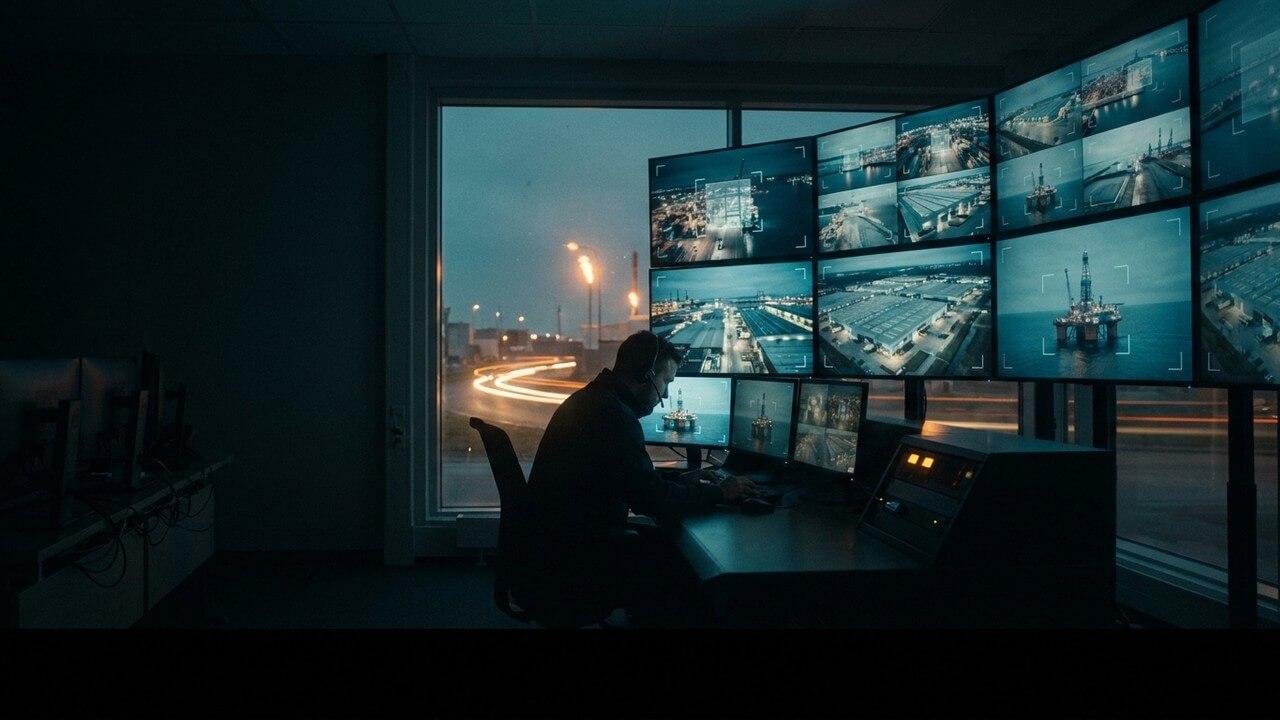
Every safety manager knows the feeling of the wall of monitors. Sixteen camera feeds, sometimes sixty-four, glowing in the corner of the control room. Somewhere on one of those screens, right now, a reversing forklift is closing on a man who has his back turned. The footage exists. The camera is pointed at it. And no human being on earth can watch all of it at once.
This is the problem computer vision was built to solve. But "AI that watches your cameras" is a phrase that hides more than it explains. What does the machine actually do when it looks at a video frame? How does a piece of software come to the conclusion that that shape, there, is a person, and it is too close to that other shape, which is a vehicle?
Here is the whole thing, without the jargon.
A camera does not see a scene. It sees numbers.
Start with what a digital image really is. To a computer, a single video frame is not a picture of a warehouse. It is a grid of pixels, and each pixel is just a set of numbers describing its brightness and colour. A high-definition frame is roughly two million of these little numbers. Thirty of those frames arrive every second.
So the raw material is not "a man near a forklift." It is a torrent of numbers with no meaning attached. The entire job of computer vision is to turn those numbers back into meaning — to look at a particular cluster of pixels and say, with a measurable degree of confidence, this is a person.
Teaching a machine what "a person" looks like
The machine learns the way a new starter learns the site: by being shown things, over and over, until the pattern sticks.
During training, a model is shown hundreds of thousands of images in which humans have already drawn boxes around the objects that matter and labelled them — person, helmet, forklift, flame. The model makes a guess, is told whether it was right or wrong, and adjusts itself very slightly. Repeat that a few million times and something remarkable happens. The model stops needing the labels. It has learned the visual patterns that reliably distinguish a person from a pallet: edges, textures, proportions, the way a torso sits above two legs.
It does not "understand" a person the way you do. It has simply become extraordinarily good at recognising the statistical fingerprint of one. That distinction matters, and we will come back to it.
Detection, in three plain steps
When a live frame arrives from your CCTV, the model does three things in a fraction of a second.
1. It finds the objects
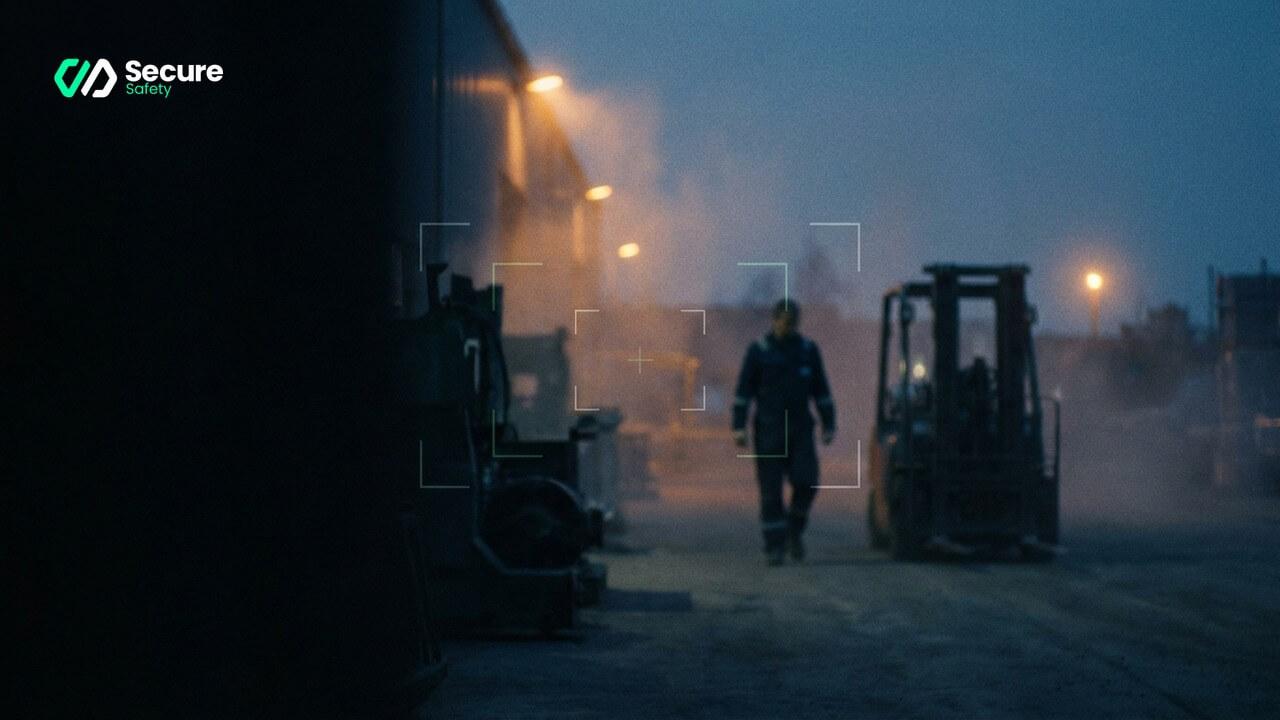
This is object detection — the part most people picture when they think of AI vision. The model scans the frame and draws a box around each thing it recognises, tagging it with a label and a confidence score: person, 98%. Forklift, 96%. Hi-vis vest, 91%. Those boxes, the ones you see in a demo overlay, are the visible tip of the whole process.
2. It tracks them through time
A single frame is a snapshot. Safety happens over time. So the system links the boxes across successive frames, understanding that the person in frame 900 is the same person from frame 899, now half a metre to the left. This is tracking, and it is what lets the system measure things a still image cannot: speed, direction, whether someone has fallen and stayed down, whether a vehicle is accelerating toward a walkway.
3. It applies the rules
Now the system knows what is in the scene and how it is moving. The final step is judgement against your rules. Is a person inside a zone marked as restricted? Has a worker been on the ground for more than a few seconds? Is a pedestrian and a moving vehicle occupying the same space at the same moment? When a rule is broken, an alert fires — in seconds, not on Monday's incident review.
Why confidence scores are the honest part
Notice that every detection comes with a percentage. The model never says "that is a person." It says "I am 98% confident that is a person." This is not marketing softness. It is the mechanism that makes the system trustworthy.
A well-tuned system uses those scores to decide when to raise an alarm and when to stay quiet, which is how you avoid the two failures that kill confidence in any safety technology: the missed hazard, and the boy-who-cried-wolf flood of false alerts that trains everyone to ignore the alarm. Getting that balance right is not a matter of a cleverer algorithm alone. It is a matter of having seen enough genuinely difficult footage to know the difference between a shadow and a man.
Which is the honest reason environment matters more than architecture. Our detection was forged offshore, on the drill floors of oil and gas — heavy equipment swinging through the frame, salt spray on the lens, floodlit night shifts, and no tolerance whatsoever for a missed call. A model that stays reliable there, and that has since run in a national oil major's operations, a major international port and an international airport at a sub-0.05% error rate, has already met a harder standard than most sites will ever ask of it. The measured result on those sites was roughly a 90% drop in unsafe behaviour — not because the software is magic, but because a hazard seen in real time is a hazard someone can still prevent.
What it does not do
It helps to be clear about the limits. Computer vision does not know why anyone is doing anything. It has no context beyond the pixels and the rules you set. It will not replace the judgement of an experienced supervisor, and it should not try to.
What it does is tireless, unblinking attention — the one thing humans cannot sustain across sixty-four screens on the back half of a night shift. It watches every frame with the same care it gave the first, and it taps someone on the shoulder the instant a line is crossed.
And because all of this runs on-premise, the analysis happens inside your own network. The numbers that make up your footage are read by the machine and never leave the site. No clips in someone else's cloud.
The cameras are already there. They have been recording the near-misses all along. The only thing that has been missing is something able to watch every second of it, and to speak up in time to matter.
How the technology matures through deployment
From generic model to site-specific calibration
Computer vision models for safety monitoring begin with capabilities trained on large datasets of industrial footage. The transition from a generic model to a site-specific deployment involves a calibration phase in which the model learns the visual characteristics of the specific environment: the type of PPE in use, the vehicle classes present, the lighting conditions, and the visual noise sources (steam, dust, exhaust) that might otherwise generate false positives. This calibration is not a one-time activity — it is an ongoing process as the site environment changes.
Multi-model inference in a single frame
A modern safety monitoring deployment is not a single model watching for a single event. A camera frame is simultaneously processed by models for PPE detection, person detection, vehicle detection, zone boundary analysis, fire/smoke signature detection, and pose estimation for fall/behaviour detection. The outputs of these models are fused to generate alerts that combine multiple signals — a person without a hard hat approaching a vehicle zone is a higher-priority alert than either signal alone. This multi-model inference is what makes the system context-aware rather than simply event-detecting.
The occlusion problem and its solution
Occlusion — when one object passes in front of another and temporarily obscures it — is the fundamental challenge of video-based safety monitoring. A person who is obscured by a forklift for three seconds does not cease to be a person who needs to be tracked. The solution is trajectory modelling: when a tracked person or vehicle disappears behind an occluder, the model uses their last known position, velocity and direction to project their continued trajectory. When they re-emerge, their identity is re-confirmed and tracking continues without loss of continuity. This capability was developed for the offshore environment where occlusion by pipe, equipment and moving steel is constant.
Technical implementation considerations
- Camera specification: the detection quality is bounded by the image quality from the camera — resolution, frame rate, lens choice and housing are all relevant; the Discovery phase camera survey provides specific recommendations for each monitoring point
- Network bandwidth for local processing: on-premise processing requires the camera streams to be available on the local network at the edge compute node — bandwidth requirement depends on camera count, resolution and frame rate, and is calculated during Discovery
- GPU vs. CPU inference: the detection models require GPU-accelerated inference for real-time performance; the edge hardware specification includes appropriate GPU capacity for the camera count and detection complexity at each site
- Model update management: detection models improve over time; the management channel from SecureSafety to the edge device delivers model updates without requiring manual intervention at the site
See what your cameras have been missing — book a demo.