Read a hundred HSE prosecution notices in a single sitting and something quietly disturbing begins to happen. The names of the companies change. The towns change. The machinery changes. But the story does not. A worker steps into a space a vehicle is reversing through. A guard is missing from a machine that has run for years without one. A man goes up to clear a blockage and does not come down. By the fiftieth case you can almost predict the next one from the first line.
That repetition is the most important finding in the enforcement record, and the most damning. These were not freak events. They were the same small number of hazards, recurring, in plain sight, on ordinary days.
The data tells a narrower story than we admit
The Health and Safety Executive publishes the outcome of every case it prosecutes: the breach, the circumstances, the penalty. Read across a large sample of recent fatal and serious-injury convictions and the causes cluster tightly. Workplace transport — vehicles and pedestrians sharing ground. Falls from height. Contact with moving or inadequately guarded machinery. Being struck by a falling or moving object. A smaller but grim seam of fires, confined-space entries and crushing incidents runs alongside.
Between them, that handful of categories accounts for the overwhelming majority of the deaths the courts examined. The national fatality statistics say the same thing: falls from height, being struck by a moving vehicle, and being struck by a moving object together make up around half of all workplace deaths in Britain, year after year, with a consistency that ought to trouble anyone.
The uncomfortable conclusion is that we are not facing a thousand different problems. We are failing to solve the same five.
What the prosecution notices actually describe
Read closely and a second pattern surfaces, underneath the first. In case after case, the hazard was not hidden. The reversing lorry had no banksman and no segregation between it and the people on foot. The unguarded flywheel had been unguarded for a long time. The forklift and the pedestrian had been crossing the same threshold, unremarked, for months.
The HSE's own language is telling. Its findings lean again and again on the phrase "reasonably practicable" — the duty to control a risk you could foresee and could have prevented. The prosecutions succeed precisely because the danger was visible in advance. Someone could have seen it. Often someone did, and said so, and the observation went into a near-miss log that no one read in time.
This is the quiet tragedy in the enforcement data. The information needed to prevent the fatality almost always existed before it happened. What failed was not knowledge. It was continuous attention — the simple, exhausting business of watching the same yard, the same machine, the same doorway, every minute of every shift, and noticing the moment the routine turned dangerous.
Where a camera never blinks
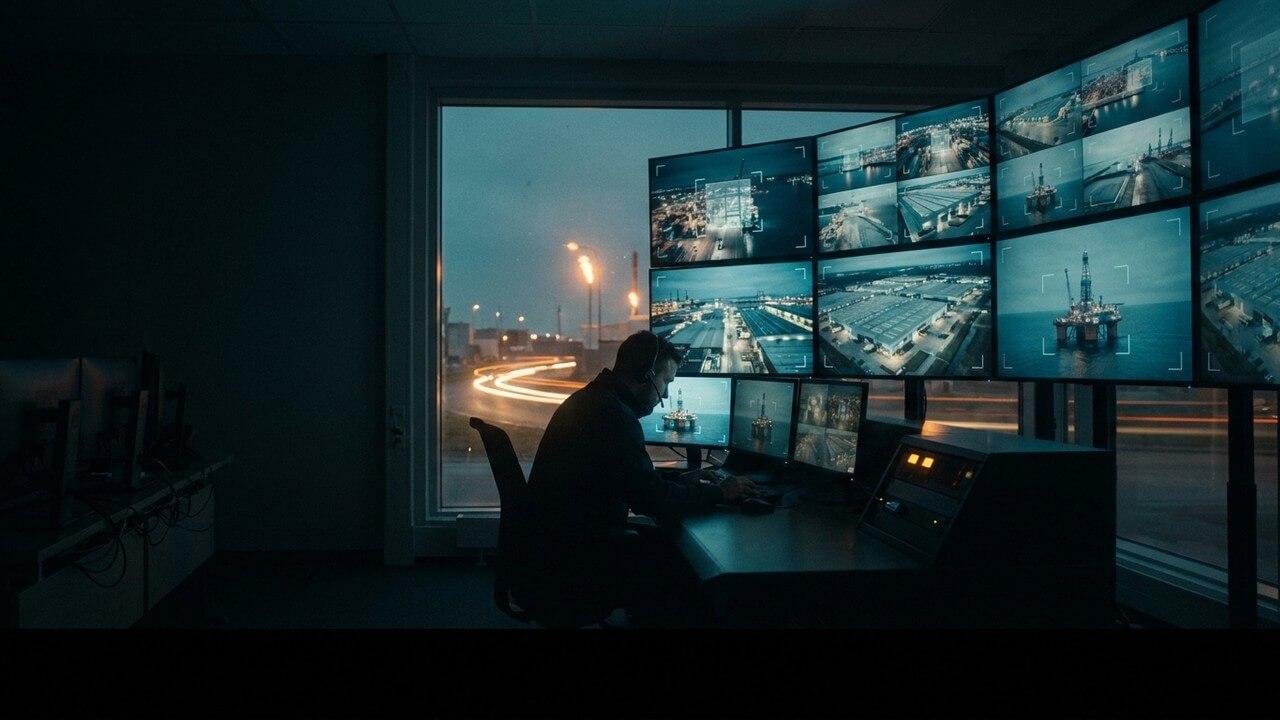
Human supervision cannot hold that line, and it is unfair to ask it to. A supervisor covers one area at a time. A safety manager cannot stand at every crossing. CCTV records everything and, in practice, is watched by no one — footage reviewed only after the incident it might have prevented.
This is the precise gap an AI monitoring layer is built to close. Applied to the cameras a site already owns, computer vision watches every feed at once and does not tire, look away, or normalise a risk because it has seen it a hundred times before. It recognises the exact situations the prosecutions describe: a person entering the path of a moving vehicle, someone on the ground who should be standing, a worker inside a red zone, the first flicker of smoke, a body posture that reads as a fall. When it sees one, it raises the alert while the situation can still be changed — not after.
Cross-reference the capability against the enforcement record and the overlap is almost complete. Vehicle-pedestrian conflict, falls, restricted-area entry, fire, person-on-ground — these are the leading causes of the deaths the courts examined, and they are the events this class of system is designed to catch in real time.
Proven where the stakes are highest
We did not learn this in a laboratory. Our detection was forged offshore, on the drill floors of oil and gas — heavy equipment in constant motion, no room for error, lives depending on the margin. It has since run in the operations of a national oil major, at a major international port and inside an international airport, holding a sub-0.05% error rate and, where measured, cutting unsafe behaviours by around 90%. The categories that fill the prosecution notices are the categories it was built, in the hardest environment there is, to prevent.
From hindsight to foresight
The enforcement record is written entirely in hindsight. Every notice is an autopsy — a reconstruction of a hazard that was foreseeable, preventable and, too often, previously observed. The value of reading a hundred of them is not the sorrow. It is the pattern, and the fact that the pattern is short enough to act on.
Look at your own site through that lens. The crossing where vehicles and people meet. The height without a proper edge. The machine that has always been fine. The prosecution notices are full of firms that could have described their fatal hazard in advance and simply had no way to watch it continuously. That is no longer a limitation you have to accept.
The five hazard categories that explain most prosecutions
Vehicle-pedestrian conflict: the largest single category. Delivery drivers, site pedestrians, and maintenance crews sharing ground-level space with forklifts, HGVs and other moving plant. The prosecution pattern is consistent: a shared route, a blind corner or reversing bay, and no continuous monitoring of the crossing point. AI detection watches every crossing simultaneously, every second, and alerts before contact.
Falls from height: the second largest category. Access equipment without proper edge protection, workers using improvised means of access, and roof work without fall-arrest systems feature repeatedly. Camera-based detection at height-access points and zone monitoring around unprotected edges adds a layer that checks compliance at the moment of risk rather than during a morning walk-round that may be hours before the exposure occurs.
Contact with machinery: guarding failures and maintenance isolation failures. The prosecution pattern here typically shows that the guard had been missing or bypassed for a period before the incident, and that no one had systematically checked whether guarding controls were in place on every shift. Camera-based machine-zone monitoring adds a continuous check on the approach area and the guard condition that a supervisor walking the floor once per shift cannot replicate.
Struck by falling or moving objects: dropped objects during lifting operations, and materials dislodged by vehicles. The prosecution pattern shows consistently that the drop zone was not enforced, or was not clearly defined. Camera-based drop-zone monitoring enforces the exclusion for the duration of every lift without requiring a banksman to stand at the boundary.
Fire and explosion: a smaller category in absolute numbers but a large one in outcome severity. Fires that reach prosecution are almost always fires that were not detected early enough to prevent escalation. Camera-based fire detection activates at the visual smoke or flame stage, typically minutes before a ceiling-mounted detector, providing the intervention window that the prosecution cases consistently show was missing.
Using prosecution data in a safety review
The HSE prosecution database is publicly available and searchable. Safety managers who are preparing a hazard review or a board presentation can search for cases in their specific sector, their specific geographic area, and their specific hazard categories. The resulting case summaries provide the most relevant and credible evidence for why a specific control is needed: not a generic industry statistic but a specific case, in your sector, with a named fine and a described hazard that matches the one on your floor.
Combining prosecution case data with near-miss data from an AI monitoring system creates the strongest possible evidence base for a safety investment decision: historical cases that demonstrate the hazard leads to prosecution, and current near-miss data that demonstrates the hazard is present on the specific site.
Implementation guidance: starting with the prosecution categories
A systematic approach to deploying AI monitoring against the prosecution categories suggests the following priority order:
- Vehicle-pedestrian crossings first: identify every point on site where a vehicle route and a pedestrian route intersect without physical segregation — these are the points most likely to appear in a future prosecution and the most immediately improvable with camera monitoring
- Machine guard zones second: for every machine where guards could be defeated or where maintenance access creates an exposure, configure a camera zone that monitors the approach area
- Height access points third: camera coverage at fixed ladder and stair access points to unprotected height areas
- Fire risk areas fourth: battery charging bays, electrical rooms and high-value stock areas where an early detection advantage is worth most
This priority order is not arbitrary — it follows the frequency distribution of the prosecution data and ensures that the highest-volume hazard categories are addressed first.
See what your cameras have been missing — book a demo.