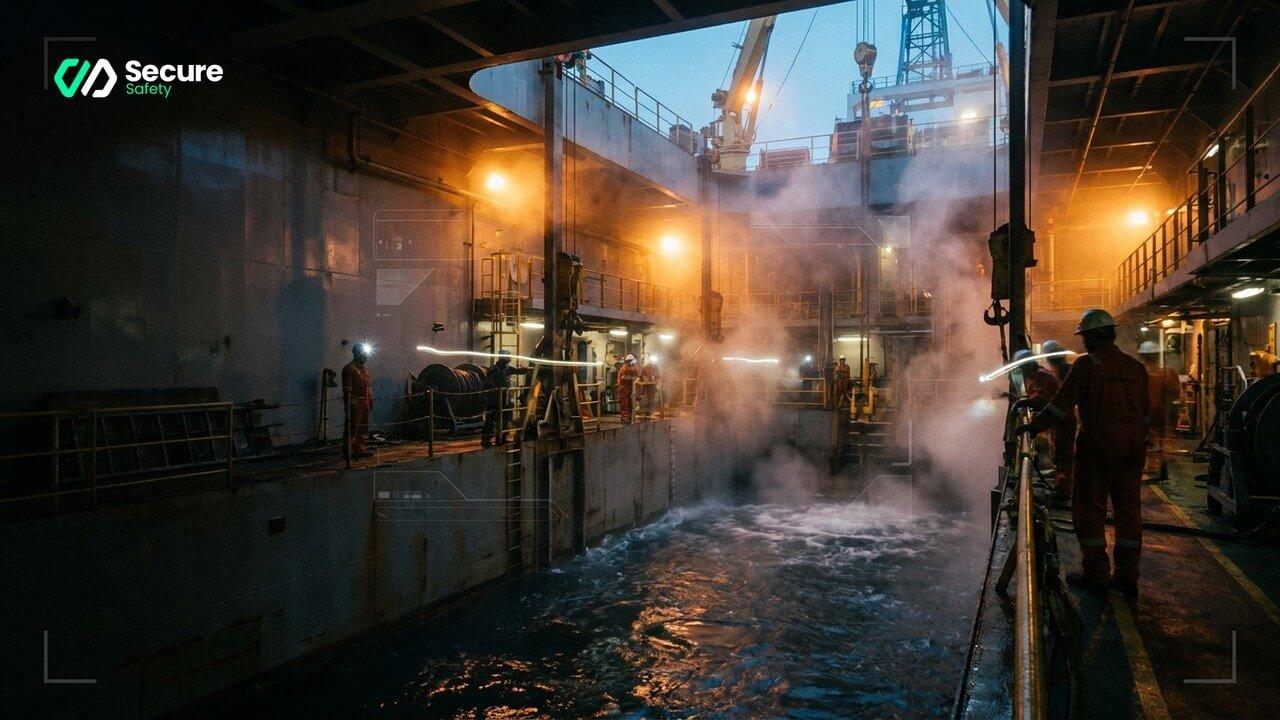
Every drillship crew knows the sound before they know the danger: the deep, wet suck of the sea moving inside the hull. The moonpool is the strangest opening in all of heavy industry — a hole cut clean through the bottom of a vessel, open to the ocean, through which every riser, tool and subsea package must pass. It is where the ship meets the deep. It is also where too many offshore incidents begin.
Walk the deck around it and you will understand the problem at a glance. Heavy equipment swings on cursors and guide wires. Water surges up and slaps against the guide frame with the swell. Crew lean over the edge to make up connections and land tooling. And below their boots there is nothing but forty feet of black water and the open Atlantic beneath that. There is no forgiving surface here. A dropped object does not bounce; it vanishes. A person who goes over the edge does not have a floor to catch them.
Why the moonpool defeats ordinary monitoring
Most safety systems, human and digital alike, were built for solid ground. The moonpool breaks their assumptions.
The lighting is poor and constantly shifting — spray, steam, the glare of work lamps against wet steel. The geometry is awkward, with the pool sunk below the working deck and sight lines broken by the guide frame, the cursor and the moving load. Reflections off the water fool the eye and fool most cameras. And the work happens in bursts of intense activity, often on night shift, often in weather, when the crew is most stretched and least able to keep every hazard in view.
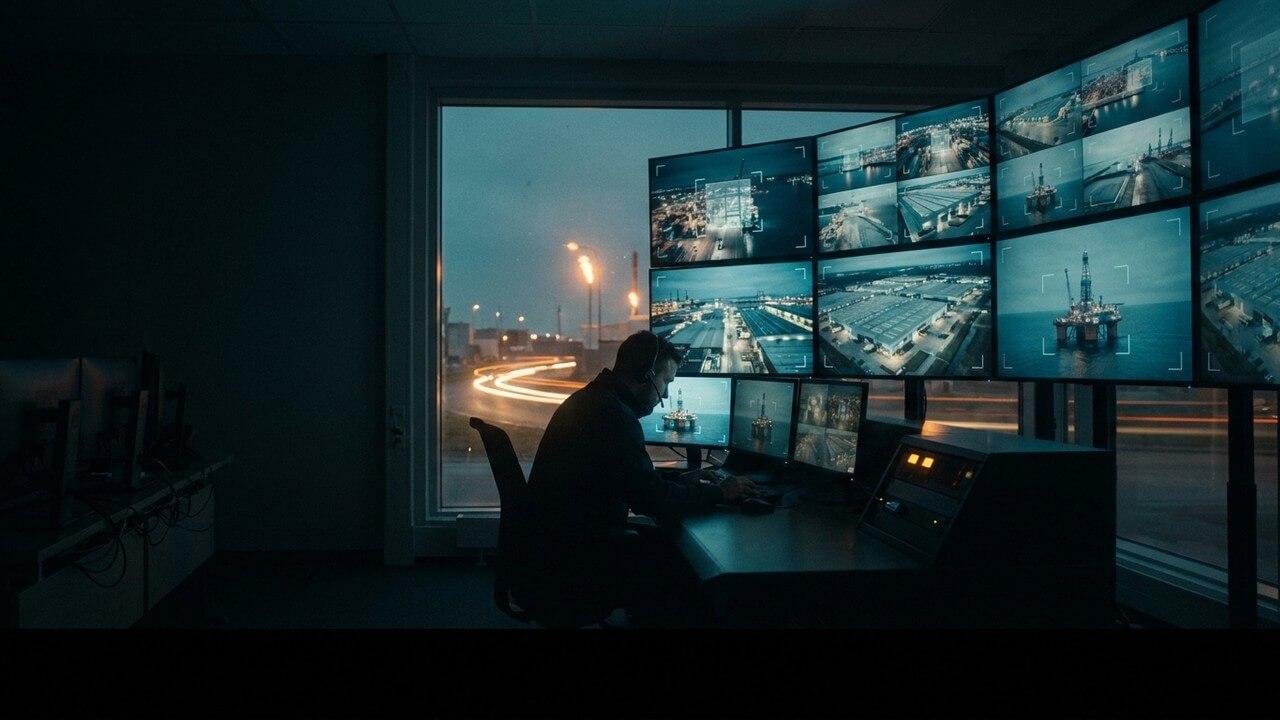
A supervisor cannot watch the load, the water and four crew members at once. A fixed camera records everything and warns of nothing — it is a witness after the fact, not a guard in the moment. The result is a stubborn blind spot at the single most unforgiving point on the vessel.
What "monitoring the moonpool" actually means
Real moonpool monitoring is not one detection. It is several, running at once, on the same live feed.
People near the edge
The system knows where the moonpool boundary is and knows where every person is in relation to it. When a crew member crosses into the exclusion zone during a lift, or lingers at the edge while a load is in transit, it flags it in real time — not in the incident report a week later.
Loads over water
During deployment, the moment a tool or package swings over the open pool is the moment of maximum consequence. The system tracks the load and the people in a single frame, so a person and a suspended load are never allowed to occupy the same space unnoticed.
Man-overboard, inward
Conventional man-overboard systems watch the sea outside the hull. The moonpool needs the mirror image — detection of a person entering the water inside the vessel, instantly, so recovery begins in seconds rather than after a headcount discovers someone missing.
Dropped objects
A tool over water is a tool that cannot be retrieved and a hazard to the subsea equipment below. Detecting a dropped object at the moment it leaves the deck turns a silent loss into an immediate alert.
Detection forged where the stakes are highest
This is not theory retrofitted to the sea. Our detection was built on drill floors — the most demanding safety environment there is, with heavy moving equipment, zero tolerance for error and lives at stake. It has been proven in national oil-major operations, a major international port and an international airport, running at a sub-0.05% error rate and delivering field-measured reductions of around 90% in unsafe behaviour. The moonpool is not where we started applying computer vision to danger; it is the logical extension of it. If a system can hold up on a live drill floor, the pool a few decks below is within its reach.
No new hardware, and nothing leaves the ship
Two objections usually arrive together on any offshore vessel, and both have short answers.
The first is hardware. A drillship is not a place where you casually install new equipment; deck space, cabling and certification are precious. So the platform does not ask for any. It adds an intelligent layer to the CCTV already trained on the moonpool. The cameras you have become the sensors you need.
The second is data. Offshore footage is commercially and operationally sensitive, and satellite links are thin. So processing happens on-premise, on the vessel. The video never leaves the hull. What travels back to shore, if anything, is an alert — not a feed.
The white space no one else has filled
The offshore safety market is not empty. There are capable vendors working on PPE, on red zones, on general deck monitoring. But walk the floor of any offshore technology exhibition and ask a simple question — who monitors the moonpool specifically? — and the room goes quiet.
It is genuine white space. The moonpool is too specialised for generic safety products and too dangerous to leave to a camera and a hopeful supervisor. That gap is precisely where a system built on real drill-floor experience belongs. The hardest opening on the vessel deserves more than a passive recording of whatever went wrong.
The sea will keep moving inside the hull. The loads will keep swinging over open water. The only variable you control is whether something is watching the edge with the same attention as your best supervisor on their best day — and never blinking.
Moonpool monitoring: the offshore capability that defines the platform
Why the moonpool is the most critical zone on the rig
The moonpool of a drillship or semi-submersible is the opening in the hull through which the drill string, riser and subsea equipment are deployed. During active operations, the area around the moonpool combines the hazards of over-water working, heavy suspended loads, and the tension system that manages the riser — a steel pipe assembly under several hundred tonnes of tension. A person in the wrong position during moonpool operations faces a risk that cannot be mitigated by PPE or physical barriers alone. The zone must be enforced continuously, and the enforcement must be both fast and reliable.
Automatic activation based on operational state
Moonpool zone enforcement in SecureSafety activates based on the operational state of the moonpool, not on a manual control room action. Integration with the rig's drilling management system allows the zone to activate automatically when the moon pool is open and an operation is in progress, and to deactivate when the riser is landed and the operational phase is complete. This removes the human factor from zone activation — the zone is always in the state that the current operation requires, rather than the state that someone remembered to set.
Fleet-level moonpool monitoring
For a drilling operator with multiple vessels, moonpool monitoring is a fleet-level risk that must be managed consistently across all assets. The multi-rig management layer in SecureSafety provides the fleet safety team with visibility of moonpool zone status, breach events and response actions across all vessels simultaneously. A fleet-wide report showing moonpool breach frequency by vessel enables targeted improvement actions where they are most needed.
The offshore-to-onshore capability transfer
The moonpool monitoring capability, while specific to offshore drilling, demonstrates the spatial reasoning capability that underpins all zone monitoring in the platform. A zone that must be enforced based on the position of a dynamic hazard (a moving load, an open moonpool, an active crane) requires a system that understands the current state of the scene, not just the presence of a person in a defined area. That contextual zone management capability is what makes the platform effective in complex onshore environments with dynamic operations — crane operations in ports, maintenance windows in manufacturing, lifting operations on construction sites.
See what your cameras have been missing — book a demo.