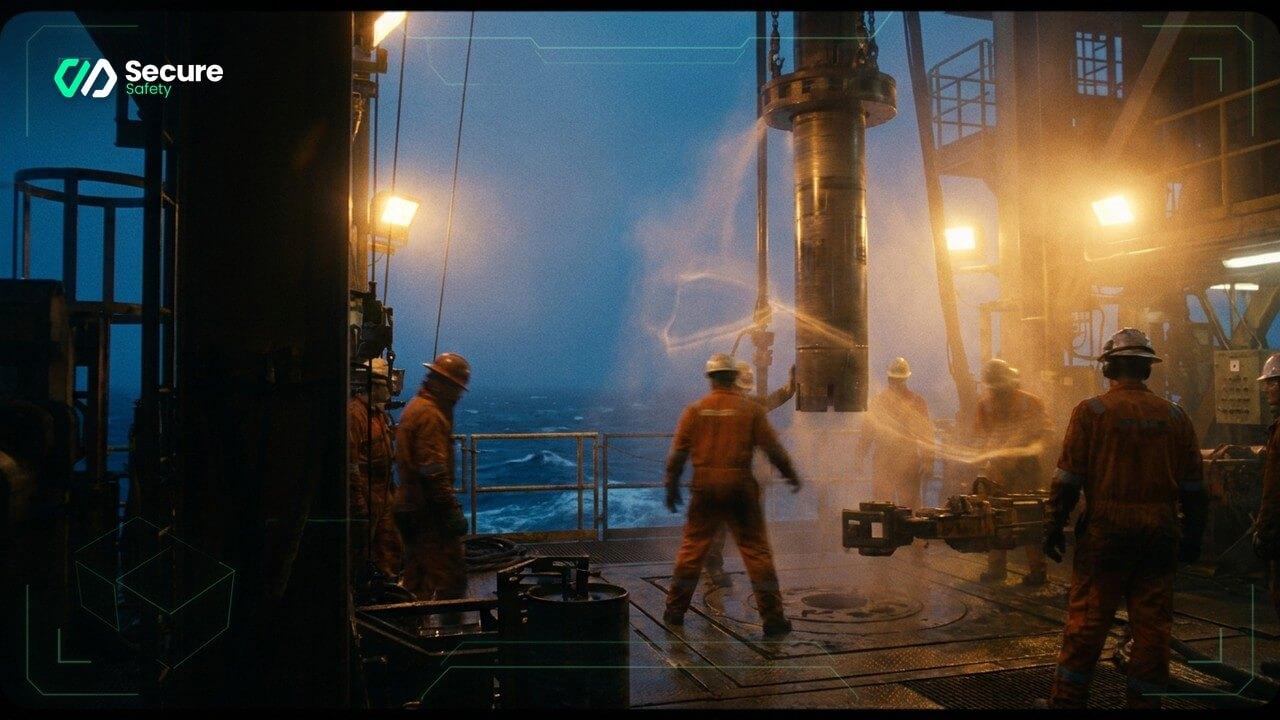
Stand on a drill floor for ten minutes and you understand the problem in your bones. A steel pipe the length of a lorry swings into position overhead. The iron roughneck spins into place with a mechanical shriek. A driller watches from the doghouse, a floorhand steps across the rotary table, and everything that moves weighs enough to end a life without slowing down. There is spray, there is glare, there is diesel haze, and the deck itself is pitching on the swell of the North Sea. This is not a warehouse aisle. This is the most unforgiving room in industry.
We built our detection here, in this room. And it turned out that a safety system forged on a drill floor is the best possible preparation for everywhere else.
The hardest classroom in the world
Most computer-vision safety systems are trained and tuned in easy conditions. Good indoor light. Clean sightlines. People walking predictably across a factory floor. Take one of those systems offshore and it falls apart within the hour, because the drill floor breaks every assumption a comfortable dataset makes.
The light is wrong. It swings from flat grey dawn to blinding low sun to the sodium wash of floodlights at night, sometimes within the same shift. The weather is wrong. Rain, sea spray and salt haze sit between the camera and the hazard. The bodies are wrong, too: crews in bulky coveralls, gloves and full-face visors look nothing like the tidy pedestrian silhouettes in a public dataset. And the equipment never stops. Pipe, tongs, elevators and travelling blocks move constantly, occluding people for seconds at a time and then revealing them again in a different place.
A system that learns to hold its nerve in that environment has learned something durable. When you then point it at a distribution centre, a runway apron or a food plant, the conditions feel almost gentle by comparison. The hard version came first, so the ordinary version is easy.
Four lessons that travel
1. Precision is not optional
On a drill floor there is no such thing as a harmless false alarm. Cry wolf during a pipe connection and the crew learns, correctly, to ignore you — and the one time it matters, they will ignore you then too. Offshore taught us to treat every false positive as a wound to the system's credibility, not a rounding error in a metric.
That discipline is why our detection runs at a sub-0.05% error rate. It is proven in the operations of a national oil major, at a major international port and at an international airport, where crews measured reductions of around 90% in unsafe behaviour once the system was watching and, crucially, once they came to trust what it told them. Trust is earned in the boring hours, when the system stays quiet because nothing is wrong. The drill floor taught us to earn it.
2. Occlusion is the norm, not the exception
In a tidy environment you can pretend that a person is either visible or absent. Offshore, a floorhand vanishes behind a stand of pipe and reappears two metres away a heartbeat later. If your tracking loses them in the gap, your red-zone logic is fiction.
Building for constant occlusion forced us to track intent and trajectory, not just pixels in the current frame. That same capability is exactly what a busy loading bay needs when a forklift passes between a camera and a walker, or what an airport apron needs when a tug crosses behind a fuselage. Solve it for the drill floor and you have solved it for the warehouse without trying.
3. Context decides everything
A person lying on the deck is a fall in one place and a routine maintenance task in another. A person inside a marked boundary is a violation during one operation and entirely expected during another. Offshore work is a sequence of legitimate exceptions, and a system that shouts at every one of them is worse than useless.
So we learned to read the scene, not the pixel. Where the zones are, what the operation is, what normal looks like at this moment on this deck. That contextual habit is what lets the same platform tell a genuine person-on-the-ground emergency from a technician kneeling to a valve — in a data centre, a quarry or a factory just as reliably as offshore.
4. The footage cannot leave
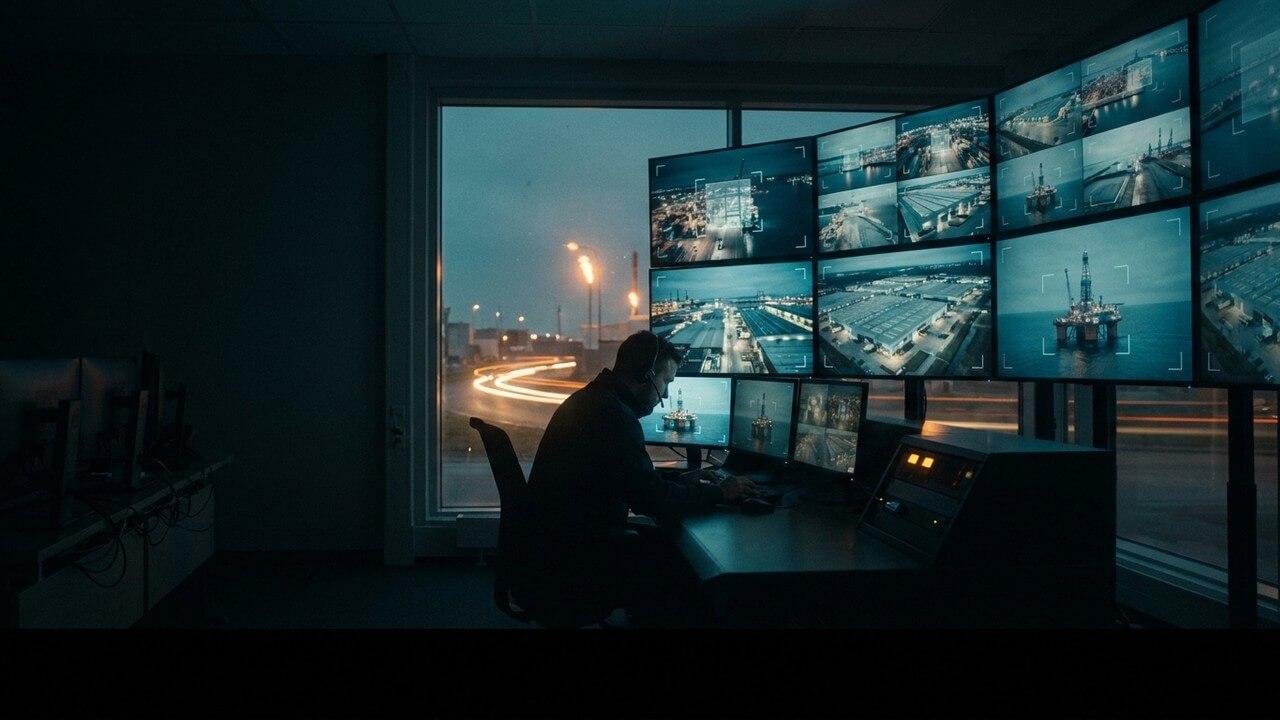
An offshore asset is a security-sensitive, bandwidth-starved environment where sending live video ashore is neither practical nor permitted. That constraint was a gift. It forced us to run entirely on-premise, processing every frame on site and keeping the footage where it belongs.
Onshore, that same architecture answers the question every EHS and operations leader eventually asks: where does the video go? With us, the answer is nowhere. The AI layer sits on top of the cameras you already own, the analysis happens on your own hardware, and no images are shipped to a cloud you do not control. What began as an offshore necessity turned out to be exactly what a privacy-conscious factory, hospital or port wanted all along.
Depth you cannot fake
There is a difference between a system that has read about hard environments and one that has survived them. You cannot retrofit that depth. It comes from thousands of hours where the cost of being wrong was measured in people, not packages — from moonpool monitoring, from pipe-handling zones, from crews who told us plainly when we got it wrong and expected us to fix it by the next tour.
That is the quiet advantage the drill floor gave us. Not a longer feature list, but a system whose instincts were shaped where instincts matter most. When it looks at your site, it is bringing the caution it learned in the worst room in the world.
Everything else, frankly, is a calmer version of a problem we have already solved.
Applying offshore lessons on land: what carries over directly
Error rate discipline
The sub-0.05% error rate standard established offshore carries over to every deployment without modification. On a drill floor, a false positive during a critical lift is dangerous. In a warehouse, a false positive just costs an operator's attention. But the principle holds: alert fatigue is how safety systems get switched off, and the only defence against alert fatigue is a system with high enough precision that every alert is credible. Sites that have deployed lower-precision systems and experienced the inevitable muting response are the most receptive to understanding why the error rate figure matters.
On-premise architecture
The satellite-bandwidth constraint that forced on-premise processing offshore turns out to be exactly the architecture that factories, ports and airports want for data protection reasons. "The footage never leaves the site" was a technical requirement on a remote drillship and is a business requirement for a food manufacturer whose CCTV covers production processes, or a pharmaceutical company with strict data governance. The offshore necessity became the onshore selling point.
Occlusion handling
The tracking-through-occlusion capability built for a busy drill floor is the same capability that handles a forklift crossing between a camera and a pedestrian in a warehouse aisle. The problem is topologically identical — a known object disappears from view and must be tracked continuously through the occlusion — and the solution is the same: trajectory modelling based on velocity, direction and scene context. Sites with heavy occlusion environments (dense racking, structural columns, complex process machinery) benefit most from a detection system that was built to handle the problem rather than retrofitted with a workaround.
Zone management under pressure
The drill floor zone management requirement — enforcing exclusions that change with the operation, in a sequence of legitimate exceptions, without generating alert fatigue from normal activity — maps directly onto the dynamic zone requirements of a busy port, a construction site with evolving layouts, or a manufacturing facility with different zone rules for different shift patterns. The scheduling and manual toggle capabilities in the zone configuration system were operational requirements from offshore deployment, not product features added later.
The honest limit of the analogy
One thing that does not transfer from offshore is the specific regulatory framework. Offshore oil and gas operates under the Offshore Installations (Safety Case) Regulations 2015, PFEER, and a mandatory safety case regime that has no equivalent in most land-based sectors. The detection capabilities are the same; the documentation, audit and regulatory reporting requirements are different. SecureSafety adapts its deployment framework to the regulatory context of each sector — RIDDOR, ISO 45001, CDM 2015, the Control of Substances Hazardous to Health Regulations, and sector-specific requirements from the CAA, the Port Marine Safety Code, and the Food Safety Act, among others. The offshore pedigree is proof of technical robustness; the sector-specific deployment is where the regulatory alignment work happens.
Implementation checklist for sites evaluating the offshore comparison
- Ask the deployment history question directly: in how many live industrial sites has the platform been running continuously for more than two years? A platform with a long live-deployment track record behaves differently from a platform that has only run in pilots
- Request error rate data from live deployments: ask for the false-positive rate from a deployment in a comparable environment (vehicle-intensive, outdoor, multi-shift), not from a controlled demonstration environment
- Assess the occlusion handling in a site walkthrough: during the Discovery phase, walk the site with the survey team and specifically identify the high-occlusion areas — columns, racking, plant and machinery — and confirm how the detection handles them before deployment
- Review the zone management capabilities against your operational schedule: if your site has different zone rules for different operations or shift patterns, confirm that the scheduling and manual override capabilities work the way your operations team needs them to, not just in a demo
- Check the on-premise architecture before you need to justify it: data protection teams, works councils and IT security teams will all ask the same question at some point — understand the architecture well enough to answer it clearly before it is asked at a board presentation
See what your cameras have been missing — book a demo.