There is no harder place to keep people safe than an offshore drill floor.
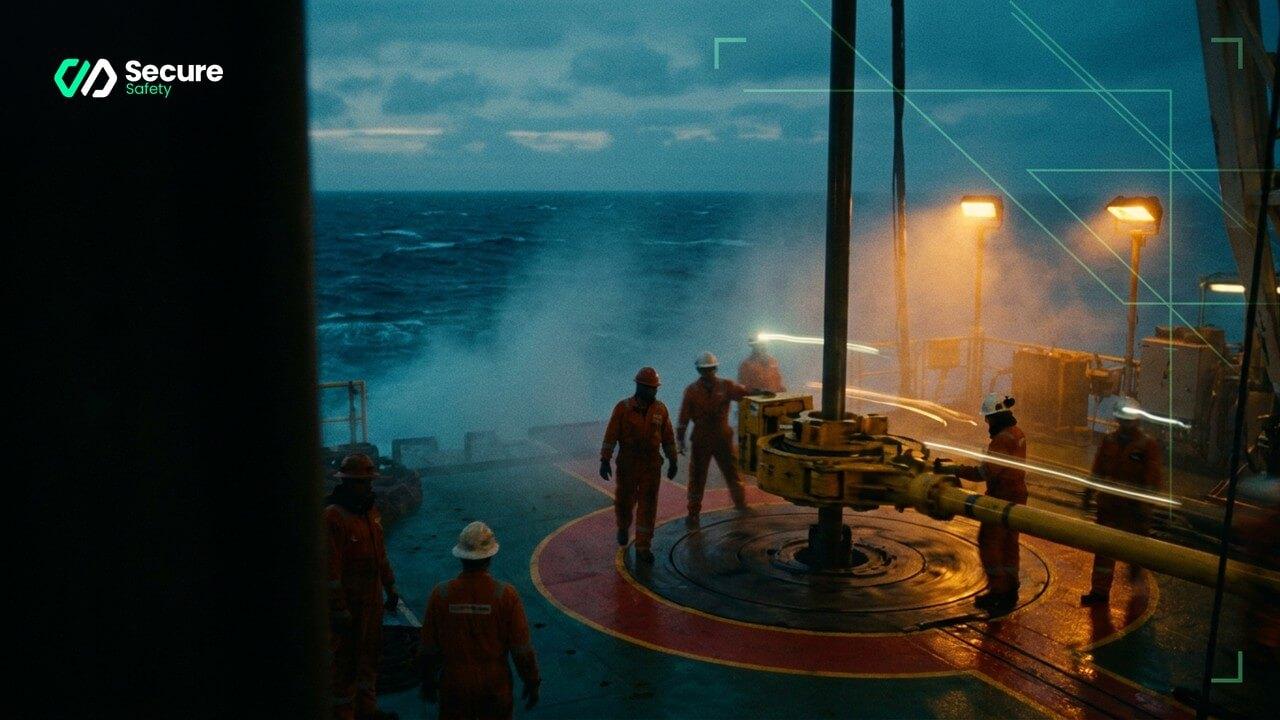
Picture it. A steel platform in the North Sea, moving with the swell. Salt spray and glare on every lens. Tonnes of pipe and machinery swinging through tight spaces, inches from the crew working around them. And around the most dangerous operations, a "red zone". This is an area where, when equipment is live, no person should ever be. Step into it at the wrong moment and there is no second chance.
This is where SecureSafety was built. Not in a clean warehouse or a software lab, but in the most unforgiving safety environment on earth. That origin shapes everything about how the technology works. It's the reason it performs so well when it comes ashore.
The red zone problem
On a rig, the red zone is sacred. The trouble is that drilling is fast, physical, repetitive work, and human attention is finite. A crew member crosses a boundary to reach a tool. A driller's view is blocked at the critical second. Fatigue, weather, and time pressure erode even the best procedures. The rules are clear; the difficulty is enforcing them, continuously, when the people enforcing them are also doing the job.
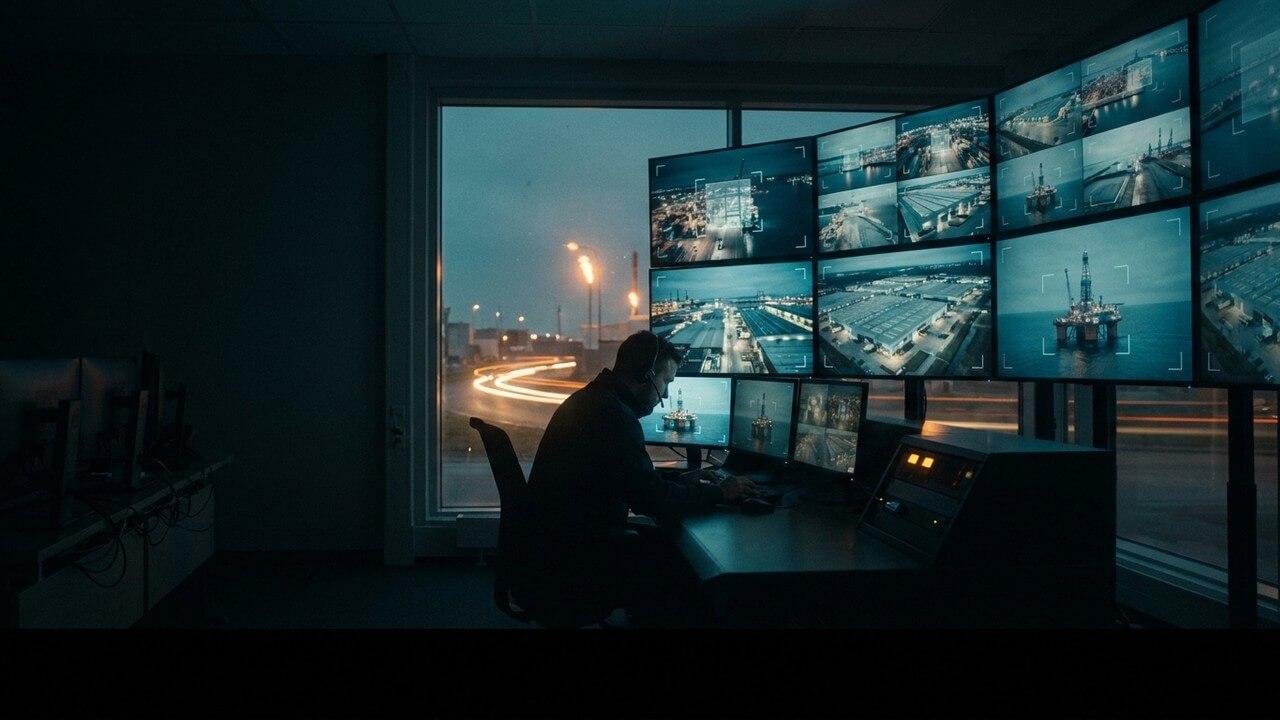
Cameras were always there. Every drill floor is watched. But watching is not seeing. A bank of monitors in a control room, scanned by an overworked eye, cannot reliably catch the one second that matters out of a twelve-hour shift.
So we built AI that could. Detection that understands where the red zone is, who is inside it, what equipment is live, and whether a person is in a place they shouldn't be. It raises the alarm instantly. We extended it to the hazards that define offshore work: people working at height, suspended loads with crew underneath, falls, and even moonpool monitoring, watching the opening in the hull through which equipment passes to the seabed.
What the hardest environment teaches you
Building for offshore forces a kind of engineering discipline that softer environments never demand.
It has to work in terrible conditions. Rain, glare, vibration, poor light, salt on the lens, a deck that won't hold still. A system that only works in a tidy, well-lit room is no system at all. Hardening detection against the North Sea means it shrugs off the dust, weather, and awkward camera angles of an ordinary yard.
It cannot cry wolf. On a rig, an alert that's wrong half the time is quickly ignored, and an ignored alert is worse than none. Offshore tolerances forced us to make detections that crews would actually trust and act on.
The consequences are absolute. When the cost of a miss is a life, you don't ship "good enough." That standard travels. The same technology that watches a drill floor doesn't suddenly become less rigorous when it watches a loading bay.
Why this matters on land
Here is the thing about safety technology: it is far easier to take a system built for the hardest environment and apply it to an easier one than to do the reverse.
A forklift aisle, a steel yard, a port terminal, a distribution centre: these are demanding environments with real risk, and we take them seriously. But they are, frankly, kinder than a drill floor in a storm. Technology proven offshore arrives on land already hardened, already disciplined about false alarms, already built around the idea that a red zone is a line that must never be crossed.
When a site chooses SecureSafety, it isn't buying another camera-AI startup chasing the latest use case. It's buying safety technology that earned its stripes where failure was never an option. It brings that standard to vehicle-pedestrian conflicts, PPE compliance, falls, fire, and restricted-area monitoring on solid ground.
The same promise, wherever you operate
Whether your red zone is around a drilling operation offshore or a reversing forklift in a warehouse, the principle is identical: the camera should not merely film the accident. It should help prevent it.
That's what we built offshore. That's what we now bring to your floor.
What offshore pedigree means in practice for a land-based deployment
Error rate that holds under pressure
The sub-0.05% error rate was established under offshore conditions: cameras fouled by sea spray, vibration, low-light night-watch conditions, and the continuous motion noise of an active drill floor. A system that holds its accuracy in those conditions does not degrade in a warehouse, a port yard or a construction site. The error rate is not a marketing claim; it is a measured outcome from 18,000+ events processed daily across 13 rigs.
On-premise architecture proven at the bandwidth limit
Offshore rigs have satellite connections that are expensive, limited and unreliable. A safety system that requires cloud connectivity would fail precisely when the connection is worst. The on-premise architecture — all processing on the edge device, no live video leaving the site — was a technical requirement before it became a privacy benefit. Your footage stays on your site because that is the only architecture that has ever been reliable enough for the environments we serve.
Zone management built for dynamic operations
Offshore zone management is complex: the moonpool zone is only active when equipment is deployed through it; the drill-floor exclusion changes configuration when equipment is in operation versus being rigged up or rigged down. The scheduling and manual-activation capabilities in the platform were not added for land-based customers — they were original requirements from the offshore deployment. That means they are production-grade features, not demo features.
From offshore to your operation: what to expect
The Discovery phase for a new land-based deployment typically takes one to two weeks. It produces a hazard map of your specific site matched against the detection capabilities that address those hazards, a camera survey confirming coverage of the priority areas, and a fully costed proposal for the implementation phase. Most sites go live within four to six weeks of Discovery sign-off.
The transition from offshore to your environment is not technically complex — the platform is designed to be configured to each site's specific requirements. What it brings from offshore is the certainty that the detection has been tested under conditions more demanding than any land site will present.
[ Book a free 6-week pilot ] and we'll prove it on your own cameras, at no cost, in six weeks.