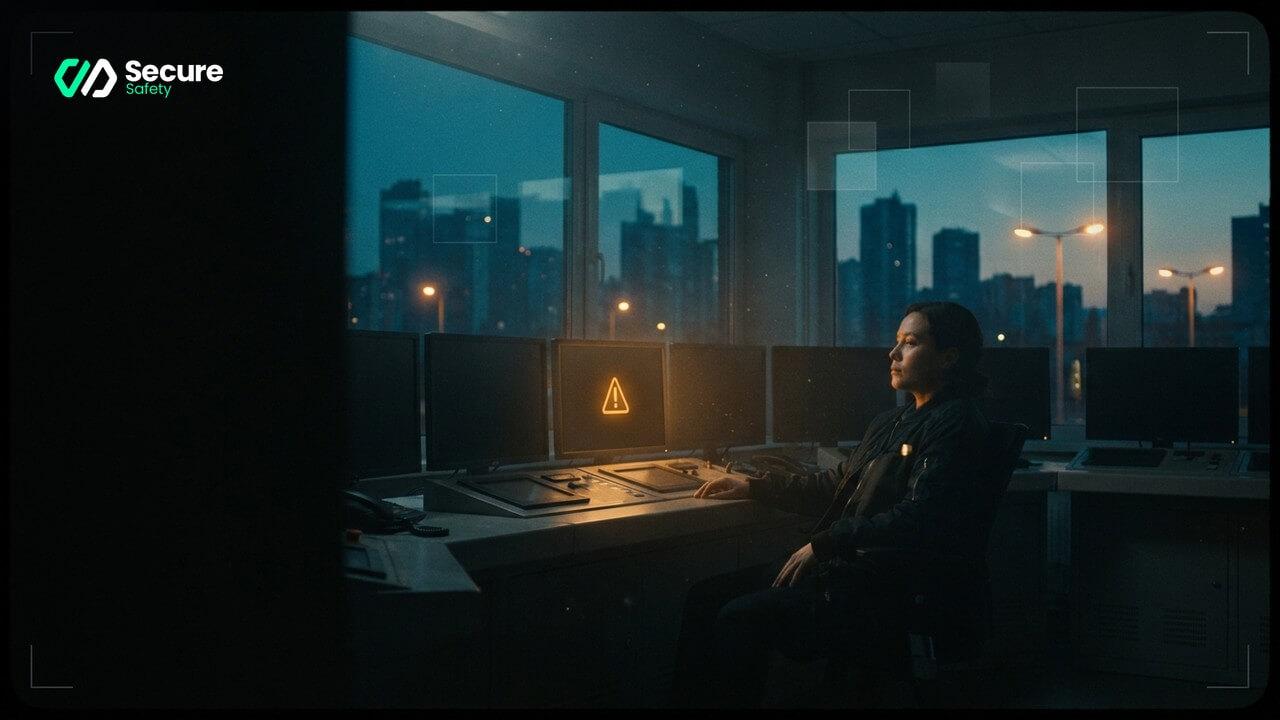
Every control-room operator knows the sound. Somewhere on the third day of a new detection system, the alert tone stops meaning "look" and starts meaning "silence it". A pallet stacked a little high trips the restricted-zone alarm. A worker in a dark hi-vis reads as no hi-vis at all. A shadow moving across a doorway becomes a person on the ground. By the end of the week, the operator has learned the only lesson a noisy system ever teaches: most alerts are nothing, so treat all of them as nothing.
This is the quiet way safety AI dies. Not with a failed procurement or a damning audit, but with a hand reaching over to turn the volume down. And the tragedy is that the one alert that mattered — the real fall, the genuine incursion — arrived in exactly the same tone as the hundred that did not.
Why false alarms are not a nuisance but a safety hazard
It is tempting to treat false positives as a cosmetic problem, something to apologise for and tune out later. That underestimates the damage. A false alarm is not neutral. Each one spends a little of the operator's trust, and trust, once spent, does not come back at the same exchange rate.
Human factors researchers have a name for what follows: alert fatigue. It is the same phenomenon that plagues hospital wards, where nurses exposed to hundreds of monitor alarms a shift begin to miss the ones that signal a crash. The mechanism is not laziness. It is a rational adaptation to a channel that has proven unreliable. If ninety-five alerts in a hundred are noise, the sensible human response is to deprioritise the channel — and a safety system that has been deprioritised is worse than no system at all, because it carries the illusion of coverage.
So the real cost of a false positive is never the ten seconds spent dismissing it. It is the future true positive that gets dismissed with the same reflex.
The other failure: the alarm that never comes
There is a mirror image to this problem, and any honest discussion has to name it. The crude way to make an alert stream quiet is to make the system timid — raise the confidence threshold until it almost never fires. Now the control room is peaceful. It is also blind.
This is the false negative, and it is the more dangerous of the two failures precisely because it is invisible. Nobody complains about an alert they never received. The system looks calm, disciplined, mature — right up until the incident it should have caught happens in silence. Every safety AI lives on this tightrope between crying wolf and saying nothing, and where a vendor chooses to stand tells you almost everything about whether they have done this work in the real world.
What actually separates a trustworthy system from a noisy one
Reducing false alarms in video analytics is not one trick. It is a stack of unglamorous engineering decisions, and it is worth knowing what to ask for.
Context, not just detection
A box that recognises "person" and "forklift" in the same frame will generate an alarm every time the two are near each other, which in a working facility is constantly. A system that understands trajectory, speed, separation and whether a barrier sits between them raises the alarm only when the geometry is genuinely dangerous. The difference between those two systems is the difference between an alert stream a human respects and one they mute.
Site-specific tuning
No two sites share a camera layout, a lighting profile or a definition of "restricted". A red zone that is live during a lift and dormant afterward cannot be a fixed rectangle on a screen. Trustworthy systems are calibrated to the site — to its zones, its shift patterns, its normal — rather than shipped with factory defaults that treat a drill floor like a car park.
Alerts that carry their own evidence
When an alarm arrives with the clip attached, the operator can verify it in three seconds rather than pivoting a camera and guessing. Fast verification is not a convenience feature. It is what keeps the human in the loop willing to stay in the loop, because the cost of checking has been kept honestly low.
Confidence that is visible and honest
A mature system tells you how sure it is, and lets you set the bar for what reaches a human versus what is simply logged for later review. Not every signal needs to interrupt someone. The art is in routing certainty to attention and uncertainty to the record.
Forged where false alarms are not an option
We learned this discipline in the least forgiving place we could have chosen. Our detection was built on offshore drill floors — heavy equipment in constant motion, crews working within feet of it, and no tolerance whatsoever for a system that cried wolf. On a rig, an operator who has learned to ignore your alerts is a liability you cannot afford, so the false-positive rate was never a marketing number to us. It was the thing that decided whether the crew kept the system on. That work has since run in national oil-major operations, a major international port and an international airport, at a measured error rate below 0.05% and with field-recorded reductions of around 90% in unsafe behaviour. The behaviour changes only because people trust the alerts enough to act on them.
How to test this before you buy
Do not accept a demo on the vendor's footage. Their reel is chosen to make the model look infallible, and it will. Ask instead for a pilot on your own cameras, in your own light, across a normal working week including a shift change and a bad-weather day. Then measure two things, not one: how many alerts fired that should not have, and — harder, more important — walk back a known near-miss and ask whether the system caught it.
A vendor confident in their false-alarm rate will welcome that test. A vendor who steers you back to the showreel is telling you something. The right question is never "how clever is your AI". It is "how often will you waste my operator's attention, and how do you know".
Because in the end, a safety system earns its place the way a good colleague does — by being right often enough, and quiet often enough, that when it finally raises its voice, everyone in the room turns to look.
Managing false positives in practice: a systematic approach
The false positive tolerance curve
Every safety monitoring system operates on a tolerance curve: detection sensitivity is set to catch a certain proportion of genuine events, and the false positive rate is the cost of that sensitivity. Moving the sensitivity up catches more real events but also more false positives; moving it down reduces false positives but risks missing genuine events. The correct calibration is not the same for all environments or all hazard categories.
For a high-consequence hazard category — a person on the ground in a remote area, a fire in a battery charging room — the tolerance for a false positive is high because the consequence of missing a genuine event is severe. For a lower-consequence category — a person at the edge of a pedestrian zone in a low-traffic area — a higher sensitivity may not be justified if the result is alert saturation in the control room.
The Discovery phase establishes the appropriate sensitivity setting for each zone and hazard category based on the site-specific risk assessment, the expected event frequency and the control room's alert-handling capacity. This is a calibration process, not a fixed setting.
Alert quality metrics as an operational KPI
False positive rates should be tracked as an operational metric and reviewed regularly. A quarterly review of alert quality — what proportion of alerts led to a confirmed genuine event, a near-miss, or a false positive — provides the data needed to refine zone configurations and sensitivity settings. Alert quality should improve over time as the system learns the visual noise patterns of the specific environment.
Sites that track alert quality as a KPI are the ones that maintain operational trust in the system over the long term. A system that was well-calibrated on day one but has not been reviewed in two years will have accumulated configuration debt as the site has changed, leading to a gradual increase in false positives that erodes trust.
Implementation checklist for managing alert quality
- Establish an alert quality baseline in the first 30 days: record the proportion of alerts that are confirmed genuine events vs. false positives during the baseline period, categorised by zone and detection type
- Set a false positive rate target: agree an acceptable false positive rate for each detection category — a strict target for fire and person-on-ground detection, a more permissive target for lower-consequence categories
- Review alert quality quarterly: at each quarterly review, compare current false positive rates against the target and identify the zones or conditions generating the most false positives
- Update zone configurations as the site changes: layout changes, new equipment and seasonal conditions (outdoor cameras in summer sunlight vs. winter fog) all affect the false positive profile and require configuration review
- Provide operator feedback mechanisms: ensure control room operators can flag false positives with a single action that feeds back into the model calibration review — this makes the quality improvement process continuous rather than periodic
See what your cameras have been missing — book a demo.