Every plant manager knows the handover. The shift change on the floor, a knot of workers and a supervisor going over the night's work, hard hats on, the right words being said. It is a picture of a healthy safety culture. And then, ten metres behind them, a man crosses the marked walkway at a diagonal, straight through a live vehicle lane, because it saves him thirty seconds and he has done it a thousand times without harm.
Both of these things are true at once. The culture in the foreground is real. So is the shortcut in the background. The uncomfortable question for any safety leader is not which one to believe. It is: which one did you actually measure?
Culture is what happens when the auditor leaves
Safety culture has a hundred definitions, but the honest ones all reduce to the same idea. It is what your people do when no one with a clipboard is watching. It is the sum of a thousand small decisions made at the point of work, under time pressure, out of habit, when the choice between the safe way and the quick way costs a few seconds and nobody is keeping score.
This is precisely why culture is so hard to manage. The things that define it are the things you cannot see. Your audits sample a few hours a quarter. Your observations are announced, or they change behaviour the moment the observer appears — the Hawthorne effect, dressed in a hi-vis vest. Your incident reports capture only the shortcuts that went wrong, which are a tiny and unrepresentative fraction of the shortcuts that were taken. You are trying to steer an enormous, living system using a handful of blurry snapshots, most of them taken at the worst possible moment.
So a certain hope has grown up around technology. Buy the cameras, buy the AI, and the culture problem gets solved. It is a comfortable idea, and it is wrong.
Technology cannot install a culture
Let us be plain about what a detection system does not do. It does not make a supervisor stop and coach a worker instead of walking past. It does not decide whether a near-miss is treated as a learning opportunity or a disciplinary event. It does not build the trust that makes a rigger comfortable stopping a job. It does not set the tone from the top that tells everyone whether safety is a value or merely a rule to be gamed. Culture is made of human decisions, and no algorithm makes those decisions for you.
Anyone selling AI as a replacement for leadership is selling you a comfort that will fail you. A camera that spots an unsafe act and does nothing has changed nothing. The technology is inert until a human being decides to act on what it shows.
What the technology does is different, and in some ways harder to sit with. It removes your excuses for not knowing.
What it does instead: it measures the truth
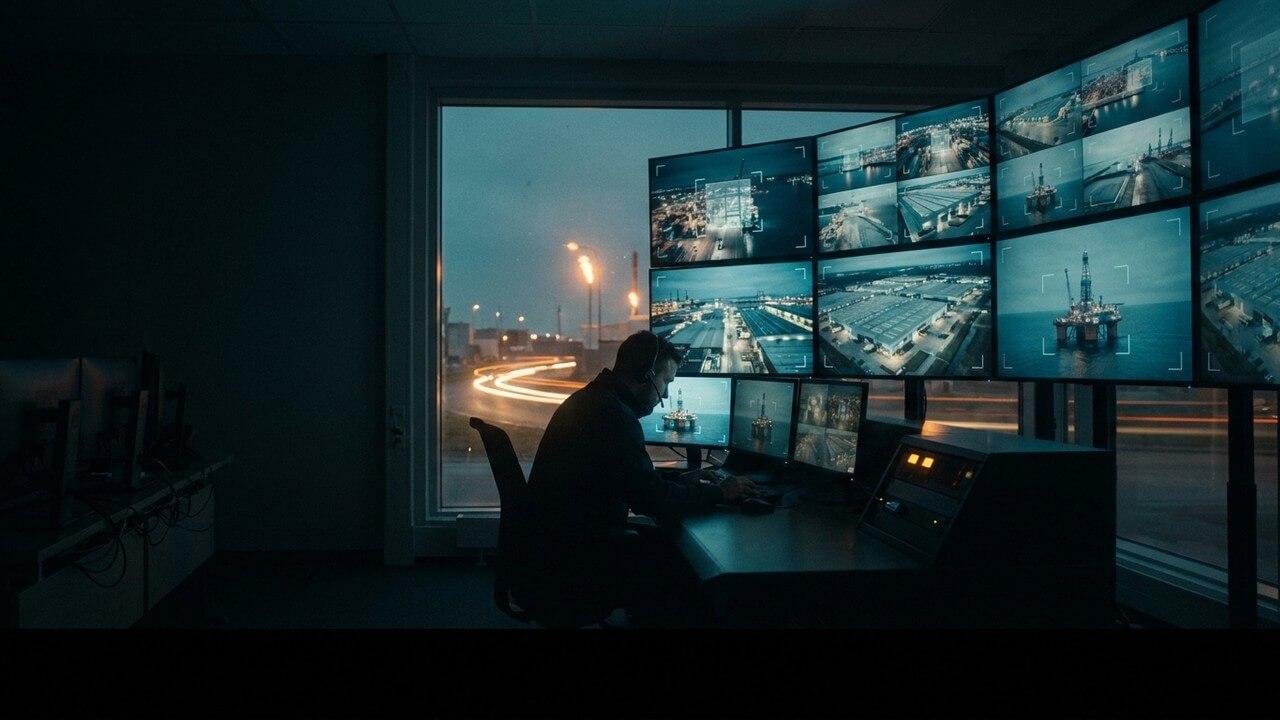
A computer-vision layer on your existing CCTV does not sleep, does not get bored, and does not announce itself. It watches every shift, every lane, every zone, every hour — the 2 a.m. shortcut as faithfully as the 10 a.m. one. And it counts. Not the injuries, which are rare and lagging, but the behaviours underneath them: how many times the walkway was crossed unsafely, how often the PPE was missing, which gate people entered the red zone through, at what hour compliance quietly falls apart.
For the first time, culture stops being a feeling and becomes a number you can trust — because it is measured continuously and without flattery. And that number will, at first, be unwelcome.
Our own detection was forged in offshore oil and gas, on drill floors, the most demanding safety environment there is: heavy moving equipment, zero tolerance for error, lives on the line every hour. It has since been proven in a national oil major's operations, a major international port and an international airport, running at a sub-0.05% error rate. In the field it has been measured alongside reductions of roughly 90% in unsafe behaviour. But the reductions never came from the camera. They came from what leaders did once the camera showed them, week after week, precisely where the gap between their stated culture and their actual culture really sat.
The gap you did not want to see
This is the exposure in the title, and it is worth naming honestly. When you begin measuring behaviour continuously, the first finding is almost always humbling. The site you believed was disciplined turns out to have a lane everyone cuts across on the night shift. The PPE compliance you reported at ninety-five per cent was ninety-five per cent during audits and rather less the rest of the time. The red zone you thought was sealed has an informal entrance everyone uses.
None of this means your culture is bad. It means you were previously managing it blind, and blindness always flatters. The data does not create the gap between what you say and what you do. The gap was always there. The data simply ends your ability to look away from it.
What good leaders do with the mirror
A mirror is only cruel if you do nothing about what it shows. Used well, continuous behavioural data is the most powerful tool a safety leader has ever had, for three reasons.
It lets you coach patterns, not people. When you can see that a hazard clusters at one gate, on one shift, you fix the layout or the process rather than blaming an individual. That is the difference between a just culture and a blame culture, and now you have the evidence to choose it.
It gives your leading indicators teeth. A behavioural trend that is climbing tells you trouble is coming weeks before it arrives as an incident. You can intervene while everyone still has their health.
And it closes the loop honestly. When you make a change — a new barrier, a toolbox talk, a redesigned route — you can watch the behaviour actually shift on the numbers, or fail to. No more guessing whether the initiative worked. You can see it.
The technology does not care about your reputation, your quarterly slide, or the story you tell the board. It reports what happened. Whether that becomes a threat or the best coaching instrument you have ever owned depends entirely on the culture you bring to the data — which is, of course, the whole point.
Technology will not fix your safety culture. But it will hold up a mirror that does not lie, and for a serious leader, that is worth more.
How AI monitoring supports a positive safety culture
The difference between surveillance and protection
The most common concern about AI safety monitoring is that it will be perceived by the workforce as surveillance rather than protection. The concern is legitimate — technology that monitors worker behaviour can be used in ways that are counterproductive to safety culture if it is deployed as a performance monitoring or disciplinary tool rather than as a genuine safety protection tool. The distinction lies in how the data is used, communicated, and governed.
A monitoring system used to identify where the site's layout creates unavoidable risk, to detect the medical emergency that would otherwise go unnoticed for an hour, and to provide objective evidence that safety improvements are working, is a protection tool. A monitoring system used to identify which individual workers take the most shortcuts, to generate disciplinary evidence, or to demonstrate to an insurance auditor that the organisation is monitoring, is a surveillance tool. The technology is identical; the use determines the culture impact.
Positive reinforcement through data
The near-miss data from AI monitoring can be used for positive reinforcement as well as hazard identification. A team whose near-miss rate has fallen by 50% following a layout improvement that was identified through monitoring data has a concrete demonstration that the organisation takes the data seriously and acts on it. Communicating this — "we moved the crossing because the data showed it was the highest-conflict point, and the conflict rate has halved" — builds the trust that makes workers willing to engage with the monitoring programme rather than resistant to it.
Worker voice in the monitoring programme
The most successful AI monitoring deployments are those where the workforce has been involved in defining what is monitored and how the data is used, rather than having the system imposed on them. Safety representatives and works councils who understand the monitoring scope, the purpose of each detection type, and the governance of the data are the most effective communicators of the programme to the wider workforce. Their endorsement converts a management decision into a shared safety commitment.
Implementation checklist for culture-positive deployment
- Involve safety representatives before go-live: a briefing and consultation with safety representatives before the system is deployed is the most effective way to address concerns before they become resistance
- Define the data use policy explicitly: document in writing how AI monitoring data will and will not be used — for safety purposes only, not for performance management or disciplinary proceedings in isolation
- Communicate the safety benefits specifically: when the monitoring data leads to an engineering improvement, communicate the improvement and the data that prompted it to the workforce — this is the feedback loop that builds trust
- Review the cultural impact annually: include a specific assessment of workforce perception of the monitoring programme in the annual OH&S management review
See what your cameras have been missing — book a demo.