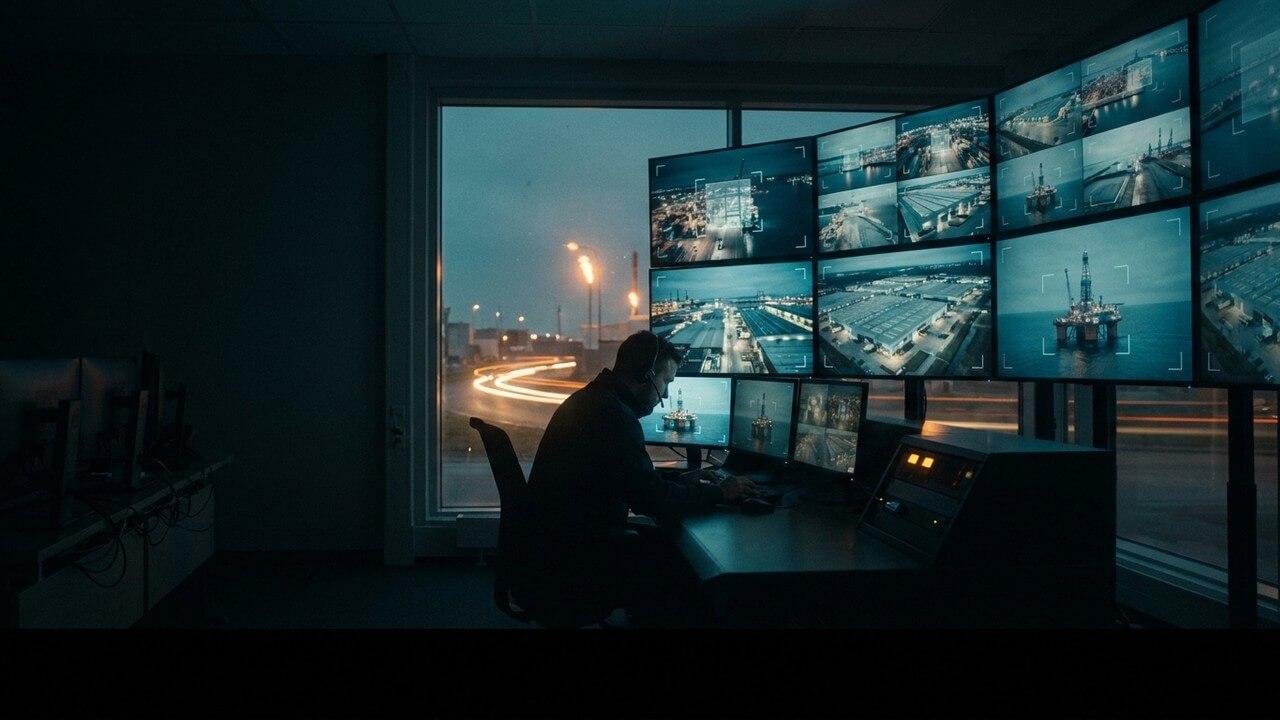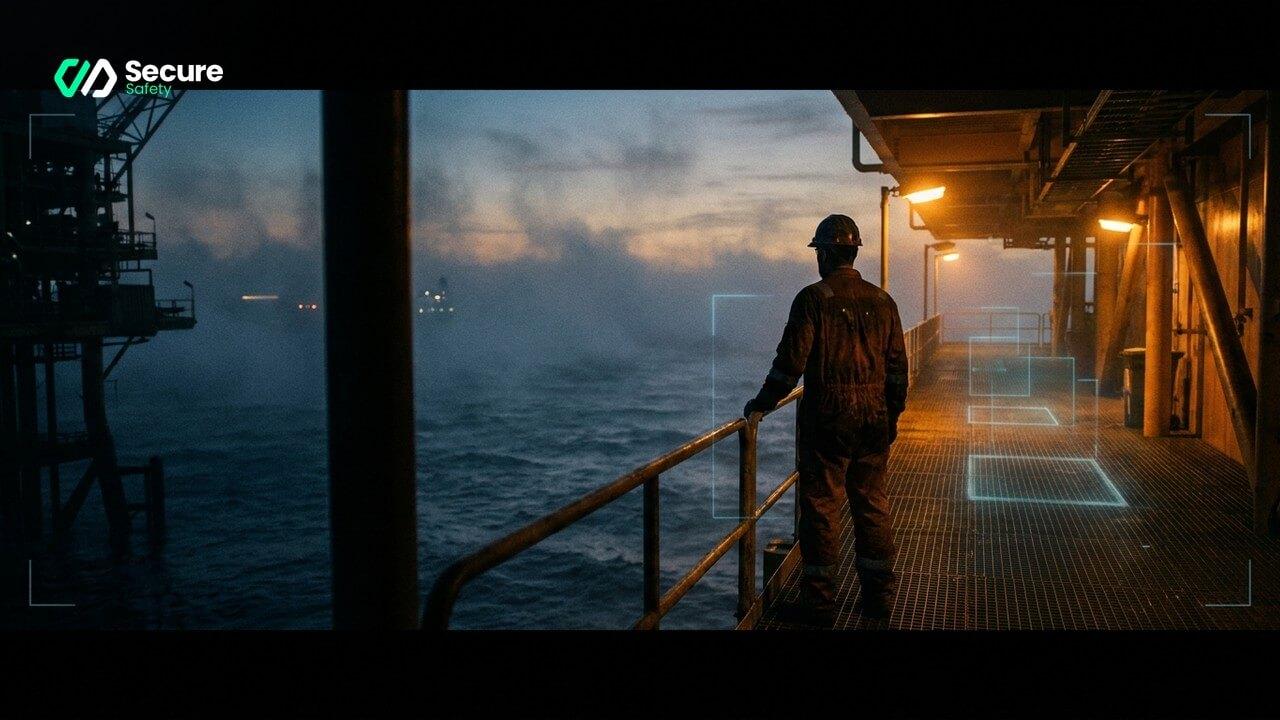
Picture a drill floor at three in the morning. A hundred tonnes of steel pipe swings on the elevators. Diesel and salt hang in the air. Twelve men move around machinery that would not notice if it killed one of them. On a monitor in a cabin two decks up, a supervisor watches nine camera feeds at once, hour after hour, and tries to keep every one of those twelve men alive.
That is where SecureSafety began. Not in a laboratory, and not in a pitch deck. On a working platform, in the one environment where a missed hazard is not a near-miss report but a funeral.
The problem with watching
Every operations leader in heavy industry knows the quiet truth about CCTV: nobody is really watching it.
The cameras are there. The footage is recorded. But a human being can hold attention on a bank of monitors for perhaps twenty minutes before the mind wanders, the eyes glaze, and the feeds become wallpaper. When something finally goes wrong, the video is superb — for the investigation. It tells you, in high definition, exactly how a person came to be standing in the wrong place at the wrong moment. It just tells you afterwards.
We found this maddening. Sites had already paid for the one thing that could see every hazard: the cameras. What they lacked was something that never blinked, never got bored, and never looked away at the wrong second.
We started at the hard end on purpose
Most safety-technology companies begin with the easy environments and hope to work their way up. We did the opposite, and not by choice. Our first customers ran offshore oil and gas operations, and offshore is about as unforgiving as an industrial setting gets. Heavy moving equipment. Constant motion. Spray, glare, vibration, and shadow. Crews in near-identical coveralls. A red zone beneath a suspended load where a person may stand safely one second and be in mortal danger the next.
If a detection system can hold its nerve there, the warehouse, the yard, the factory floor and the loading dock become, frankly, straightforward.
The detection was forged in offshore oil and gas, on drill floors — the most demanding safety environment there is, where heavy equipment moves without pause and there is no tolerance for error because lives are the stake. It has since been proven in national oil-major operations, a major international port and an international airport, running at a sub-0.05% error rate, with field-measured reductions of around 90% in unsafe behaviour. We do not offer those numbers as a boast. We offer them as the reason we are confident enough to put the system on your site and let it prove itself.
What we decided the system had to be
The offshore years taught us three convictions, and they are the spine of everything we build.
It must add to what you already own
We refused to be a hardware company. Asking a site to rip out its cameras and rewire itself is how good safety intentions die on a budget spreadsheet. SecureSafety is a software layer that sits on top of your existing CCTV. No new cameras. No civil works. The infrastructure you bought years ago suddenly starts doing far more than record.
It must work where lesser systems break
A demo runs beautifully in a clean, bright, static room. Real industrial sites are none of those things. So depth in genuinely hazardous, chaotic, poorly lit environments is not a feature to us — it is the whole point. A system that only performs in ideal conditions is not a safety system. It is a screensaver with ambitions.
The footage must never leave the site
Cameras watching your people are a matter of trust, and trust is easily lost. That is why SecureSafety runs on-premise. The video stays on your site, behind your own walls. Nothing is streamed to a cloud you do not control. Your people are protected without being exposed, and your legal and IT teams can sleep.
Detection is not the same as paperwork
There is a version of "safety technology" that mostly generates dashboards. It counts incidents after they happen and produces handsome charts for the quarterly review. That was never the mission.
We built SecureSafety to change the moment before the incident. When a person steps into a red zone beneath a load, when a worker goes to the ground and does not get up, when a helmet or a vest is missing, when smoke curls up in a corner no one is looking at, when a forklift and a pedestrian are on a collision course — the system sees it as it happens and raises the alarm while there is still time to act. Falls, fire and smoke, PPE compliance, restricted-area entry, speed, people counting, and offshore-specific watches like the moonpool: all of it in real time, all of it on-premise.
The measure of success is not a better report on the accident. It is the accident that never occurred, and the person who went home not knowing how close it had been.
Why the name changed, and why the mission didn’t
We began life in Brazil as MettaSafe. As the work spread beyond one country and one industry, we became SecureSafety — an international brand for a system that had outgrown its origins. The name is new. The obsession is not. It is the same one we carried up to that cabin above the drill floor: that the technology to prevent a tragedy already exists, and there is no honourable reason to wait for the tragedy to prove it.
Heavy industry has spent a century learning safety the hard way — one investigation, one inquest, one hard-won rule at a time. We think there is a better teacher now. One that watches every feed at once, through the whole of the night, and never once looks away.
That is why we built SecureSafety. Not to explain what went wrong, but to make sure it never does.
What eight years of deployment has taught us
The problems that only appear in live deployment
The most important lessons in building a safety AI system come not from the development environment but from the first three months of each new deployment type. The problem that breaks a system in a cold store is different from the problem that breaks it on a drill floor; the false positive source in a grain silo is different from the one in a paint spray booth. Eight years of deployment across offshore rigs, ports and airports has accumulated a library of these environment-specific failure modes and their solutions that no amount of pre-deployment testing can replicate.
The customer relationships that shaped the product
The operational capability of SecureSafety is not the product of a product roadmap designed by technologists. It is the product of long-term relationships with safety teams who used the system in live operations and told us, directly and specifically, what it was not doing that it needed to do. The moonpool monitoring capability was not on a feature list — it was a response to a safety manager saying "we need to know the moment that zone is entered." The fleet management dashboard was not a product decision — it was the answer to a fleet safety director who needed to see all 13 rigs simultaneously. The product is shaped by the problems it has been asked to solve.
The standard we hold ourselves to
The sub-0.05% error rate is not a specification that was set by market research. It is the standard that the offshore deployment established when the operational team told us that any higher false positive rate would cause the alert to be muted. An alert that is muted is not a safety system. The standard exists because the cost of failing to meet it was operational: the system would be switched off. That accountability — to operational reality, not to a benchmark — is why the number holds.
See what your cameras have been missing — book a demo.